
Ship Boiler Tubes – Class-Approved Marine Boiler Tubes Supplier & Exporter
Ship boiler tubes (also called marine boiler tubes) are the seamless pressure tubes used in boilers on board ships – auxiliary oil-fired boilers, exhaust gas boilers and economizers, composite boilers and main propulsion boilers. ASC LLP, Mumbai, supplies smoke tubes, stay tubes, water tubes, superheater tubes and finned economizer tubes in ASTM, EN and JIS grades, with class-witnessed certification for DNV, LR, ABS, BV, ClassNK, KR, RINA and other societies.
We support shipyards, ship managers, boiler makers and repair contractors with new-build supply and urgent retubing – cut to length, bent to drawing and packed for delivery to the yard or port. Ship boiler tubes are part of our full range of boiler tubes.
Quick specification: OD 25.4–114.3 mm · wall 2.6–12.5 mm · ASTM A192, A210 A-1, A213 T11/T22, EN 10216-2 P235GH/P265GH/16Mo3, JIS G3461 STB340/410 · EN 10204 3.1 / 3.2 / class certificates.
What Are Ship Boiler Tubes?
Ships need steam for fuel-oil heating, cargo heating, accommodation services and – on steam-turbine ships and LNG carriers – propulsion. That steam is raised in marine boilers whose tubes carry either hot gas or water under pressure. Because a boiler failure at sea affects the whole vessel, marine boiler tubes are pressure-equipment products made and certified to strict rules:
- Material standards – ASTM / ASME, EN 10216-2, JIS G3461 / G3462 or equivalent boiler tube standards.
- Classification rules – the vessel’s class society sets requirements for approved manufacturers, testing and certification.
- Boiler maker’s design – tube OD, wall thickness, length, end preparation and bends must match the original drawing.
A ship boiler tube that meets all three can be fitted and accepted by the class surveyor without delay.
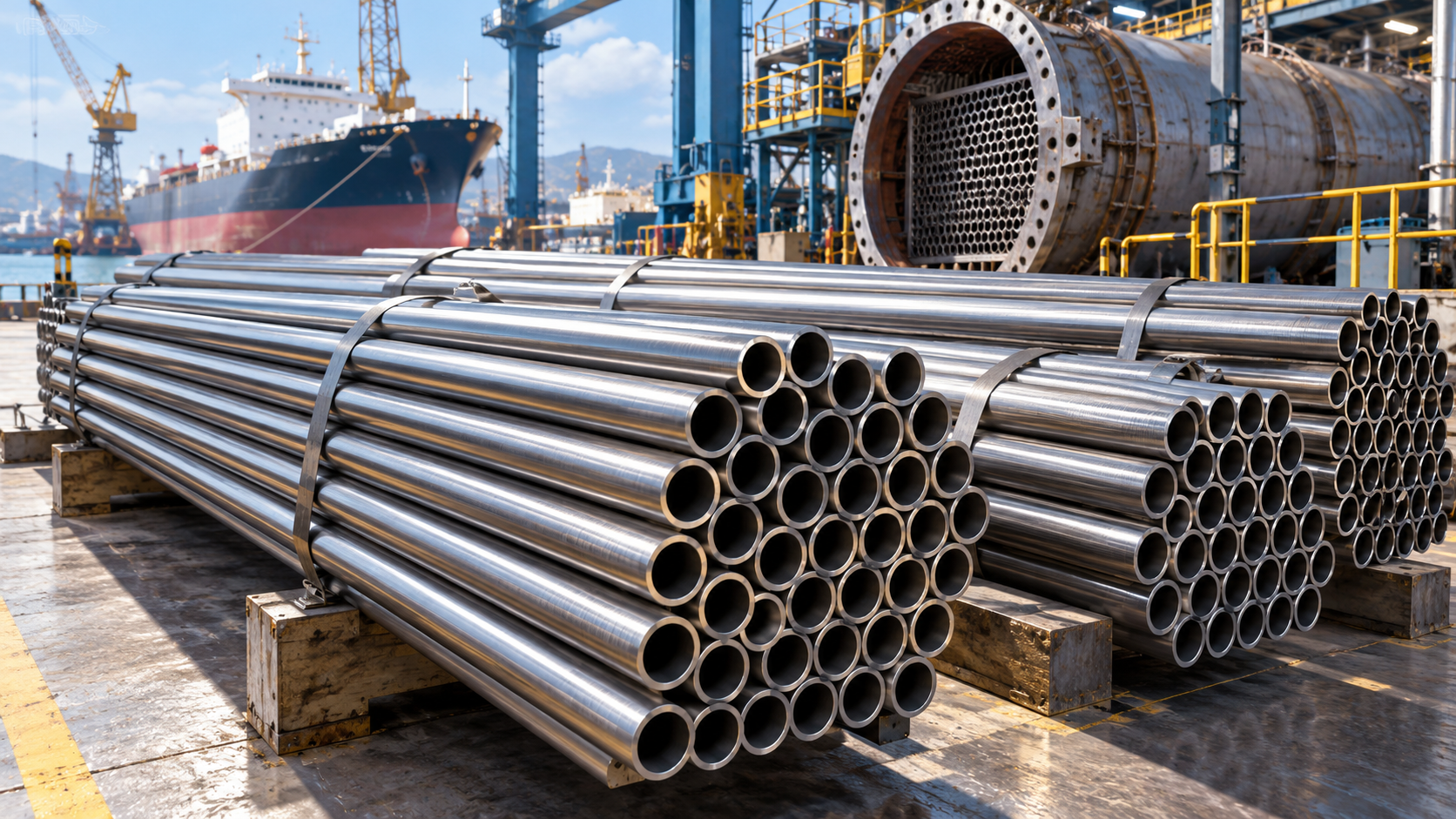
Types of Ship Boiler Tubes We Supply
Smoke Tubes (Fire Tubes)
- Plain seamless tubes carrying flue or exhaust gas inside, surrounded by water
- Used in marine auxiliary boilers, exhaust gas boilers and composite boilers
Stay Tubes
- Thicker-walled smoke tubes welded or expanded into both tube plates to stay them against pressure
- Supplied with the exact wall thickness and end preparation required by the boiler design
Water Tubes
- Tubes carrying water and steam, heated by gas outside
- Used in marine water-tube boilers, D-type and two-drum boilers, and forced-circulation exhaust gas boilers
Superheater Tubes
- Alloy steel tubes (T11, T22, 16Mo3, 13CrMo4-5) for steam superheaters – see alloy steel tubes
Exhaust Gas Economizer Tubes
- Plain, pinned, spiral finned and H / double-H finned tubes for waste heat recovery from main and auxiliary engines
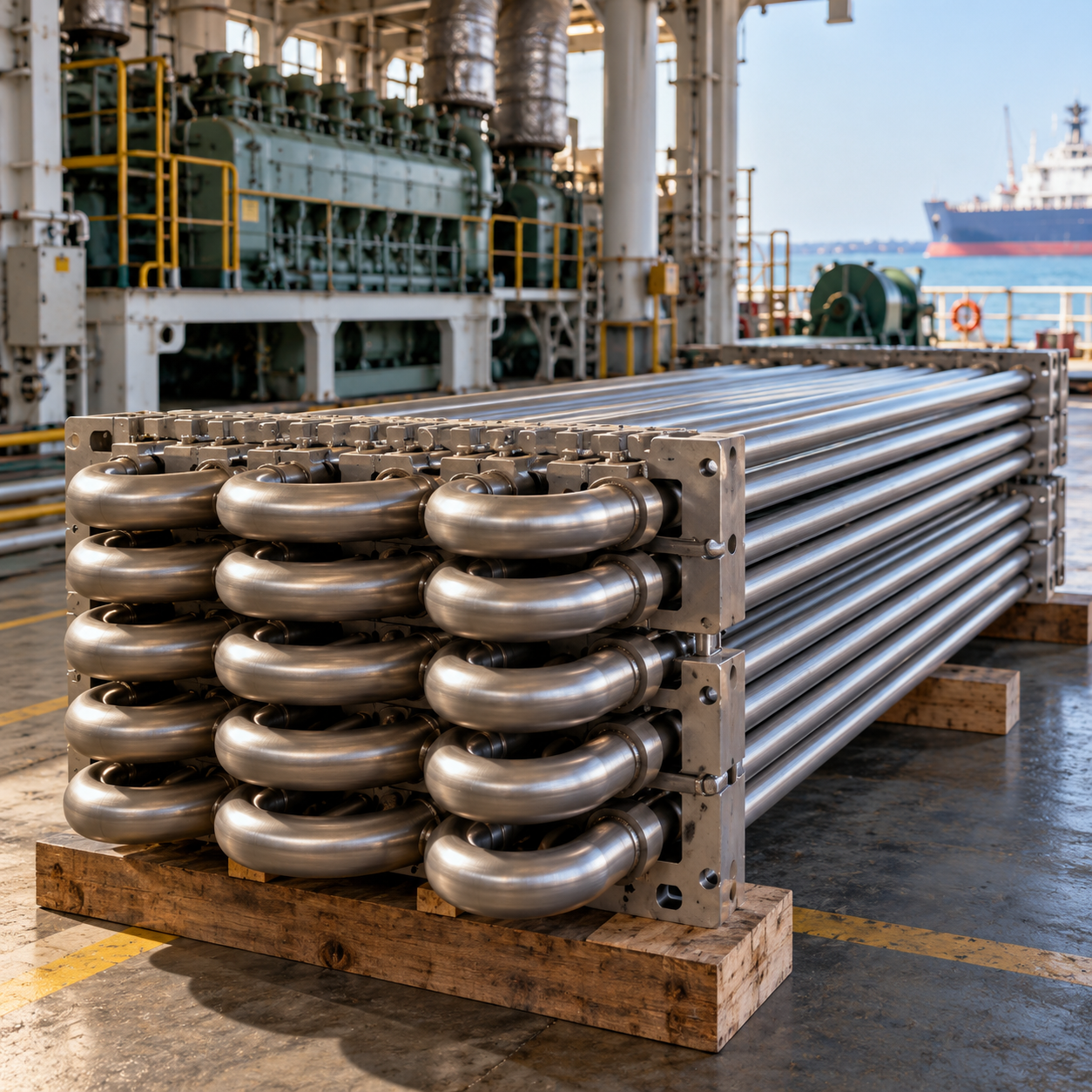
Bent Tubes, Coils & Pre-Fabricated Sections
- U-bends, serpentine coils and tube sections made to the boiler maker’s drawing or to sample
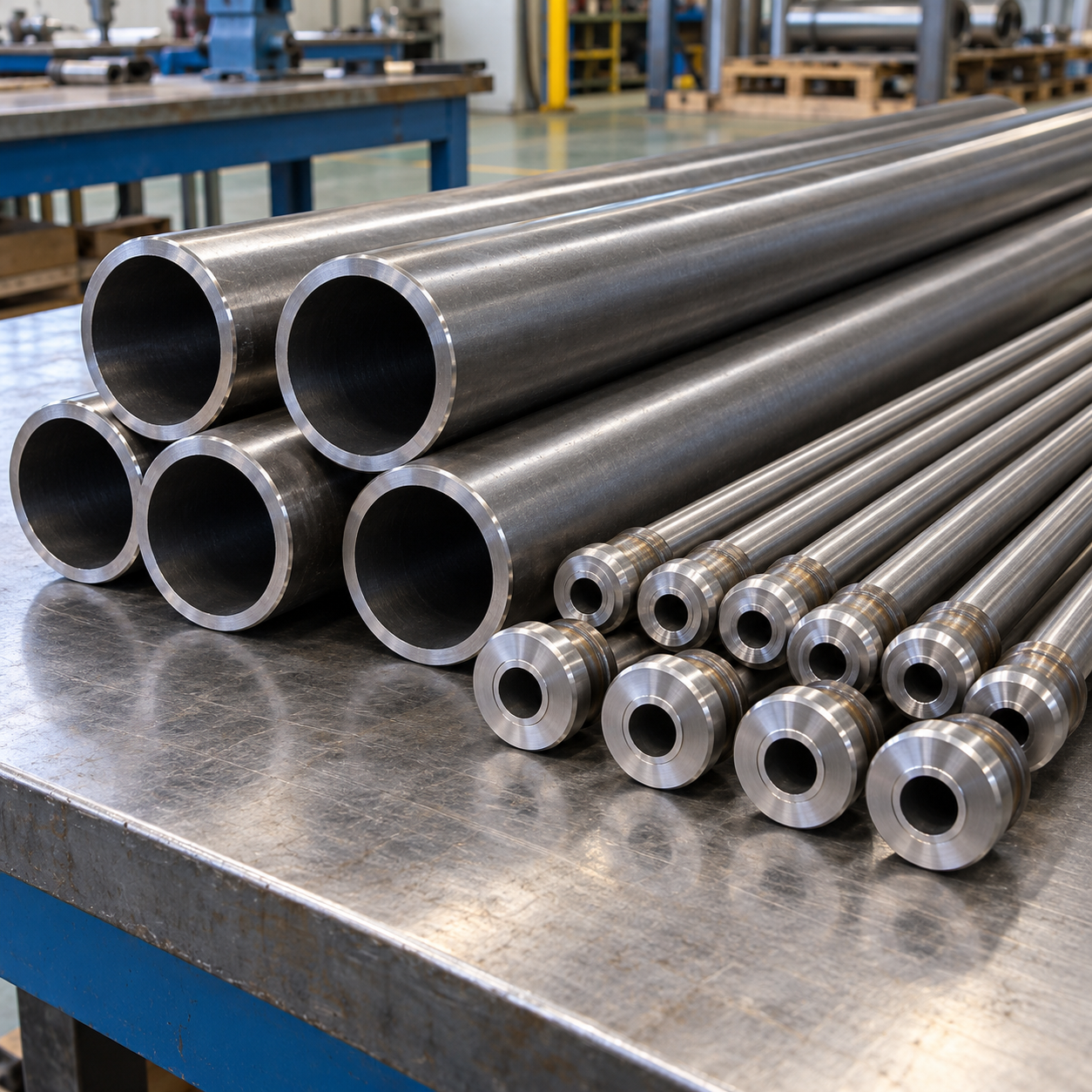
Ship Boiler Tube Material Grades
Marine boilers built in Europe, Japan, Korea, China and the USA use different tube standards. We supply the grade that matches your boiler’s original specification:
| Standard | Grades | Type | Typical Ship Boiler Use |
| ASTM A192 / ASME SA192 | — | Seamless carbon steel | Smoke, stay and water tubes |
| ASTM A210 / ASME SA210 | Grade A-1, Grade C | Seamless medium-carbon steel | Water tubes, economizer tubes |
| ASTM A179 / A178 | — / Grade A | Cold-drawn / ERW low-carbon steel | Low-pressure economizer and heater tubes |
| ASTM A213 / ASME SA213 | T11, T22 | Seamless alloy steel | Superheater tubes |
| EN 10216-2 | P235GH, P265GH, 16Mo3, 13CrMo4-5 | Seamless pressure tubes | European-built boilers – smoke, water and superheater tubes |
| JIS G3461 | STB340, STB410, STB510 | Carbon steel boiler tubes | Japanese and Korean-built boilers |
| JIS G3462 | STBA22, STBA23 | Alloy steel boiler tubes | Superheater tubes in Japanese boilers |
| DIN 17175 (legacy) | St35.8, St45.8, 15Mo3 | Seamless boiler tubes | Replacement for older European boilers – supplied as EN 10216-2 equivalents |
See our EN 10216-2 P235GH tubes and EN 10216-2 P265GH tubes for full grade details.
Ship Boiler Tube Specifications
| Parameter | Details |
| Manufacturing | Seamless – hot finished or cold drawn; ERW for low-pressure economizer service |
| Outside Diameter | 25.4 mm to 114.3 mm (other sizes on request) |
| Wall Thickness | 2.6 mm to 12.5 mm (stay tubes to design) |
| Length | Fixed cut lengths to drawing, random lengths up to 12 m |
| Ends | Plain, bevelled for welding, swaged or prepared for expanding |
| Forms | Straight, U-bent, coils, pre-fabricated sections |
| Delivery Condition | Normalized / as per standard |
| Testing | Hydrostatic or eddy current, tensile, flattening, flaring, hardness, impact where required |
| Certification | EN 10204 3.1, EN 10204 3.2, class society certificate (DNV, LR, ABS, BV, ClassNK, KR, RINA, IRS, CCS) |
| Packing | Bundled with end caps, wooden boxes for bent tubes, marked for vessel and boiler |
Typical Ship Boiler Tube Sizes
These are typical sizes found in marine boilers; your boiler drawing always takes priority:
| Tube Function | Typical OD (mm) | Typical Wall (mm) | Common Grades |
| Smoke tubes – auxiliary / exhaust gas boilers | 51 – 76.1 | 3.2 – 4.5 | A192, P235GH, P265GH, STB340 |
| Stay tubes | 51 – 76.1 | 5 – 8 | A192, P235GH, P265GH, STB410 |
| Water tubes – water-tube boilers | 31.8 – 63.5 | 2.9 – 5 | A192, A210 A-1, P265GH, STB410 |
| Superheater tubes | 31.8 – 51 | 3.2 – 6 | T11, T22, 16Mo3, 13CrMo4-5, STBA22 |
| Exhaust gas economizer tubes | 31.8 – 51 | 3.2 – 5 | A192, A210 A-1, P265GH (plain or finned) |
Typical values only – always confirm against the boiler maker’s drawing or a sample tube.
Classification Society Approval & Certification
For boilers on classed ships, tube material normally has to satisfy the class society’s rules for pressure equipment as well as the material standard. In practice this means:
- Approved manufacturer – tubes are made by a mill approved by the relevant class society for boiler and superheater tubes.
- Witnessed testing – tests are carried out in the presence of the class surveyor where the rules require it.
- Certificate – an EN 10204 3.2 certificate or the class society’s own material certificate, stating the class and the tube’s heat and test results.
- Marking – tubes are marked with grade, size, heat number and the surveyor’s stamp where required.
We arrange class-witnessed inspection for DNV, Lloyd’s Register, ABS, Bureau Veritas, ClassNK, KR, RINA, IRS and CCS. Tell us your vessel’s class when you enquire, so the correct certification is planned from the start.
Why Ship Boiler Tubes Fail – and How to Prevent It
| Failure Cause | Where It Happens | Prevention |
| Low-temperature acid corrosion | Gas side of smoke tubes and economizers at low load | Keep tube metal above the acid dew point; consider Corten-type A423 Gr 1 tubes for cold-end economizers |
| Soot deposits and soot fires | Exhaust gas boilers and economizers | Regular soot blowing and water washing; avoid prolonged low-load operation |
| Oxygen pitting | Water side of tubes | Proper deaeration and feedwater treatment |
| Chloride attack and scale | Water side after seawater contamination | Monitor condensate salinity; act quickly on leaks |
| Overheating | Smoke tubes and furnace tubes with low water level | Reliable level control and alarms |
| Thermal fatigue and leaks at tube ends | Tube-to-tube-plate joints | Controlled start-up and correct expanding / welding |
When a tube fails, replacing it with the same grade, size and certification is the fastest route to class acceptance.
Marine Boiler Retubing – How We Support Repairs
- Send your details – vessel, class, boiler type, tube drawing or sample dimensions and quantity.
- Grade matching – we confirm the original material (including legacy DIN or JIS grades) and its current equivalent.
- Stock check and quotation – common sizes ship from stock; class-witnessed lots are scheduled with the surveyor.
- Cutting, bending and end preparation – tubes are made ready to fit, with ends prepared for expanding or welding.
- Testing and certification – 3.1, 3.2 or class certificates issued with the delivery.
- Packing and delivery – export packing marked for the vessel, delivered to the yard, workshop or port.
Applications of Ship Boiler Tubes
- Auxiliary oil-fired boilers on tankers, bulk carriers and container ships
- Exhaust gas boilers and economizers recovering heat from main and auxiliary engines
- Composite boilers combining oil firing and exhaust gas heating
- Main propulsion boilers on steam-turbine ships and LNG carriers
- Cargo heating systems on tankers and chemical carriers
- Naval, offshore and FPSO steam systems
- Shipyard new-builds and dry-dock repairs
For finned economizer sections, see our finned tubes, H fin tubes and G fin tubes.
Ship Boiler Tube Enquiry Checklist
Send these details for an accurate, fast quotation:
- Vessel name or IMO number, and class society
- Boiler type (auxiliary, exhaust gas, composite, water-tube) and maker
- Tube function – smoke, stay, water, superheater or economizer
- Material grade and standard (or the original drawing / old certificate)
- OD, wall thickness and length – or a sample tube
- Quantity and any bends, swaging or end preparation
- Certification needed – EN 10204 3.1, 3.2 or class certificate
- Required delivery date and port
Why Choose ASC LLP for Ship Boiler Tubes?
- Since 1984: decades of supplying boiler tubes and pressure tubes worldwide
- All marine grades: ASTM, ASME, EN, JIS and legacy DIN equivalents from one source
- Class certification: DNV, LR, ABS, BV, ClassNK, KR, RINA, IRS and CCS witnessed inspection arranged
- Ready stock of common smoke-tube and water-tube sizes for urgent repairs
- Made ready to fit: cut, bent and end-prepared to drawing or sample
- Export and port delivery with vessel-marked packing
Related Products
Frequently Asked Questions – Ship Boiler Tubes
What are ship boiler tubes?
Ship boiler tubes (marine boiler tubes) are seamless or welded steel tubes used in boilers on board ships – auxiliary oil-fired boilers, exhaust gas boilers and economizers, composite boilers and main propulsion boilers. They include smoke tubes, stay tubes, water tubes, superheater tubes and finned economizer tubes.
Do marine boiler tubes need classification society approval?
Yes, in most cases. Class rules (DNV, LR, ABS, BV, ClassNK, KR, RINA and others) generally require boiler tubes for ships to come from a class-approved manufacturer and to be certified to the class rules – usually with an inspection certificate witnessed by the class surveyor (EN 10204 3.2 or a class certificate). Check the requirement for your vessel’s class before ordering.
Which materials are used for ship boiler tubes?
Common grades are ASTM A192 / ASME SA192 and ASTM A210 Grade A-1 carbon steel, EN 10216-2 P235GH and P265GH, JIS G3461 STB340 / STB410, and the old DIN St35.8 / St45.8. Superheater tubes use alloy steels such as ASTM A213 T11 / T22, EN 16Mo3 or 13CrMo4-5.
What is the difference between smoke tubes and water tubes?
In a smoke-tube (fire-tube) boiler, hot gas flows inside the tubes and water surrounds them – common in marine auxiliary and exhaust gas boilers. In a water-tube boiler, water and steam flow inside the tubes and hot gas flows around them – used for higher pressures and in main propulsion boilers.
What are stay tubes in a marine boiler?
Stay tubes are thicker-walled smoke tubes that are welded or expanded into both tube plates so they also act as stays, holding the flat tube plates against boiler pressure. They are distributed among the plain smoke tubes and must be replaced with tubes of the correct wall thickness and material.
Why do ship boiler tubes fail?
Common causes are low-temperature acid corrosion on the gas side, soot deposits and soot fires in exhaust gas boilers, oxygen pitting and scale from poor feedwater treatment, chloride attack from seawater contamination, overheating from low water level, and erosion or thermal fatigue.
Which tubes are used in marine exhaust gas economizers?
Marine exhaust gas economizers use plain smoke tubes, plain or pinned water tubes, spiral (HFW) finned tubes and H or double-H finned tubes. Finned designs give more surface in a compact unit; plain and H-fin designs are easier to clean and less prone to soot build-up.
Can you supply replacement tubes to an OEM drawing?
Yes. We supply cut-to-length and bent replacement tubes to the boiler maker’s drawing or to sample tubes, with matching material grade, OD, wall thickness and class certification.
How fast can ship boiler tubes be delivered?
Common sizes in ASTM A192, A210 A-1 and EN 10216-2 P235GH / P265GH are available from stock for urgent repairs. Class-witnessed certification and custom bends need additional time, so share the vessel’s schedule and port with your enquiry.
What should a ship boiler tube enquiry include?
Include the vessel name or IMO number, class society, boiler type and maker, tube function (smoke, stay, water, superheater or economizer), material grade, OD, wall thickness, length, quantity, bends or drawing, certification (3.1, 3.2 or class) and the delivery port.
