
H Fin Tubes | H-Type & Double H Finned Tube Manufacturer, Supplier & Exporter
H fin tubes – also called H-type finned tubes, square finned tubes or H-fin economizer tubes – are boiler tubes with pairs of flat steel fin plates welded on opposite sides, forming an “H” when viewed from the end. ASC LLP, Mumbai, supplies single H and double H (HH) fin tubes in carbon steel, ND steel, alloy steel and stainless steel for economizers, air preheaters and waste heat boilers handling dusty flue gas. They are part of our full range of finned tubes.
What Are H Fin Tubes?
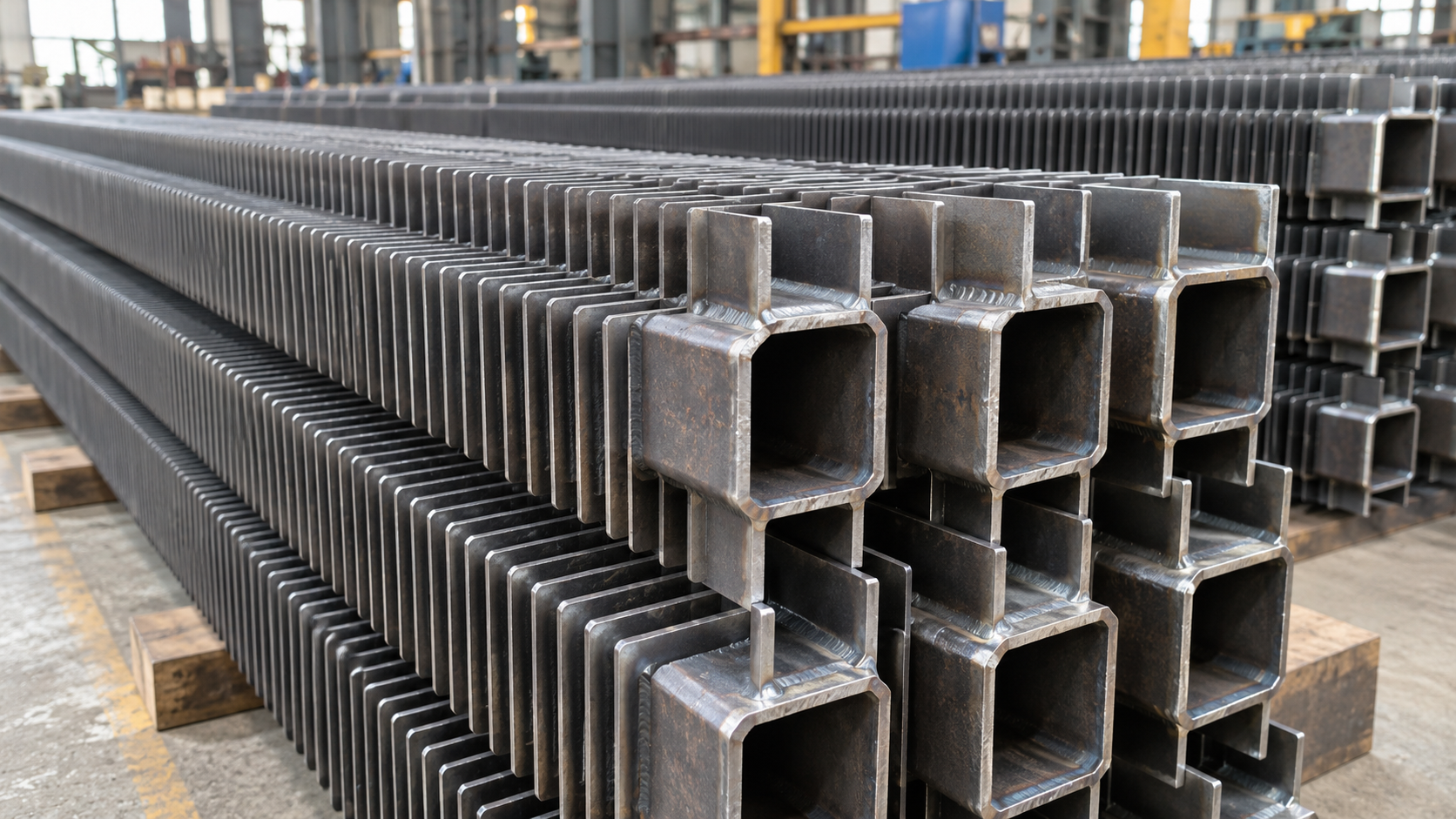
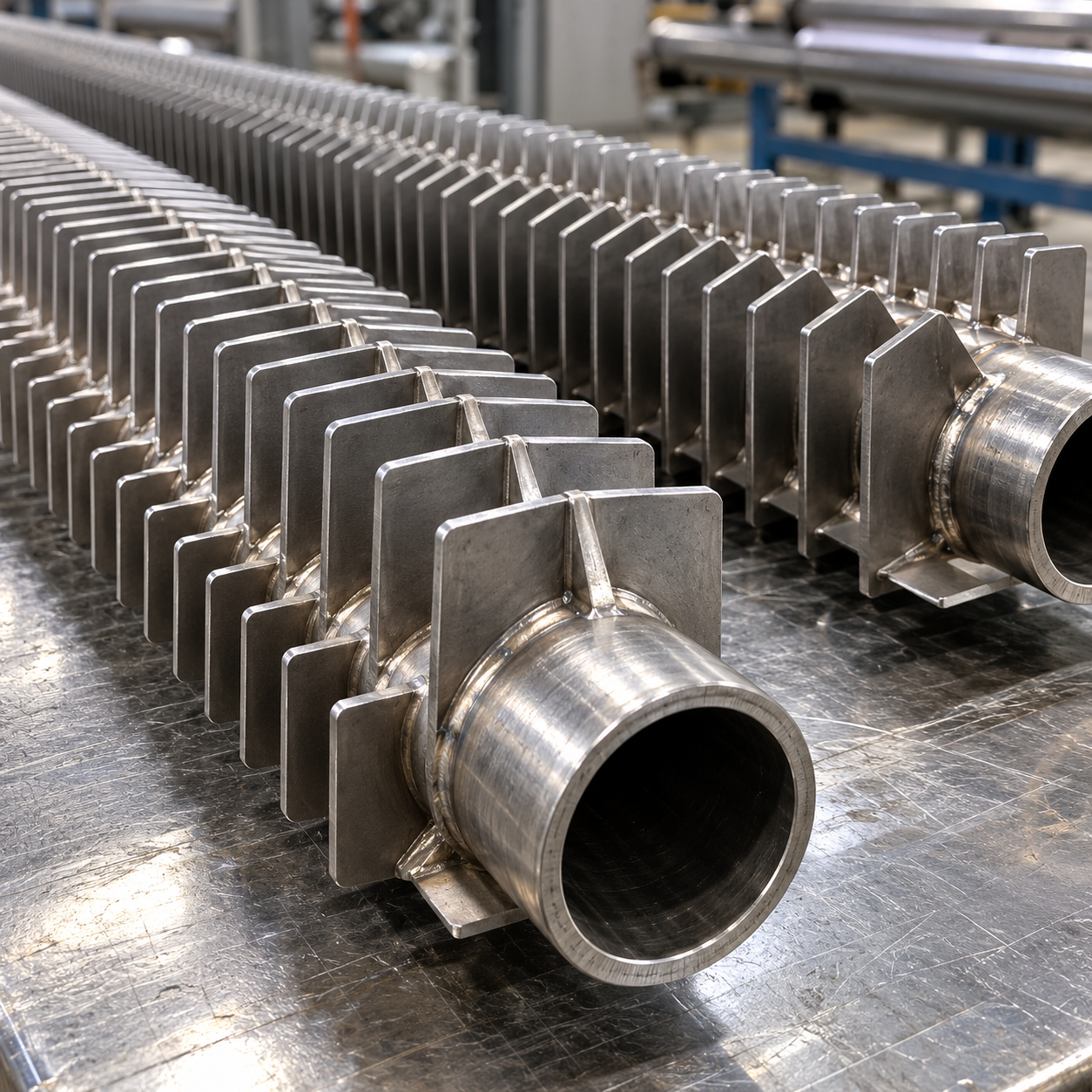
An H fin tube is an extended-surface boiler tube. Two rectangular fin plates, each with a semicircular cut-out, are resistance welded to the tube from opposite sides. A narrow gap is left between the two halves, so the fin looks like the letter H. The fins are roughly square, with a side length about twice the tube diameter, and give up to about 9 times the heating surface of a plain tube of the same length.
Because the fins are flat and lined up with the gas flow, the passages between tubes are straight. Fly ash and soot pass through instead of settling, which is why H-type finned tubes are the preferred extended surface for coal-fired, biomass and waste boiler economizers – applications where spiral finned tubes would foul or erode.
Buyers also search for this product as:
- H Type Finned Tubes and H Finned Tubes
- Double H Fin Tubes / HH Fin Tubes / Twin H Finned Tubes
- Square Finned Tubes and Rectangular Finned Tubes
- H Fin Economizer Tubes
- H Type Fin Tube Economizer and H Fin Tube Heat Exchanger
- ND Steel H Fin Tubes
Types of H Fin Tubes We Supply
Single H Fin Tubes
- One pair of fin plates welded to a single tube
- Flexible arrangement for economizers and air preheaters of any layout
Double H (HH) Fin Tubes
- One longer fin pair welded across two parallel tubes, forming a rigid rectangular element
- Suits long tube rows, needs fewer supports and lowers installation cost
Carbon Steel H Fin Tubes
- Carbon steel boiler tube with carbon steel fins
- Standard choice for economizers above the flue-gas acid dew point
ND Steel (Acid Dew-Point Resistant) H Fin Tubes
- ND steel (09CrCuSb) tube and fins for low-temperature economizers where acid can condense
- A Corten-type alternative to ASTM A423 Grade 1 tubes
Alloy Steel H Fin Tubes
- T11 / T22 Cr-Mo tubes for hotter zones – see our alloy steel finned tubes
Stainless Steel H Fin Tubes
- Stainless steel tubes or fins for corrosive flue gas and condensing service
H Fin Tube Modules & Coils
- Serpentine coils and shop-assembled economizer blocks with headers, built to drawing
Single H vs Double H Fin Tubes
Single H Fin Tubes
- Each tube finned individually – flexible tube pitch and layout
- Easier to replace individual tubes
- Common in compact economizers and air preheaters
Double H (HH) Fin Tubes
- Two tubes joined by one fin pair – high rigidity and less vibration
- Fewer supports for long tube rows
- Faster production and installation per square metre of surface
Choose single or double H based on tube length, layout and support design of your economizer.
H Fin Tubes Quality Control & Testing
Every lot of H fin tubes is inspected for base tube, weld and fin geometry:
- Base tube mill test certificate (chemistry, mechanical, hydro / NDT) to its material standard
- Fin weld strength (tensile / pull test on sample fins)
- Weld penetration and weld appearance check
- Fin size, thickness, pitch, centre gap and alignment checks
- Tube straightness and bare-end length checks
- Hydrostatic test of finished tubes, coils or modules
- Optional: eddy current test, third-party inspection (TÜV, BV, SGS, Lloyd’s, DNV)
H fin tubes are supplied with EN 10204 3.1 / 3.2 base tube certificates and a finning inspection report.
Specifications Table – H Fin Tubes
| Parameter | Details |
| Type | Single H, double H (HH / twin H) |
| Base Tube Materials | ASTM A192, A210 Gr A-1, A106 Gr B, 20G, EN 10216-2 P235GH / P265GH, ND steel (09CrCuSb), T11, T22, stainless steel |
| Fin Materials | Carbon steel, ND steel (09CrCuSb), stainless steel |
| Base Tube OD | 25 mm to 65 mm (commonly 32, 38, 42, 51 mm) |
| Base Tube Wall Thickness | 3 mm to 6 mm |
| Fin Size (width × height) | Approx. 2 × tube OD – e.g. 70 × 70, 75 × 75, 95 × 89 mm; double H up to approx. 200 × 100 mm |
| Fin Thickness | 1.5 mm to 3 mm |
| Fin Pitch | 10 mm to 25 mm |
| Centre Gap | 4 mm to 10 mm |
| Welding Method | Resistance / flash butt welding |
| Tube Length | Up to 15 m |
| Forms | Straight tubes, serpentine coils, economizer modules |
| Test Certificate | EN 10204 3.1 / 3.2 with finning inspection report |
H Fin Tube Material Selection
| Service | Base Tube | Fin Material |
| Standard economizer (gas above acid dew point) | ASTM A192 / A210 A-1 / P265GH / 20G | Carbon steel |
| Low-temperature economizer (acid dew-point risk) | ND steel (09CrCuSb) or Corten-type tube | ND steel |
| Hotter economizer / superheater zones | T11 / T22 alloy steel | Carbon steel or 409 stainless |
| Corrosive or condensing flue gas | Stainless steel | Stainless steel |
See our EN 10216-2 P265GH tubes, ASTM A423 Grade 1 tubes and alloy steel tubes for base tube details.
H Fin Tubes vs Spiral Fin Tubes
| Feature | H Fin Tubes | Spiral (HFW) Fin Tubes |
| Fin shape | Flat rectangular plates in line with gas flow | Continuous helical strip |
| Ash and dust handling | Excellent – straight gas paths, low deposition | Moderate – ash can bridge between fins |
| Erosion / wear resistance | High – fins shield the tube | Lower in high-dust gas |
| Gas-side pressure drop | Low | Low to medium |
| Cleaning | Easy – soot blowers clear straight passages | Harder in dirty gas |
| Best for | Coal, biomass, CFB, waste-incineration boilers | Clean gas – gas turbines, HRSGs, air coolers |
For clean-gas applications, see our carbon steel finned tubes and alloy steel finned tubes.
Typical H Fin Tube Size Combinations
| Base Tube (OD × wall, mm) | Typical Fin Size (mm) | Fin Thickness (mm) | Fin Pitch (mm) |
| 32 × 4 / 32 × 5 | 70 × 70 | 1.5 – 2.5 | 10 – 25 |
| 38 × 4 / 38 × 5 | 75 × 75 | 1.5 – 2.5 | 10 – 25 |
| 42 × 5 | 89 × 89 | 2 – 3 | 15 – 25 |
| 48 × 5 | 95 × 89 | 2 – 3 | 15 – 25 |
| 51 × 5 / 51 × 6 | 95 × 95 to 100 × 100 | 2 – 3 | 15 – 25 |
Fin size, thickness and pitch are made to the thermal design. Dusty gas needs wider fin pitch.
How H Fin Tubes Resist Ash, Fouling and Wear
- Straight gas passages: flat fins aligned with the flow leave open lanes, so fly ash passes through instead of settling.
- Centre gap: the slot between the two fin halves lets gas and soot-blower steam sweep the tube surface clean.
- Tube shielding: the fins protect the windward face of the tube from direct particle impact, reducing erosion.
- In-line arrangement: in-line tube banks with H fins give lower pressure drop than staggered spiral-fin banks.
- Large surface: up to about 9 times the plain-tube surface means fewer tubes and a more compact economizer.
How to Choose H Fin Tubes by Fuel and Flue Gas
| Boiler / Flue Gas | Recommended Design | Notes |
| Pulverized coal boiler | Single or double H, carbon steel | Wide fin pitch for high ash load |
| Circulating fluidized bed (CFB) | Double H, thicker fins | High dust and erosion |
| Biomass / bagasse boiler | Single H, wide pitch | Sticky ash – easy soot blowing |
| Waste incineration boiler | H fin with ND or stainless fins | Corrosive, chloride-bearing gas |
| Sinter / coke-oven / cement waste heat | Double H, carbon steel | Dusty, moderate-temperature gas |
| Low-temperature flue gas heat recovery | ND steel H fin tubes | Acid dew-point protection |
Send us your gas temperature, dust load and fuel type, and we will recommend the fin design and materials.
Standards & Codes for H Fin Tubes
| Standard / Code | Covers |
| ASTM A192 / ASME SA192 | Seamless carbon steel boiler tubes |
| ASTM A210 / ASME SA210 | Seamless medium-carbon boiler and superheater tubes |
| ASTM A213 / ASME SA213 | Alloy and stainless steel boiler tubes (T11, T22) |
| EN 10216-2 | Seamless pressure tubes (P235GH, P265GH) |
| GB/T 5310 | Seamless boiler tubes (20G) |
| ASME Section I / EN 12952 | Boiler and economizer design |
Applications of H Fin Tubes
H fin tubes are used wherever flue gas is dusty, abrasive or prone to fouling:
- Boiler economizers in coal-fired power plants
- Circulating fluidized bed (CFB) boiler economizers
- Biomass and bagasse boiler economizers
- Waste incineration boilers
- Air preheaters and gas-to-air heat exchangers
- Sintering, coke-oven and steel plant waste heat boilers
- Cement kiln and glass furnace waste heat recovery
- Low-temperature flue gas heat recovery systems
Why Choose Us as Your H Fin Tubes Supplier?
With decades of experience in boiler tubes, we supply H fin tubes that match your economizer design and code requirements:
- Since 1984: a long record of supplying boiler and heat-exchanger tubes
- Single and double H: all common fin sizes, plus custom designs
- Right material: carbon steel, ND steel, alloy and stainless options with EN 10204 3.1 / 3.2 certificates
- Made to drawing: custom fin size, pitch, gap, bare ends, coils and modules
- Third-party inspection welcomed during finning and before dispatch
- Export-ready packing: fin-protecting spacers and seaworthy wooden crates
For coal, biomass and waste boiler economizers, our H fin tubes deliver efficient heat recovery with low fouling and long life.
Related Products
Frequently Asked Questions – H Fin Tubes
What are H fin tubes?
H fin tubes (H-type or square finned tubes) are boiler and heat-recovery tubes with pairs of rectangular steel fin plates welded on opposite sides of the tube. Seen from the end, each fin pair forms the letter H. The fins add up to about 9 times the heating surface of a plain tube of the same length.
What is the difference between single H and double H (HH) fin tubes?
A single H fin tube has fin plates welded to one tube. A double H (HH or twin H) fin tube has one longer fin plate pair welded across two parallel tubes, giving a rigid rectangular element that suits long tube rows and reduces the number of supports.
Why are H fin tubes used in economizers?
Their straight, in-line gas passages let fly ash pass through the tube bank, so they resist ash build-up, fouling and erosion better than spiral fins in dusty flue gas. They also offer a large heating surface with low gas-side pressure drop, making the economizer compact and efficient.
What is the difference between H fin tubes and spiral fin tubes?
Spiral fins wrap helically around the tube and suit clean gas such as gas-turbine exhaust. H fins are flat plates aligned with the gas flow, so they suit dusty, ash-laden flue gas from coal, biomass and waste boilers, with better wear resistance and easier cleaning.
How are H fin tubes made?
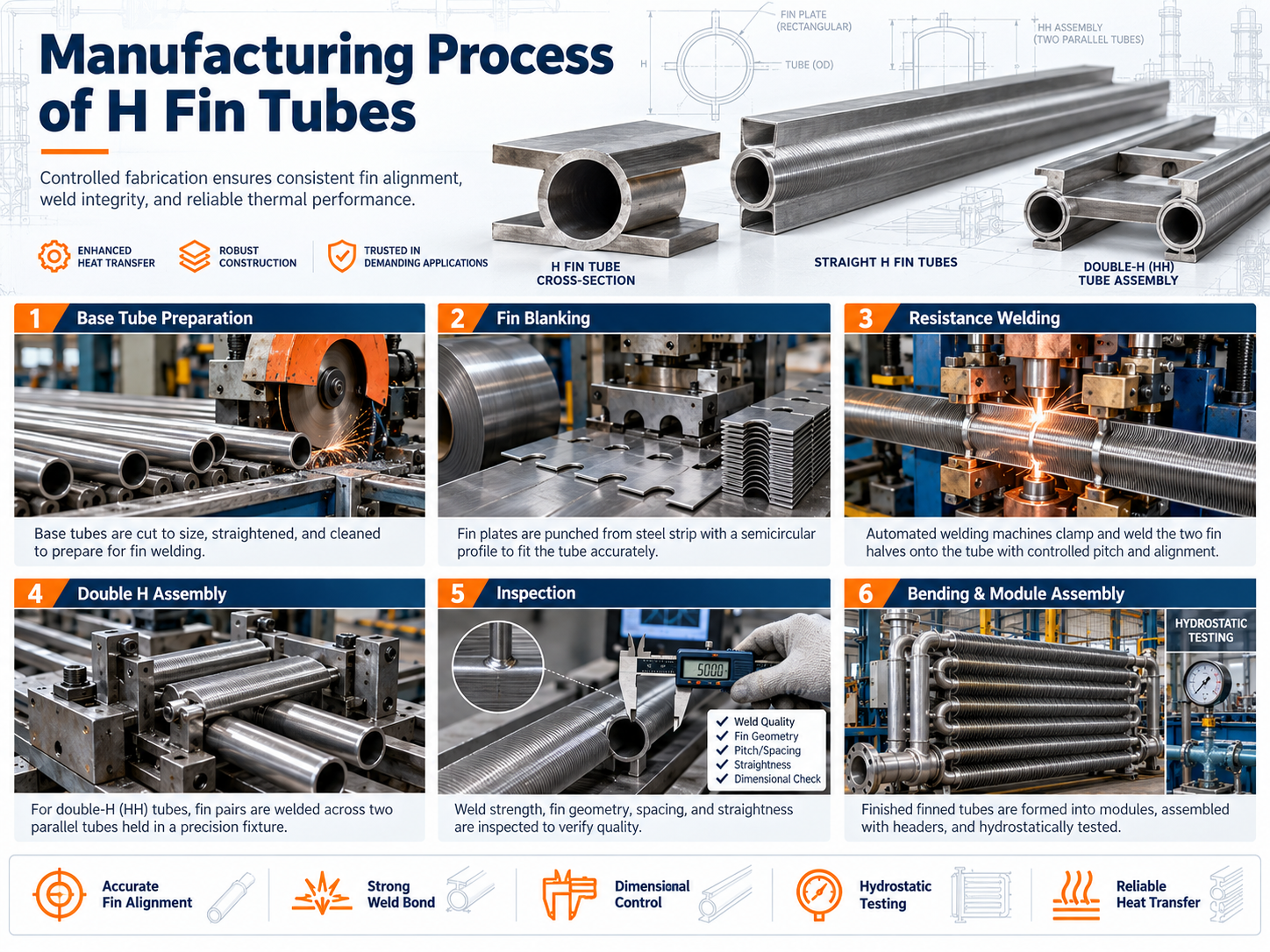
The fin plates are joined to the tube by resistance (flash butt) welding on automated machines that index along the tube to keep fin pitch and alignment consistent. A small gap is left between the two fin halves so ash and soot-blower steam can pass through.
What materials are H fin tubes made from?
Base tubes are usually carbon steel boiler tubes such as ASTM A192, A210 Grade A-1, 20G or EN 10216-2 P265GH, or alloy steel such as T11 and T22 for hotter zones. Fins are carbon steel, ND steel (09CrCuSb) for acid dew-point resistance, or stainless steel.
What are typical H fin tube dimensions?
Common base tubes are 25 to 51 mm OD with walls of about 3 to 6 mm. The fin is roughly square, with a side length about twice the tube OD (for example 70 × 70, 75 × 75 or 95 × 89 mm), fin thickness of about 1.5 to 3 mm and fin pitch of about 10 to 25 mm.
Where are H fin tubes used?
H fin tubes are used in coal-fired and biomass boiler economizers, air preheaters, circulating fluidized bed (CFB) boilers, waste incineration boilers, sintering and coke-oven waste heat boilers, cement and steel plant heat recovery, and low-temperature flue gas heat exchangers.
Can H fin tubes resist acid dew-point corrosion?
Yes, when the right fin and tube material is chosen. In low-temperature economizers where flue gas may cool below its acid dew point, ND steel (09CrCuSb) or Corten-type steel fins and tubes are used to slow sulfuric acid corrosion.
What should I include in an H fin tube enquiry?
State single or double H, base tube grade, OD and wall thickness, tube length, fin size (width × height), fin thickness, fin pitch, centre gap, fin material, bare-end lengths, bends or coils, quantity, and testing or inspection requirements.
