
Carbon Steel Finned Tubes | CS Fin Tube Manufacturer, Supplier & Exporter
Carbon steel finned tubes are carbon steel tubes with spiral, serrated or longitudinal fins on their outer surface to increase heat transfer on the gas or air side. ASC LLP, Mumbai, supplies CS finned tubes – high frequency welded (HFW) spiral fin, serrated fin, extruded, embedded G-fin, L / LL / KL wrapped and integral low-fin tubes – for economizers, HRSGs, air coolers and heat exchangers across the USA, Europe, the Middle East and Asia.
What Are Carbon Steel Finned Tubes?
A finned tube is a base tube with fins added to its outside surface. Because gas and air carry heat far less efficiently than water or steam, the outside of the tube usually limits heat transfer. Fins multiply the outside surface area – typically by 5 to 15 times – so the same duty can be handled with fewer tubes, smaller equipment and lower cost.
In a carbon steel finned tube, the base tube is a carbon steel pressure tube such as ASTM A179 / A192 boiler tubes, ASTM A106 Grade B or EN 10216-2 P265GH tube. The fins may be carbon steel (welded), aluminium (extruded, embedded or wrapped) or stainless steel, depending on temperature and environment. Carbon steel is the most economical base material wherever corrosion and temperature allow, which is why CS fin tubes are the standard choice for boiler economizers and air-cooled heat exchangers.
Buyers also search for this product as:
- CS Finned Tubes / Carbon Steel Fin Tubes
- Spiral Finned Tubes and Helical Finned Tubes
- HFW Finned Tubes (High Frequency Welded)
- Serrated Finned Tubes
- Extruded Finned Tubes and G-Type Embedded Finned Tubes
- Economizer Finned Tubes and Air Cooler Fin Tubes
Types of Carbon Steel Finned Tubes We Supply
We supply all common fin designs on carbon steel base tubes:
HFW Solid Spiral Finned Tubes
- Continuous carbon steel strip helically wound and welded to the tube by high frequency resistance welding
- Strong metallurgical bond for high temperature and high gas velocity
- Used in economizers, boilers and fired-heater convection sections
HFW Serrated Finned Tubes
- Fin strip cut into segments, creating turbulence and higher heat transfer than solid fins
- Standard in heat recovery steam generators (HRSG) and waste heat boilers
Extruded Finned Tubes
- Aluminium fins formed from an outer aluminium sleeve extruded over the carbon steel tube
- Excellent atmospheric corrosion protection of the base tube; up to about 285 °C
- Widely used in air-cooled heat exchangers (API 661)
Embedded G-Type Finned Tubes
- Aluminium fin strip wound into a helical groove machined into the tube wall
- High fin bond strength and service up to about 400 °C
L, LL and KL Wrapped Finned Tubes
- Aluminium fin strip tension-wound with an L-shaped foot; LL has overlapping feet, KL has a knurled foot
- Economical choice for lower temperatures (L about 150 °C, LL about 180 °C, KL about 260 °C)
Integral Low-Fin Tubes (ASTM A498)
- Fins cold-formed from the tube wall itself – no separate fin material
- For shell-and-tube exchangers, condensers and evaporators, up to 2″ OD
Longitudinal Finned Tubes & Studded Tubes
- Longitudinal (straight) fins for double-pipe exchangers and tank heaters
- Studded tubes for fired-heater convection sections with dirty flue gas
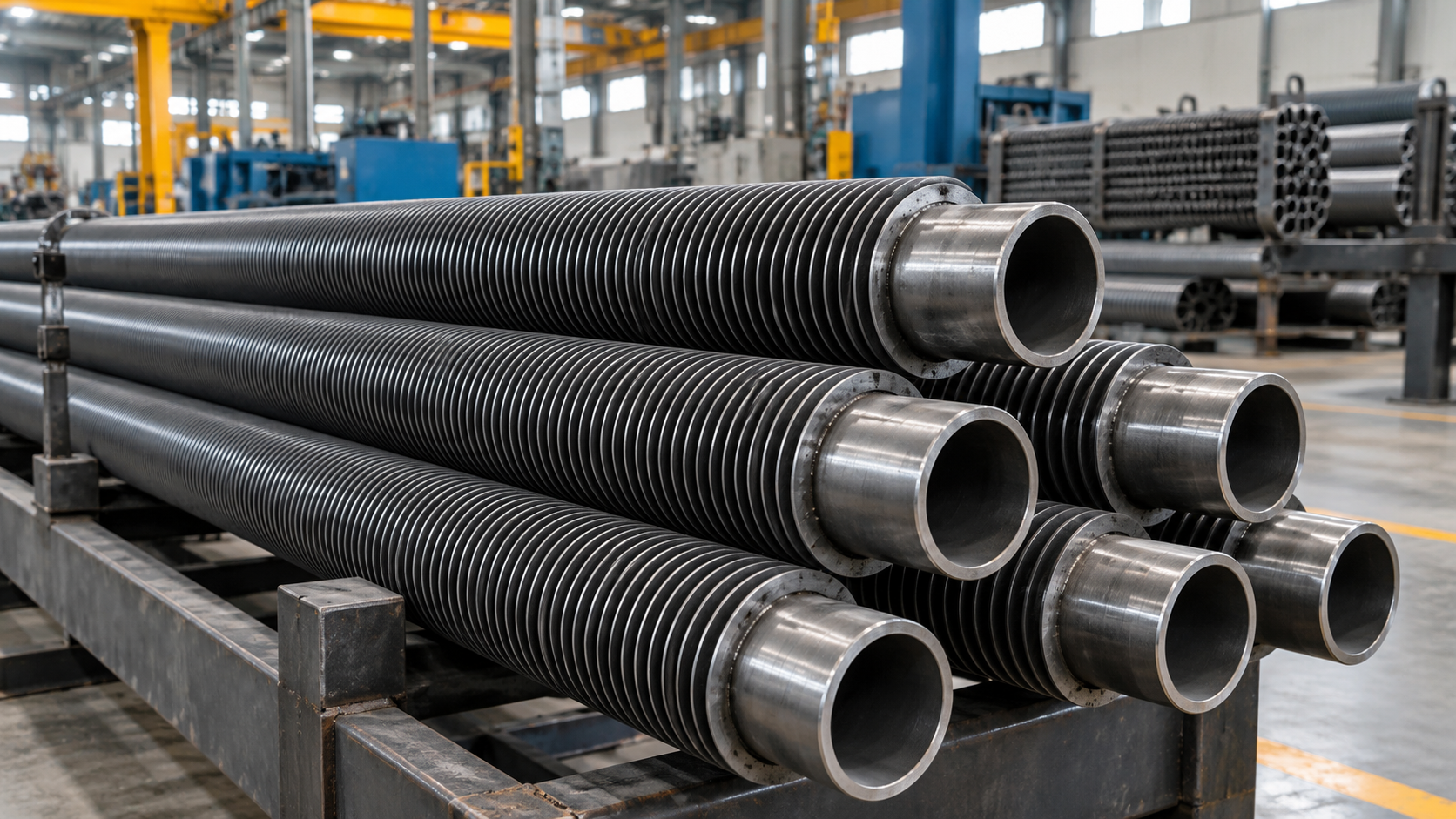
Solid vs Serrated Finned Tubes
Solid Spiral Fins
- Lower gas-side pressure drop
- Easier to clean – better for dirty or ash-laden flue gas
- Simpler and slightly lower cost
Serrated Spiral Fins
- Higher heat-transfer coefficient from segment turbulence
- More compact bundles for the same duty
- Preferred in HRSGs and clean-gas waste heat recovery
Choose the fin style based on gas cleanliness, allowable pressure drop and space available.
Finned Tubes Quality Control & Testing
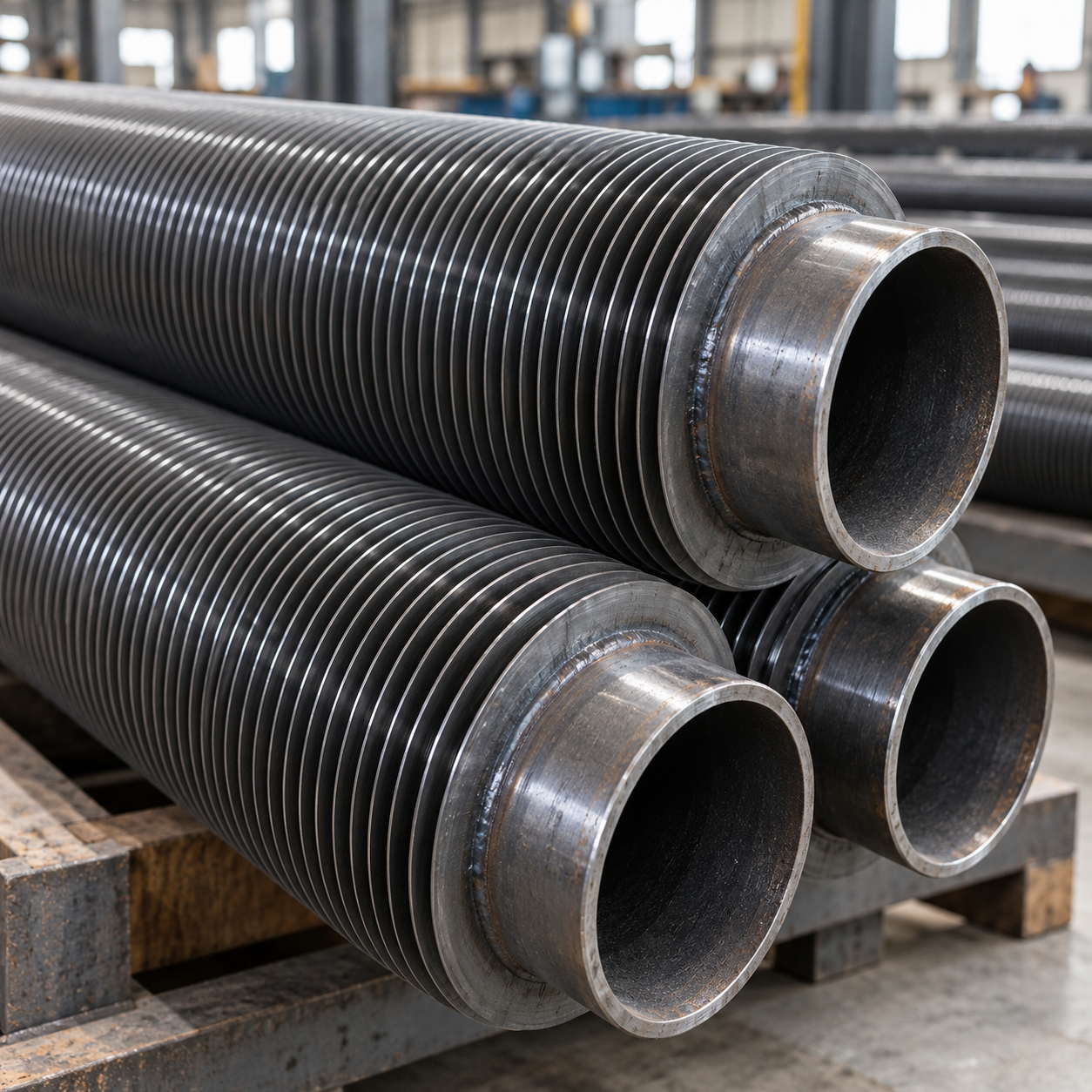
Every lot of carbon steel finned tubes is inspected for both the base tube and the fin bond:
- Base tube mill test certificate (chemistry, mechanical, hydro / NDT) to its material standard
- Hydrostatic or pneumatic pressure test of finned tubes on request
- Fin weld / bond strength check (fin pull or peel test) for HFW and embedded fins
- Fin height, fin thickness, fin pitch and fin-free (bare) end length checks
- Visual inspection of fin straightness, weld continuity and surface damage
- Optional: cut-section examination, third-party inspection (TÜV, BV, SGS, Lloyd’s, DNV)
Finned tubes are supplied with EN 10204 3.1 certificates for the base tube and a finning inspection report.
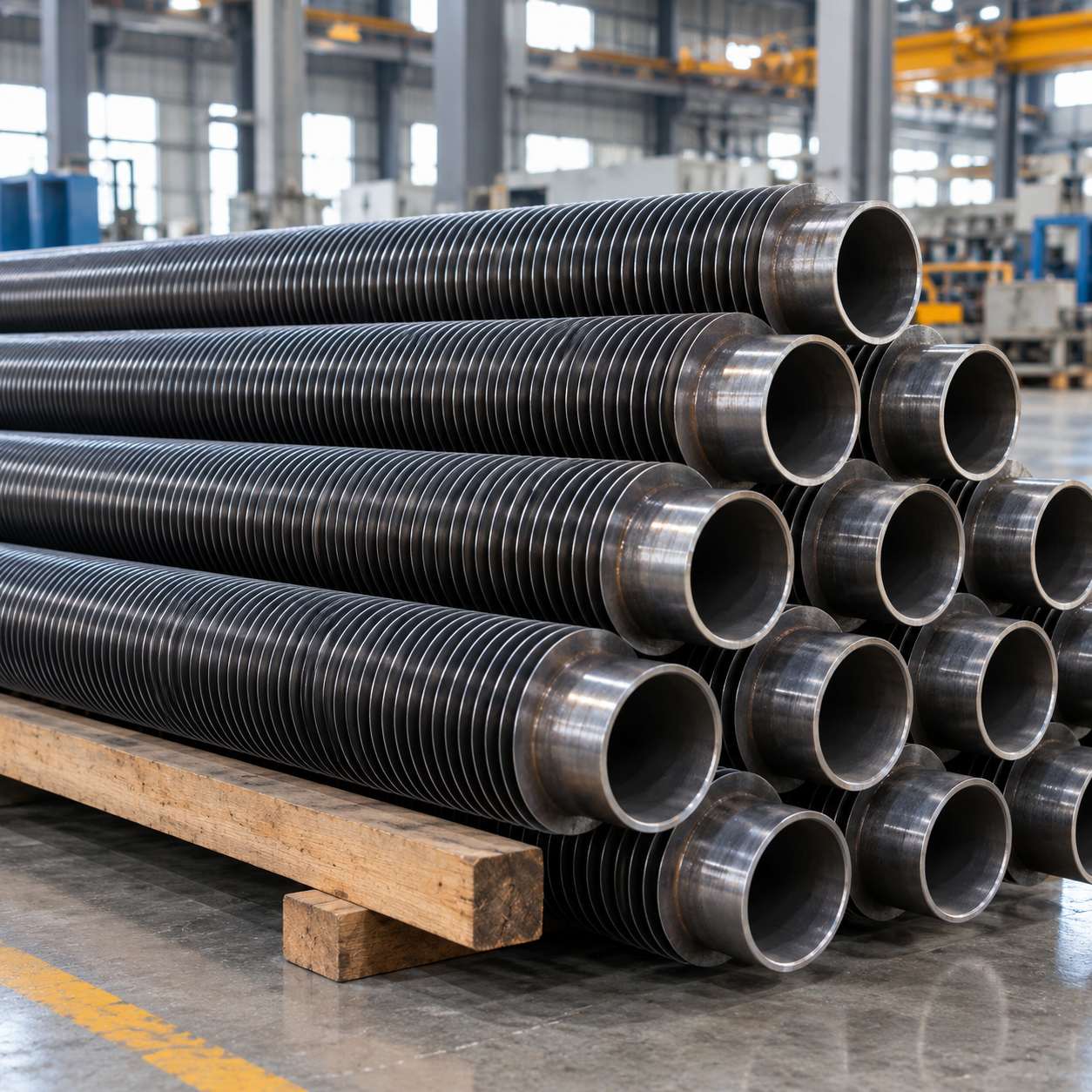
Specifications Table – Carbon Steel Finned Tubes
| Parameter | Details |
| Base Tube Materials | ASTM A179, A192, A210 Gr A-1, A106 Gr B, A214, A334 Gr 6, EN 10216-2 P235GH / P265GH |
| Base Tube OD | 15.88 mm to 219 mm |
| Base Tube Wall Thickness | 1.65 mm to 16 mm |
| Fin Types | HFW solid spiral, HFW serrated, extruded, embedded (G), L / LL / KL, integral low-fin, longitudinal, studded |
| Fin Materials | Carbon steel, stainless steel (409, 304, 316), aluminium (1050, 1060, 1100), copper |
| Fin Height | 6 mm to 38 mm |
| Fin Thickness | 0.3 mm to 4 mm (depending on fin type) |
| Fin Pitch | 2 to 11 FPI (approx. 79 to 433 fins per metre) |
| Tube Length | Up to 20 m (longer on request) |
| Bare Ends | As per drawing, for welding into headers or tube sheets |
| Forms | Straight, U-bent, serpentine coils |
| Test Certificate | EN 10204 3.1 / 3.2 with finning inspection report |
Base Tube Grades for Carbon Steel Finned Tubes
| Base Tube Grade | Type | Typical Use |
| ASTM A179 / SA179 | Seamless cold-drawn low-carbon | Air coolers, heat exchangers, condensers |
| ASTM A192 / SA192 | Seamless carbon steel boiler tube | Boiler economizers, high-pressure service |
| ASTM A210 Gr A-1 / SA210 | Seamless medium-carbon boiler tube | Economizers, HRSG, higher strength |
| ASTM A106 Gr B / SA106 | Seamless carbon steel pipe | HRSG and fired-heater convection coils |
| ASTM A214 / SA214 | ERW carbon steel tube | Air coolers and low-pressure exchangers |
| EN 10216-2 P235GH / P265GH | Seamless non-alloy pressure tube | European boiler and pressure equipment |
| ASTM A334 Grade 6 | Seamless low-temperature carbon steel | Finned tubes for sub-zero service |
See our EN 10216-2 P265GH tubes, ASTM A334 Grade 6 tubes and ASTM A423 Grade 1 Corten tubes for base tubes with special properties. For temperatures above the carbon steel range, alloy base tubes such as T11 or T22 are used – see our alloy steel tubes.
Fin Type Selection Chart
| Fin Type | Fin Material | Max Operating Temperature (approx.) | Corrosion Protection of Tube | Typical Use |
| L (wrapped) | Aluminium / copper | 150 °C | Medium | HVAC, low-temperature air coolers |
| LL (overlapped) | Aluminium / copper | 180 °C | High | Air coolers in humid or coastal air |
| KL (knurled) | Aluminium / copper | 260 °C | Medium | Air coolers with higher temperatures |
| Extruded | Aluminium | 285 °C | High | API 661 air-cooled heat exchangers |
| Embedded (G) | Aluminium / copper / carbon steel | 400 °C | Low | High-temperature air coolers |
| HFW solid / serrated | Carbon steel | approx. 450 °C | Low (tube exposed) | Economizers, HRSG, fired heaters |
| HFW solid / serrated | Stainless steel | Higher, per alloy | Good | Hot or corrosive flue gas |
Temperature limits are typical industry values for the fin bond and fin material; confirm with the design for your service.
Fin Pitch Conversion Chart – FPI, Fins per Metre and Pitch
| Fins per Inch (FPI) | Fins per Metre (FPM) | Fin Pitch (mm) |
| 2 | 79 | 12.70 |
| 3 | 118 | 8.47 |
| 4 | 157 | 6.35 |
| 5 | 197 | 5.08 |
| 6 | 236 | 4.23 |
| 7 | 276 | 3.63 |
| 8 | 315 | 3.17 |
| 10 | 394 | 2.54 |
| 11 | 433 | 2.31 |
Fin pitch = 25.4 ÷ FPI. Economizers and HRSGs commonly use 3–6 FPI; air coolers commonly use 8–11 FPI.
How Finned Tubes Improve Heat Transfer
Heat transfer from a gas to a tube is limited by the gas-side film, which is much weaker than the water or steam side inside the tube. Adding fins increases the outside surface area, so more heat passes through each metre of tube.
- Fin height: taller fins add more area, but each extra millimetre is slightly less effective (lower fin efficiency).
- Fin pitch: closer fins add area but increase pressure drop and fouling – dirty gas needs wider pitch.
- Fin thickness and material: thicker or more conductive fins (aluminium) transfer heat more efficiently.
- Bond quality: a continuous welded or embedded bond avoids contact resistance between fin and tube.
Getting this balance right is why fin height, pitch and type should be chosen together with the thermal design of the equipment.
Manufacturing Process of HFW Carbon Steel Finned Tubes
- Base tube preparation: cutting to length and cleaning the tube surface (shot blasting or grinding) for a sound weld.
- Fin strip forming: the carbon steel strip is fed, and for serrated fins, slit into segments.
- High frequency welding: the strip is wound helically while HF current heats the contact point, forging the fin root to the tube.
- Bare ends: fin-free lengths are left at the ends for welding into headers.
- Inspection and testing: fin dimensions, weld continuity and pressure testing.
- Bending and coating (optional): U-bends, serpentine coils, or painting / galvanizing for protection.
Carbon Steel vs Stainless Steel vs Alloy Steel Finned Tubes
| Feature | Carbon Steel | Stainless Steel | Alloy Steel (T11 / T22) |
| Cost | Lowest | High | Medium |
| Max temperature (tube) | Up to approx. 425–450 °C | High | Up to approx. 550–600 °C |
| Corrosion resistance | Low – needs dry gas above dew point | High | Low to medium |
| Typical use | Economizers, air coolers, HRSG LP sections | Corrosive gas, condensing economizers | HRSG HP superheaters, high-temperature coils |
Carbon steel finned tubes give the best cost per unit of heat transfer wherever the gas stays above its acid dew point and temperatures stay within the carbon steel range.
Standards & Codes for Finned Tubes
| Standard / Code | Covers |
| ASTM A179, A192, A210, A106, A214 | Carbon steel base tube materials |
| EN 10216-2 | Seamless pressure tubes (P235GH, P265GH) |
| ASTM A498 | Carbon steel heat-exchanger tubes with integral fins |
| API 661 | Air-cooled heat exchangers for petroleum and gas service |
| ASME Section I / VIII | Boiler and pressure-vessel design |
| EN 12952 | Water-tube boilers |
| HEI / TEMA | Heat-exchanger and condenser practice |
Applications of Carbon Steel Finned Tubes
Thanks to their efficiency and low cost, CS finned tubes are used in:
- Boiler economizers and feedwater heaters
- Heat recovery steam generators (HRSG) – economizer and LP sections
- Waste heat recovery units on gas turbines, engines and furnaces
- Air-cooled heat exchangers (fin-fan coolers)
- Air preheaters and gas-to-air heat exchangers
- Fired-heater convection sections
- Process gas coolers and charge-air coolers
- Industrial heating coils, dryers and HVAC
Why Choose Us as Your Carbon Steel Finned Tubes Supplier?
With decades of experience in boiler and heat-exchanger tubes, we supply finned tubes that match your thermal design and code requirements:
- Since 1984: a long record of supplying carbon, alloy and pressure tubes
- All fin types: HFW solid and serrated, extruded, embedded, wrapped and integral fins
- Certified base tubes: ASTM, ASME and EN grades with EN 10204 3.1 / 3.2 certificates
- Made to drawing: custom fin height, pitch, bare ends, U-bends and coils
- Third-party inspection welcomed during finning and before dispatch
- Export-ready packing: fin-protecting spacers, wooden crates and secure bundling
Whether you are building a new economizer or replacing an air-cooler bundle, our carbon steel finned tubes deliver efficient heat transfer at a competitive price.
Related Products
Frequently Asked Questions – Carbon Steel Finned Tubes
What are carbon steel finned tubes?
Carbon steel finned tubes are carbon steel base tubes with fins attached to or formed on their outer surface. The fins increase the heat-transfer surface on the gas or air side by several times, so equipment such as economizers, air coolers and heat recovery units can be smaller and more efficient.
What are the main types of finned tubes?
The main types are high frequency welded (HFW) solid and serrated spiral fin tubes, extruded fin tubes, embedded (G-type) fin tubes, wrapped L, LL and KL fin tubes, integral low-fin tubes, longitudinal fin tubes and studded tubes. The right type depends on operating temperature, corrosion environment and pressure drop.
Which base tube grades are used for carbon steel finned tubes?
Common base tubes are ASTM A179, A192, A210 Grade A-1, A106 Grade B, A214, EN 10216-2 P235GH / P265GH, and ASTM A334 Grade 6 for low-temperature service. The base tube grade is chosen by design pressure, temperature and code requirements.
What is the difference between solid and serrated finned tubes?
A solid fin is a continuous helical strip. A serrated fin is cut into segments at its outer edge, which creates more turbulence and higher heat transfer in the same space. Serrated fins are common in HRSGs and economizers; solid fins have lower pressure drop and are easier to clean.
What is the maximum temperature for carbon steel finned tubes?
It depends on the fin type. Wrapped aluminium L-fin tubes are limited to about 150 °C, KL to about 260 °C, extruded aluminium fins to about 285 °C and embedded G-fins to about 400 °C. HFW carbon steel fins are typically used up to about 450 °C; above that, stainless or alloy steel fins are used.
What does FPI mean for finned tubes?
FPI means fins per inch – the number of fins along one inch of tube length. For example, 5 FPI equals a fin pitch of about 5.1 mm or about 197 fins per metre (FPM). Higher FPI gives more surface area but higher air-side pressure drop and more fouling risk.
Where are carbon steel finned tubes used?
They are used in boiler economizers, heat recovery steam generators (HRSG), waste heat recovery units, air-cooled heat exchangers (fin fans), air preheaters, fired-heater convection sections, process gas coolers and industrial heating coils.
Which standards apply to finned tubes?
Base tubes follow their own material standard, such as ASTM A179, A192 or EN 10216-2. Integral-fin carbon steel tubes are covered by ASTM A498. Air-cooled heat exchangers are designed to API 661, and boiler and pressure parts to ASME Section I / VIII or EN 12952.
Can finned tubes be supplied with bends or U-bends?
Yes. We supply carbon steel finned tubes in straight lengths, with bare ends for welding into headers, and as U-bent or serpentine coils to drawing.
How should I specify a finned tube enquiry?
State the base tube specification and grade, OD and wall thickness, tube length, fin type, fin material, fin height, fin thickness, fin pitch (FPI or FPM), bare-end lengths, quantity and any testing or inspection requirements.
