
Alloy Steel Finned Tubes | T11, T22 & T91 Fin Tube Manufacturer, Supplier & Exporter
Alloy steel finned tubes are chromium-molybdenum alloy steel tubes with solid or serrated spiral fins on their outer surface, built for heat transfer at temperatures beyond the reach of carbon steel. ASC LLP, Mumbai, supplies alloy steel fin tubes on ASTM A213 T11, T22, T91, T5 and T9 base tubes for HRSG superheaters and reheaters, boilers, fired heaters and high-temperature heat exchangers across the USA, Europe, the Middle East and Asia.
What Are Alloy Steel Finned Tubes?
A finned tube is a base tube with fins added to its outside surface to multiply the gas-side heat-transfer area – typically by 5 to 15 times. In an alloy steel finned tube, the base tube is a Cr-Mo steel such as SA213 T11 (1¼Cr-½Mo), T22 (2¼Cr-1Mo) or T91 (9Cr-1Mo-V).
Chromium and molybdenum give these tubes much higher creep strength and oxidation resistance at high temperature than carbon steel. That makes alloy steel finned tubes the standard choice once tube metal temperatures go above roughly 425–450 °C – the practical limit for carbon steel finned tubes. The fins are usually high frequency welded (HFW) carbon steel or 11–13% chromium stainless steel, selected for the fin tip temperature.
Buyers also search for this product as:
- Alloy Steel Fin Tubes / Cr-Mo Finned Tubes
- T11 Finned Tubes, T22 Finned Tubes and T91 Finned Tubes
- SA213 T22 Spiral Finned Tubes
- Serrated Finned Tubes for HRSG
- Superheater Finned Tubes and Reheater Finned Tubes
- HFW Alloy Steel Finned Tubes
Types of Alloy Steel Finned Tubes We Supply
We supply alloy steel base tubes in all high-temperature fin designs:
HFW Solid Spiral Finned Tubes
- Continuous fin strip helically wound and high-frequency welded to the Cr-Mo tube
- Strong metallurgical bond for high gas temperatures and velocities
- Easier to clean – suited to dirty or ash-laden flue gas
HFW Serrated Finned Tubes
- Segmented fins for higher turbulence and heat transfer
- Standard design for HRSG superheater, reheater and evaporator modules
T11 / T22 Finned Tubes
- Low-alloy Cr-Mo base tubes for intermediate temperatures
- Used in HRSG intermediate-pressure superheaters, boiler superheaters and fired-heater convection coils
T91 Finned Tubes
- 9Cr-1Mo-V base tubes for the highest-temperature HRSG sections
- Higher allowable stress means thinner, lighter tube walls
T5 / T9 Finned Tubes
- 5Cr and 9Cr tubes for refinery fired heaters, where sulfidation and high temperature combine
Studded Alloy Steel Tubes
- Welded studs instead of fins for fired-heater convection sections with fouling fuel oil flue gas
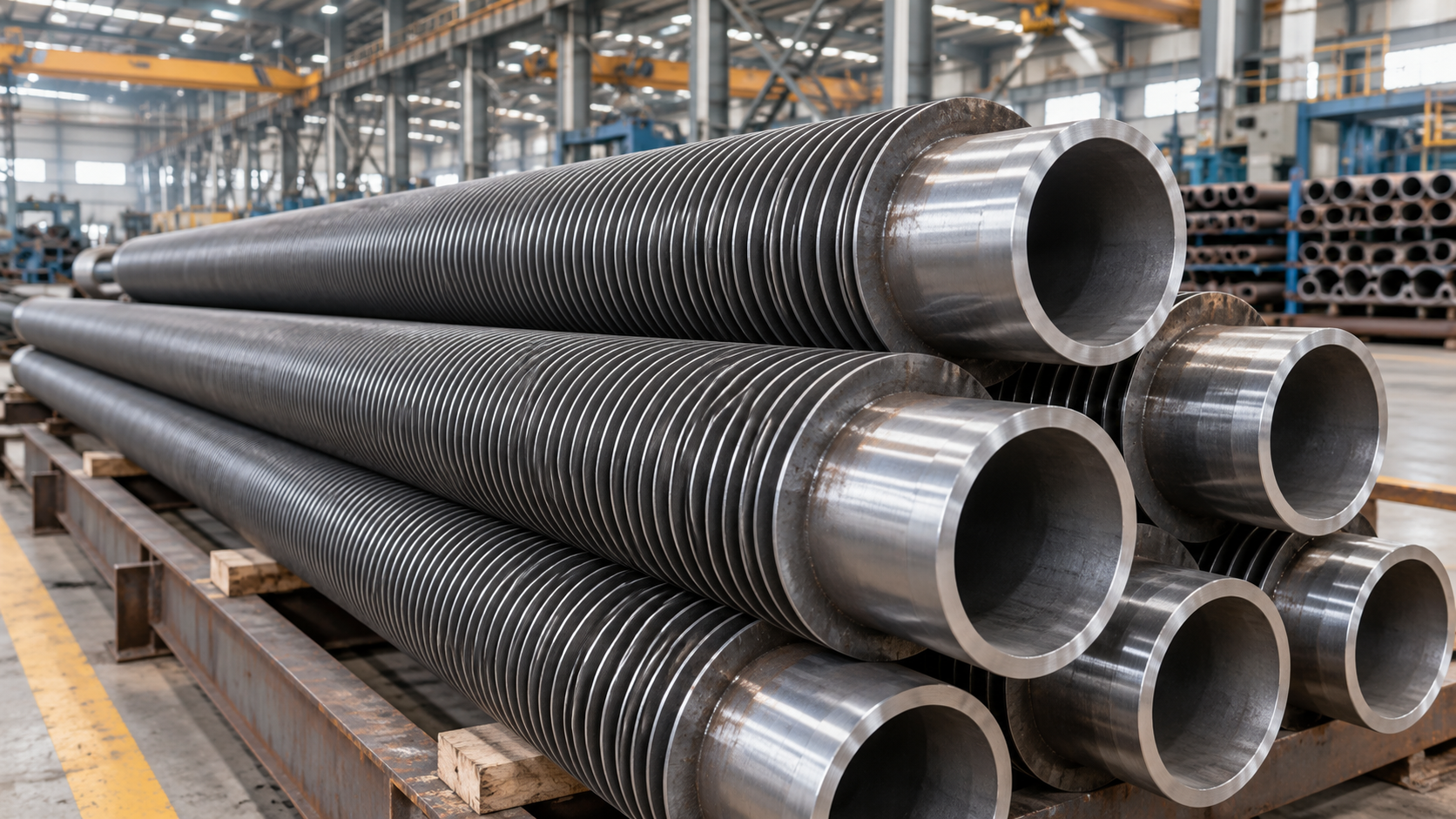
Solid vs Serrated Alloy Steel Finned Tubes
Solid Spiral Fins
- Lower gas-side pressure drop
- Easier soot-blowing and cleaning
- Preferred for fired heaters and dirty flue gas
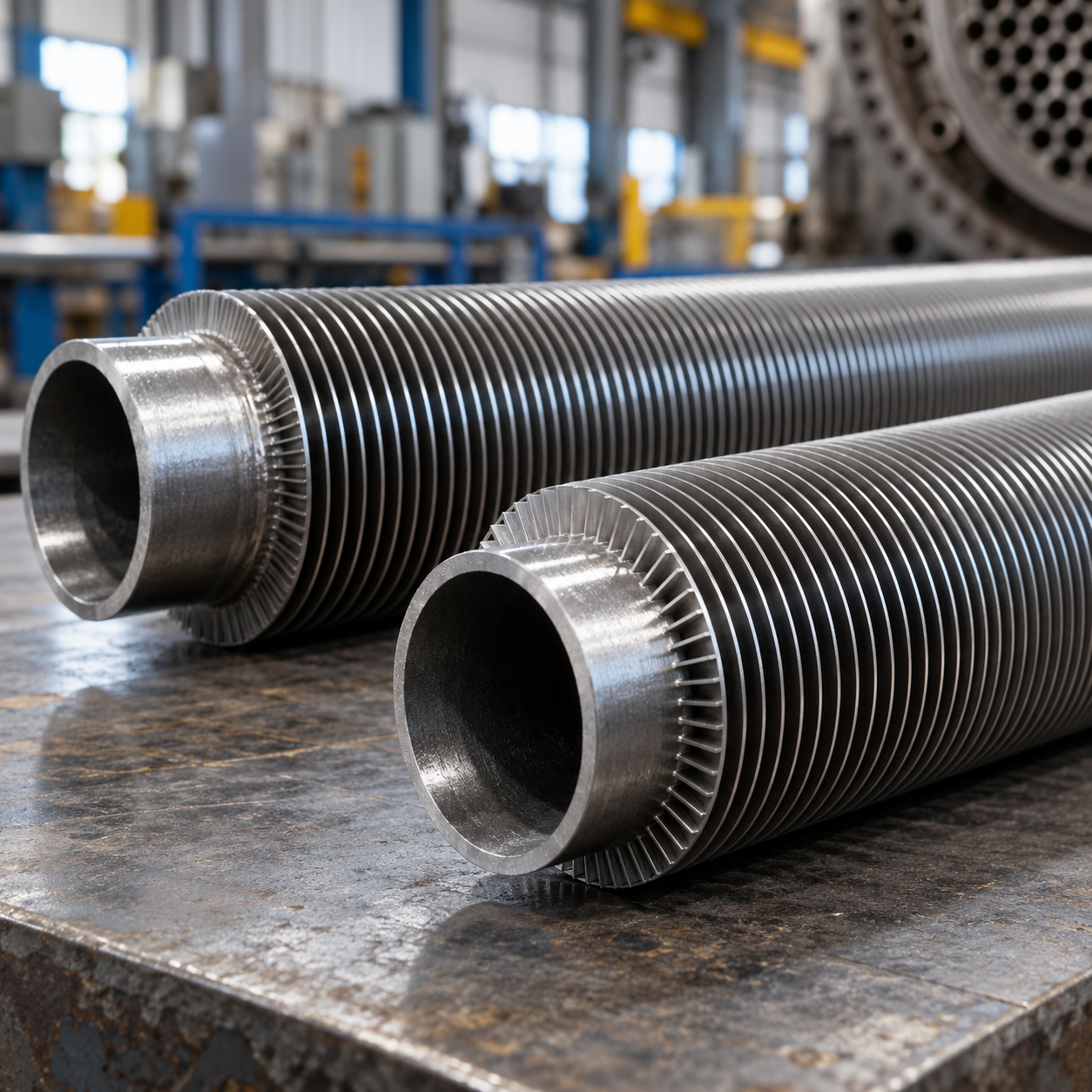
Serrated Spiral Fins
- Higher heat-transfer coefficient and more compact modules
- Preferred for clean gas-turbine exhaust in HRSGs
- Lower fin tip temperatures for the same duty
Choose the fin style based on gas cleanliness, allowable pressure drop and the HRSG or heater design.
Alloy Steel Finned Tubes Quality Control & Testing
Every lot of alloy steel finned tubes is inspected for both base tube and fin quality:
- Base tube mill test certificate to ASTM A213 / ASME SA213 or EN 10216-2 (chemistry, tensile, hardness, hydro / NDT)
- Positive material identification (PMI) of Cr-Mo base tubes
- Fin weld bond strength check (fin pull or peel test)
- Fin height, thickness, pitch and bare-end length checks
- Hydrostatic test of finished tubes or coils on request
- Hardness checks after bending and heat treatment where specified
- Optional: cut-section macro examination, third-party inspection (TÜV, BV, SGS, Lloyd’s, DNV)
Alloy steel finned tubes are supplied with EN 10204 3.1 / 3.2 certificates for the base tube and a finning inspection report.
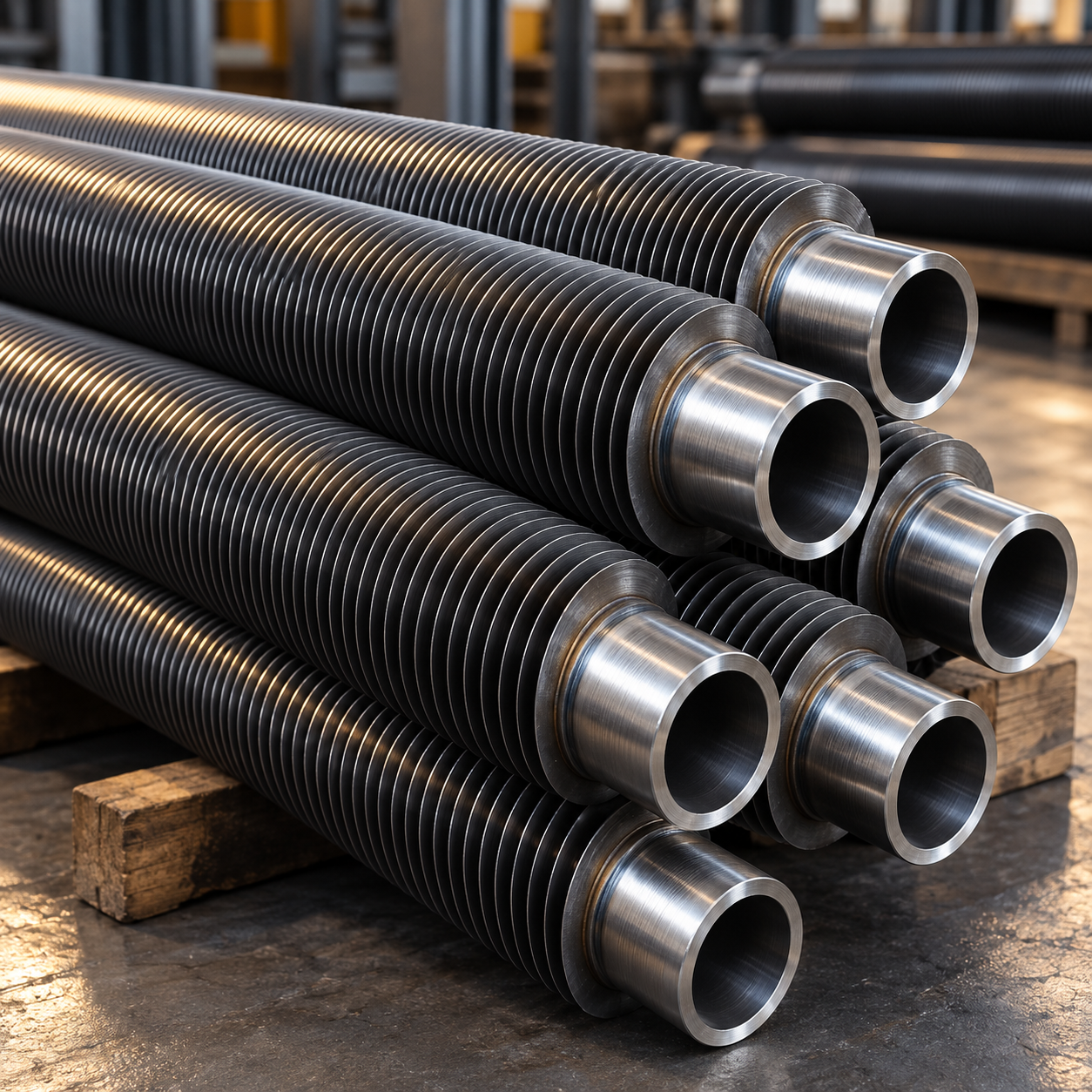
Specifications Table – Alloy Steel Finned Tubes
| Parameter | Details |
| Base Tube Materials | ASTM A213 / ASME SA213 T5, T9, T11, T12, T22, T91; EN 10216-2 16Mo3, 13CrMo4-5, 10CrMo9-10 |
| Base Tube OD | 25.4 mm to 168.3 mm |
| Base Tube Wall Thickness | 2.0 mm to 12.7 mm |
| Fin Types | HFW solid spiral, HFW serrated, studded |
| Fin Materials | Carbon steel, 409 / 410S stainless (11–13% Cr), 304 / 316 stainless |
| Fin Height | 9.5 mm to 38 mm |
| Fin Thickness | 0.8 mm to 2.5 mm |
| Fin Pitch | 2 to 7 FPI (approx. 79 to 276 fins per metre) |
| Serration Segment Width | approx. 4 mm to 4.8 mm (serrated fins) |
| Tube Length | Up to 20 m (longer on request) |
| Forms | Straight with bare ends, U-bent, serpentine coils, HRSG harps |
| Test Certificate | EN 10204 3.1 / 3.2 with finning inspection report |
Alloy Steel Base Tube Grades for Finned Tubes
| Base Tube Grade | Nominal Composition | Approx. Max Metal Temperature* | Typical Use |
| SA213 T11 | 1¼Cr-½Mo | approx. 550 °C | HRSG IP superheaters, boiler superheaters |
| SA213 T22 | 2¼Cr-1Mo | approx. 580 °C | HRSG HP superheaters, reheaters |
| SA213 T91 | 9Cr-1Mo-V | approx. 600–620 °C | HRSG final superheaters and reheaters |
| SA213 T5 | 5Cr-½Mo | approx. 600 °C | Refinery fired-heater convection coils |
| SA213 T9 | 9Cr-1Mo | approx. 620 °C | Refinery heaters with sulfidation risk |
| EN 10216-2 16Mo3 | 0.3Mo | approx. 500 °C | European boilers, economizer hot ends |
| EN 10216-2 13CrMo4-5 | 1Cr-½Mo | approx. 550 °C | European superheaters (≈ T12) |
| EN 10216-2 10CrMo9-10 | 2¼Cr-1Mo | approx. 580 °C | European superheaters (≈ T22) |
*Typical practical limits based on creep strength and oxidation; the allowable temperature for your design comes from the code and stress. For lower temperatures, see our carbon steel finned tubes and EN 10216-2 P265GH tubes.
Fin Material Selection Chart
| Fin Material | Approx. Max Fin Tip Temperature* | Typical Use |
| Carbon steel | approx. 450 °C | Cooler HRSG sections, economizer ends |
| 409 stainless (11Cr) | approx. 600 °C | HRSG superheaters and reheaters |
| 410S stainless (13Cr) | approx. 650 °C | Hotter superheater rows |
| 304 / 316 stainless | approx. 700 °C and above | Highest gas temperatures, fired heaters |
*Typical industry guide values for fin oxidation; fin tip temperature is higher than tube metal temperature, so fin material is selected from the thermal design.
Fin Pitch Conversion Chart – FPI, Fins per Metre and Pitch
| Fins per Inch (FPI) | Fins per Metre (FPM) | Fin Pitch (mm) |
| 2 | 79 | 12.70 |
| 3 | 118 | 8.47 |
| 4 | 157 | 6.35 |
| 5 | 197 | 5.08 |
| 6 | 236 | 4.23 |
| 7 | 276 | 3.63 |
Fin pitch = 25.4 ÷ FPI. HRSG superheaters commonly use 3–6 FPI; fired-heater convection sections often use 2–4 FPI to limit fouling.
Why Alloy Steel for High-Temperature Finned Tubes?
At high temperature, steel slowly deforms under constant stress (creep) and oxidizes. Alloying solves both problems:
- Chromium improves oxidation and sulfidation resistance and stabilizes carbides.
- Molybdenum increases creep strength at elevated temperature.
- Vanadium and niobium (T91) form fine precipitates that give much higher creep strength, allowing thinner walls.
- Thinner walls mean better heat transfer, lower weight and lower thermal-fatigue stress during cycling.
This is why HRSGs and boilers move from carbon steel to T11, T22 and T91 finned tubes as gas and steam temperatures rise along the gas path.
Manufacturing Process of HFW Alloy Steel Finned Tubes
- Base tube inspection: PMI and certificate review of the Cr-Mo tube.
- Surface preparation: cleaning the tube surface for a sound fin weld.
- Fin strip forming: strip fed and, for serrated fins, slit into segments.
- High frequency welding: fin wound helically and forge-welded to the tube by HF current – low heat input limits the effect on the base tube.
- Bare ends: fin-free lengths left for header welding.
- Bending and heat treatment: U-bends and coils, with post-bend heat treatment of Cr-Mo grades where the code requires.
- Final inspection and testing: dimensions, bond check, hydro test and documentation.
Alloy Steel vs Carbon Steel vs Stainless Steel Finned Tubes
| Feature | Alloy Steel (T11 / T22 / T91) | Carbon Steel | Stainless Steel |
| Cost | Medium | Lowest | High |
| Max tube temperature | approx. 550–620 °C (by grade) | approx. 425–450 °C | High (by grade) |
| Creep strength | High (very high for T91) | Low above 400 °C | Good |
| Corrosion resistance | Oxidation-resistant; not for wet acid conditions | Low | High |
| Typical use | HRSG superheaters, reheaters, fired heaters | Economizers, air coolers | Corrosive or condensing service |
Alloy steel finned tubes give the best balance of cost and high-temperature strength. For low-temperature economizer and air-cooler duty, carbon steel finned tubes are more economical.
Standards & Codes for Alloy Steel Finned Tubes
| Standard / Code | Covers |
| ASTM A213 / ASME SA213 | Seamless ferritic alloy steel boiler, superheater and heat-exchanger tubes |
| ASTM A335 / ASME SA335 | Seamless ferritic alloy steel pipe (P11, P22, P91) for headers and coils |
| EN 10216-2 | Seamless pressure tubes (16Mo3, 13CrMo4-5, 10CrMo9-10) |
| ASME Section I | Power boilers and HRSGs |
| API 560 | Fired heaters for general refinery service |
| EN 12952 | Water-tube boilers |
Applications of Alloy Steel Finned Tubes
Alloy steel finned tubes are used wherever high temperatures meet the need for compact, efficient heat transfer:
- Heat recovery steam generators (HRSG) – HP and IP superheaters and reheaters
- Utility and industrial boiler superheaters
- Refinery and petrochemical fired-heater convection sections
- Waste heat boilers on furnaces, kilns and incinerators
- Gas turbine exhaust heat recovery
- High-temperature process gas coolers and heat exchangers
- Steam superheating in combined-cycle and cogeneration plants
Why Choose Us as Your Alloy Steel Finned Tubes Supplier?
With decades of experience in alloy steel and boiler tubes, we supply finned tubes that match your thermal design and code requirements:
- Since 1984: a long record of supplying Cr-Mo alloy steel tubes and pipes
- All key grades: SA213 T5, T9, T11, T22, T91 and EN 16Mo3, 13CrMo4-5, 10CrMo9-10
- PMI-verified base tubes with EN 10204 3.1 / 3.2 certificates
- Made to drawing: solid or serrated fins, custom fin height, pitch, bare ends, U-bends and coils
- Third-party inspection welcomed during finning and before dispatch
- Export-ready packing: fin-protecting spacers and seaworthy wooden crates
Whether you are building a new HRSG module or replacing superheater tubes, our alloy steel finned tubes deliver reliable high-temperature performance.
Related Products
Frequently Asked Questions – Alloy Steel Finned Tubes
What are alloy steel finned tubes?
Alloy steel finned tubes are chromium-molybdenum (Cr-Mo) steel base tubes, such as ASTM A213 T11, T22 or T91, with fins welded or attached to the outside surface. They are used where flue-gas or steam temperatures are too high for carbon steel, such as HRSG superheaters, reheaters and fired-heater convection sections.
Which alloy steel grades are used for finned tubes?
The most common base tubes are ASTM A213 / ASME SA213 T11, T22 and T91, with T5 and T9 for refinery heaters. European equivalents are EN 10216-2 16Mo3, 13CrMo4-5 and 10CrMo9-10. Grade choice depends on metal temperature, pressure and creep strength.
When should I use alloy steel finned tubes instead of carbon steel?
Use alloy steel when the tube metal temperature exceeds the practical limit of carbon steel (roughly 425–450 °C), or when higher creep strength is needed. Typical cases are HRSG high-pressure superheaters and reheaters, and hot sections of fired-heater convection coils.
What fin material is used on alloy steel finned tubes?
Carbon steel fins are used where fin tip temperatures stay within carbon steel limits. For hotter gas, 11–13% chromium stainless fins (Type 409 or 410S) or austenitic stainless fins (304, 316) are used to resist oxidation.
What is the difference between T11, T22 and T91 finned tubes?
T11 (1¼Cr-½Mo) and T22 (2¼Cr-1Mo) are low-alloy steels for moderate high-temperature service. T91 (9Cr-1Mo-V) is a creep-strength-enhanced ferritic steel with much higher strength at high temperature, allowing thinner walls in HRSG high-pressure superheaters.
Do alloy steel finned tubes need post-weld heat treatment?
Fin attachment by high frequency welding normally does not need PWHT, but tube-to-header welds, bends and repairs on Cr-Mo grades usually do. T91 is especially sensitive: incorrect PWHT temperature or local overheating can damage its microstructure and creep strength.
What are serrated alloy steel finned tubes?
Serrated finned tubes have the fin strip cut into segments, which increases turbulence and heat transfer. Serrated fins on T11, T22 or T91 base tubes are standard in HRSG superheater and reheater modules.
Which standards apply to alloy steel finned tubes?
The base tube follows its material standard, such as ASTM A213 / ASME SA213 or EN 10216-2. Design follows ASME Section I for boilers and HRSGs, ASME Section VIII for pressure vessels, API 560 for fired heaters and EN 12952 for water-tube boilers.
Can alloy steel finned tubes be supplied as coils or U-bends?
Yes. We supply alloy steel finned tubes in straight lengths with bare ends, and as U-bent or serpentine coils to drawing, with heat treatment of bends where required.
How should I specify an alloy steel finned tube enquiry?
State the base tube specification and grade (for example SA213 T22), OD and wall thickness, tube length, fin type (solid or serrated), fin material, fin height, fin thickness, fin pitch (FPI), bare-end lengths, quantity, and testing or inspection requirements.
