
Crimped Finned Tubes – Crimped Spiral Fin Tube Manufacturer, Supplier & Exporter
Crimped finned tubes (also called crimped fin tubes, crimped spiral fin tubes or wound crimped fin tubes) have a metal fin strip wound edge-on around the tube, with a ruffled, crimped root that grips the tube surface. They are an economical way to add 7 to 14 times more outside surface to a tube, and are widely used in steam air heaters, dryers, oil coolers and HVAC coils.
ASC LLP, Mumbai, supplies crimped finned tubes in copper, aluminium, carbon steel, galvanized steel and stainless steel fins on carbon steel, stainless steel and copper base tubes – mechanically wound, brazed, soldered or hot-dip galvanized. They are part of our complete range of finned tubes.
Quick specification: base tube 12.7–50.8 mm OD · fin height 6–19 mm · fin thickness 0.3–1.0 mm · pitch 2.5–6.5 mm (4–10 FPI) · lengths up to approx. 12 m.
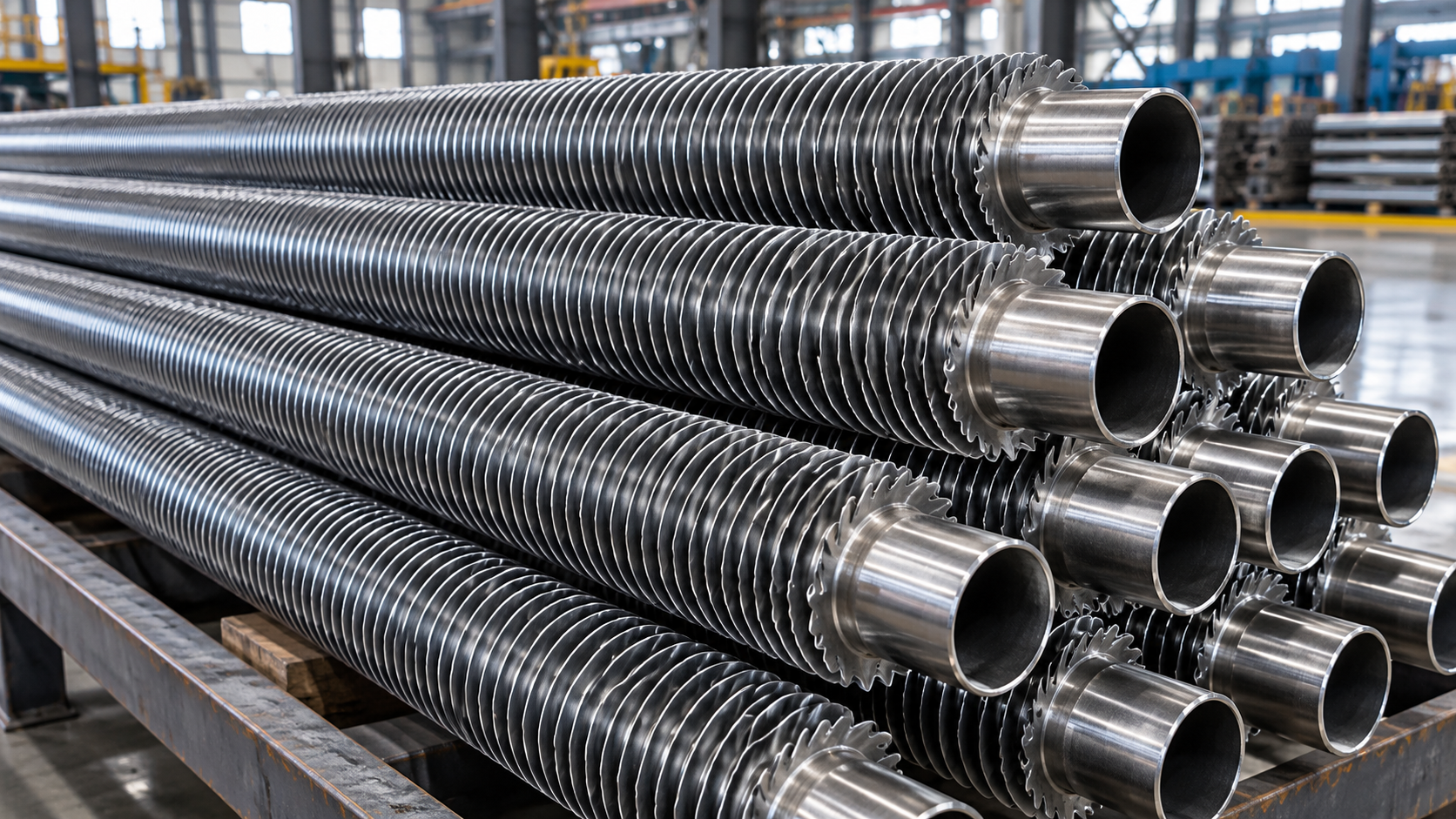
What Is a Crimped Finned Tube?
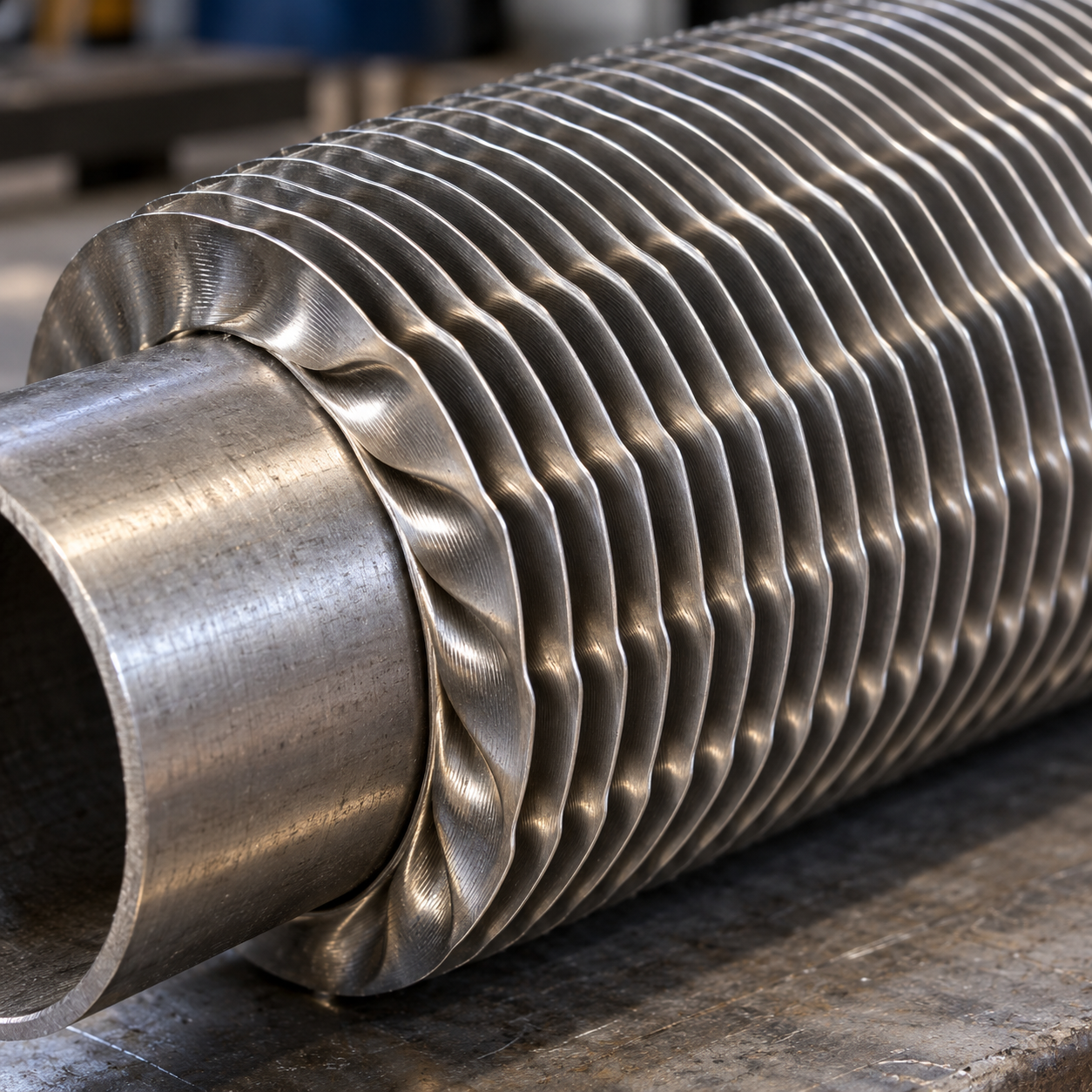
A crimped finned tube is made by winding a flat metal strip on its edge in a continuous helix around a tube. Because the inner edge of the strip has to fit a much smaller circumference than the outer edge, it is crimped – gathered into small, regular folds – as it is wound. The result is a fin with:
- a wavy, crimped root that seats firmly on the tube surface,
- a flat outer fin that provides the extended heat-transfer area, and
- a stiffer profile than a plain wound fin, with extra turbulence at the root.
On its own, the crimped fin is held by winding tension. For higher temperatures, vibration or corrosive air, the fin is permanently bonded to the tube by brazing, soldering or hot-dip galvanizing, which also improves heat transfer at the root.
How Crimped Finned Tubes Are Made
- Tube preparation – the base tube is cut to length, straightened and cleaned.
- Strip feeding – fin strip of the required width and thickness is fed to the finning head.
- Crimping and winding – the head crimps the inner edge and winds the strip edge-on around the rotating tube at a set pitch, under controlled tension.
- End securing – the fin ends are tack-welded, brazed or clamped so the helix cannot unwind.
- Bonding (optional) – furnace brazing, soldering or hot-dip galvanizing locks the fin to the tube.
- Finishing and inspection – bare ends, bends, fin height and pitch checks, and pressure testing.
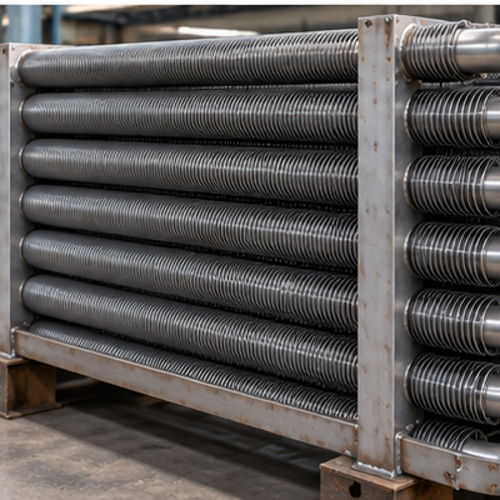
Crimped Finned Tube Specifications
| Parameter | Details |
| Fin Type | Edge-wound helical fin with crimped (ruffled) root |
| Base Tube OD | 12.7 mm to 50.8 mm (1/2″ to 2″) |
| Base Tube Materials | Carbon steel (ASTM A179, A214, A106), stainless steel (304, 316), copper |
| Fin Materials | Copper, aluminium, carbon steel, galvanized steel, stainless steel |
| Fin Height | 6 mm to 19 mm |
| Fin Thickness | 0.3 mm to 1.0 mm |
| Fin Pitch | 2.5 mm to 6.5 mm (approx. 4 to 10 FPI) |
| Bonding | Mechanical (tension), brazed, soldered, hot-dip galvanized |
| Tube Length | Up to approx. 12 m |
| Ends | Bare ends to drawing; plain, threaded or flanged |
| Forms | Straight, U-bent, serpentine coils, headered bundles |
| Certification | EN 10204 3.1 base tube certificate with finning inspection report |
Fin and Tube Material Combinations
| Fin / Tube | Key Benefit | Typical Use |
| Copper fin on copper tube | Highest heat transfer | HVAC coils, oil and water coolers |
| Aluminium fin on copper or steel tube | Light, good conductivity, low cost | Air coolers and heaters at moderate temperature |
| Steel fin on steel tube, hot-dip galvanized | Rugged, corrosion protected, bonded fins | Steam unit heaters, dryers, outdoor coils |
| Steel fin on steel tube, brazed | Strong bond for higher temperatures | Process air heaters, finned heating elements |
| Stainless fin on stainless tube | Corrosion and high-temperature resistance | Food, chemical and hot-gas service |
For heavy-duty boiler and flue-gas service, see our carbon steel finned tubes (HFW welded fins).
Bonding Options and Temperature Limits
The fin bond decides how hot a crimped finned tube can run and how long it keeps its heat-transfer performance:
| Bond Type | How It Works | Approx. Max Operating Temperature* |
| Mechanical (tension wound) | Crimped root gripped by winding tension | approx. 150–200 °C |
| Soldered | Solder fills the fin root | approx. 150 °C (depends on solder) |
| Hot-dip galvanized | Zinc bonds fin to tube and coats both | approx. 200 °C |
| Furnace brazed (steel fin) | Copper braze metallurgically bonds the fin root | approx. 400 °C |
| Stainless fin, mechanical or brazed | Stainless fin and tube | approx. 400–650 °C (by design) |
*Typical practical values; confirm with the thermal design for your service.
Crimped Fins vs Other Finned Tube Types
| Feature | Crimped Fin | L / KL Fin | G (Embedded) Fin | Extruded Fin | HFW Welded Fin |
| Fin bond | Tension, or brazed / soldered / galvanized | Tension (KL knurled) | Locked in groove | Formed from sleeve | Welded |
| Fin materials | Cu, Al, steel, SS | Al, Cu | Al, Cu, steel | Al | Steel, SS |
| Typical max temperature | 150–400 °C (by bond) | 150 / 260 °C | approx. 400 °C | approx. 285 °C | 450 °C+ |
| Relative cost | Low | Low | Medium | High | Medium |
| Best for | Air heaters, dryers, coolers, HVAC | Low-temperature air coolers | Hot air coolers | Corrosive or humid air | Boilers, HRSGs, flue gas |
When to choose crimped finned tubes
- Steam or hot-water air heating and drying at moderate temperatures
- You need copper or steel fins at a low cost per square metre
- Galvanized or brazed bonding is acceptable for corrosion and bond strength
- Compact coils and coolers where moderate pressure drop is fine
For other designs, see G fin tubes, H fin tubes and alloy steel finned tubes.
Choosing Fin Pitch for Crimped Finned Tubes
Fin pitch controls the balance between surface area, air-side pressure drop and fouling. Research on crimped spiral fin-and-tube heat exchangers tested pitches from 2.4 to 6.5 mm – the practical manufacturing range – and found heat transfer was relatively low at 2.4 mm, with about 4.2 mm giving the best overall performance in that design.
| Fin Pitch (mm) | Fins per Inch (approx.) | Typical Use |
| 2.5 – 3.2 | 8 – 10 | Clean air, compact HVAC and cooler coils |
| 4.0 – 4.5 | 6 | General air heaters and coolers – balanced performance |
| 5.0 – 6.5 | 4 – 5 | Dusty or lint-laden air – dryers, textile and grain |
Crimped Finned Tube Sizes and Surface Area
| Base Tube OD | Fin Height | Fin Pitch | Approx. Outside Surface (m² per m) | Approx. Area vs Plain Tube |
| 19.05 mm (3/4″) | 10 mm | 4.2 mm | 0.50 | 8 × |
| 25.4 mm (1″) | 10 mm | 4.2 mm | 0.62 | 8 × |
| 25.4 mm (1″) | 12.7 mm | 4.2 mm | 0.81 | 10 × |
| 25.4 mm (1″) | 12.7 mm | 6.35 mm | 0.56 | 7 × |
| 25.4 mm (1″) | 15.9 mm | 4.2 mm | 1.07 | 14 × |
| 38.1 mm (1-1/2″) | 15.9 mm | 5.08 mm | 1.19 | 10 × |
| 50.8 mm (2″) | 19.05 mm | 6.35 mm | 1.49 | 9 × |
Calculated for flat annular fins of 0.4–0.8 mm thickness; the crimped root adds a little extra area.
What to Specify When Ordering Crimped Finned Tubes
- Base tube material, grade, OD, wall thickness and length
- Fin material and thickness
- Fin height or finned OD
- Fin pitch or fins per inch
- Bonding – mechanical, brazed, soldered or hot-dip galvanized
- Bare-end lengths and end connections (plain, threaded, flanged)
- Bends, coils or headers – with drawing
- Operating temperature, pressure and fluid inside the tube
- Quantity, testing and inspection requirements
Crimped Finned Tube Quality Control & Testing
- Base tube mill test certificate (chemistry, mechanical, hydro)
- Fin height, thickness and pitch measurement
- Fin tightness / pull check on sample lengths
- Braze or galvanizing coverage inspection where specified
- Visual inspection for fin damage, crimp uniformity and straightness
- Hydrostatic or pneumatic pressure test
- Optional third-party inspection
Applications of Crimped Finned Tubes
- Steam and hot-water air heaters and unit heaters
- Industrial dryers – textile, paper, food, grain, timber and pharma
- Oil coolers – lube oil, hydraulic oil and transformer oil
- Generator, motor and compressor air coolers
- Tank heaters and process air heaters
- HVAC heating and cooling coils
- Radiators and convectors
- Finned tubular electric heating elements
- Shell-and-tube and air heat exchangers
Why Buy Crimped Finned Tubes from ASC LLP?
- Since 1984: decades of supplying heat-exchanger, boiler and carbon steel tubes
- Every fin material: copper, aluminium, steel, galvanized and stainless
- Every bond: mechanical, brazed, soldered or hot-dip galvanized
- Made to drawing: fin height, pitch, bare ends, bends and coils
- Complete finned tube range: crimped, L / KL, G, extruded, HFW and H fin from one source
- Export packing that protects fins in transit
Related Products
Frequently Asked Questions – Crimped Finned Tubes
What are crimped finned tubes?
Crimped finned tubes are tubes with a metal fin strip wound edge-on in a spiral around the outside. The inner edge of the strip is crimped (ruffled) so it can bend tightly around the tube without tearing, which creates a wavy fin root that grips the tube. The fins greatly increase the outside surface for air or gas heat transfer.
Why is the fin crimped?
When a flat strip is wound edge-on around a tube, its inner edge must shrink to a much smaller circumference than the outer edge. Crimping gathers the extra material at the root into small folds, so the fin can be wound tightly without splitting. The crimps also stiffen the fin and add turbulence.
What is the maximum temperature of crimped finned tubes?
It depends on the bond and materials. Mechanically wound crimped fins without bonding are normally used up to about 150–200 °C, because the tension grip can relax with heat. Hot-dip galvanized steel fins are typically limited to about 200 °C by the zinc, brazed steel fins can reach about 400 °C, and stainless steel fins can go higher.
What materials are used for crimped fin tubes?
Base tubes are carbon steel, stainless steel or copper. Fins are copper, aluminium, carbon steel, galvanized steel or stainless steel. Copper fins on copper tubes give the highest heat transfer; steel or stainless fins are used for higher temperatures and harsher conditions.
What is the difference between crimped fins and L fins?
Both are wound fins. An L fin has a foot bent at 90° that lies flat on the tube, giving more contact area and some protection of the tube surface. A crimped fin stands edge-on with a ruffled root; it is simpler, works with thicker strip and higher fins, and can be brazed, soldered or galvanized to the tube for a permanent bond.
What is the difference between crimped fins and HFW welded fins?
HFW (high frequency welded) fins are welded to the tube, so the bond is metallurgical and suits boilers and high-temperature flue gas. Crimped fins are wound mechanically, often with brazing, soldering or galvanizing; they are lower in cost and widely used for air heating and cooling at moderate temperatures.
What fin pitch is best for crimped finned tubes?
Crimped fins are commonly made at about 2.5–6.5 mm pitch (4–10 fins per inch). Research on crimped spiral fin heat exchangers found about 4.2 mm to be an optimum balance of heat transfer and pressure drop in the tested design. Wider pitch is better for dusty or dirty air.
Are crimped fin tubes galvanized?
They can be. Carbon steel crimped fin tubes are often hot-dip galvanized after finning. The zinc bonds the fins to the tube, improves contact for heat transfer and protects both from corrosion in steam heaters and outdoor coils.
Where are crimped finned tubes used?
They are used in steam and hot-water air heaters, unit heaters, industrial dryers (textile, paper, food, grain, timber), oil and transformer coolers, generator and compressor air coolers, tank and process heaters, HVAC coils, radiators, and finned electric heating elements.
What details are needed to quote crimped finned tubes?
Base tube material, OD, wall thickness and length; fin material, fin height (or finned OD), fin thickness and pitch or FPI; bonding (mechanical, brazed, soldered or galvanized); bare-end lengths; bends; quantity; and the operating temperature and medium.
