
Brass Finned Tubes – Admiralty & Aluminium Brass Fin Tube Manufacturer, Supplier & Exporter
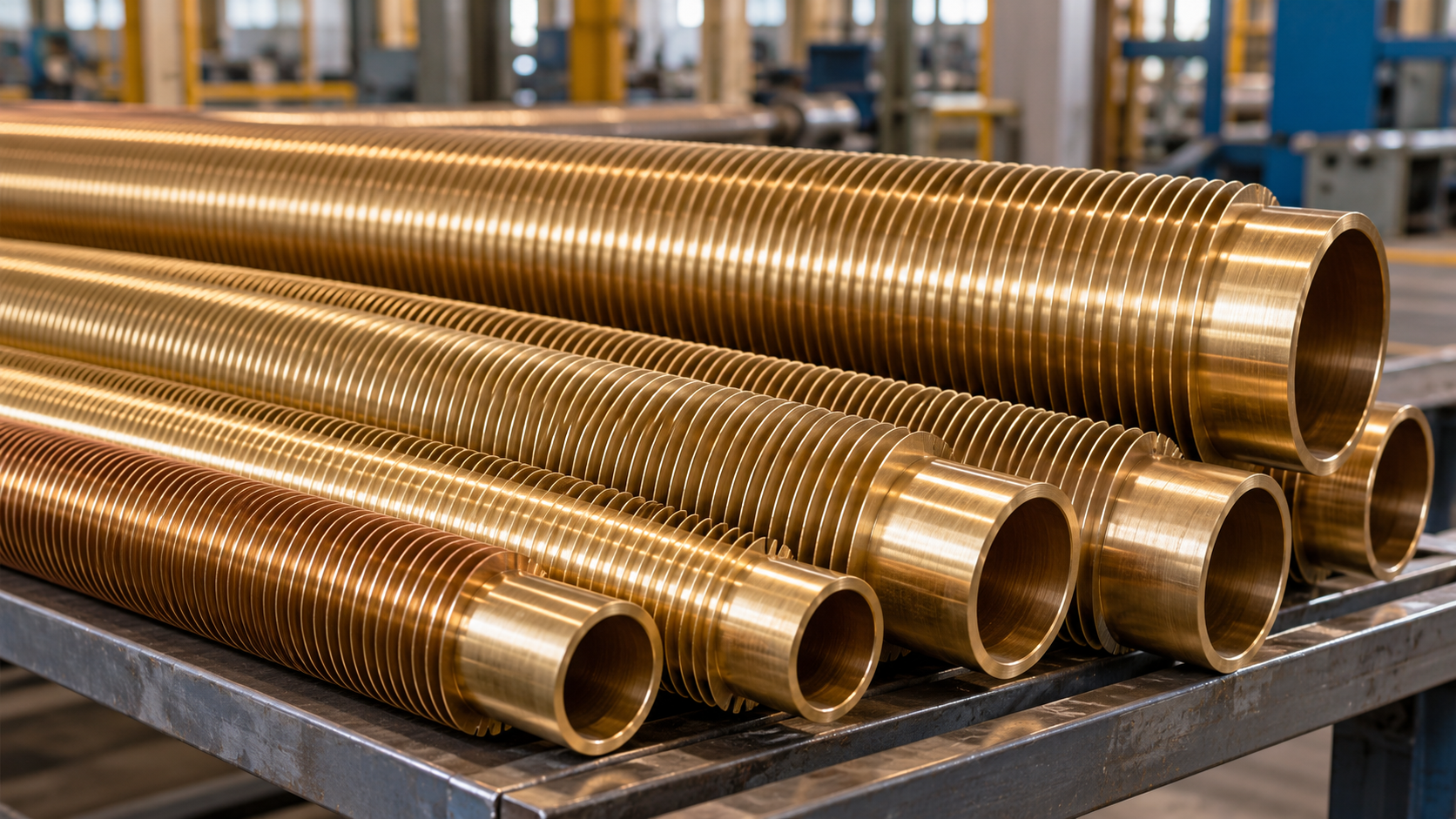
Brass finned tubes (also called brass fin tubes or brass low-fin tubes) are copper-zinc alloy heat-exchanger tubes with integral or wound fins that multiply their outside surface. Made in inhibited Admiralty brass (C44300) and aluminium brass (C68700), they combine good thermal conductivity, strength and resistance to cooling-water corrosion at a lower cost than copper-nickel.
ASC LLP, Mumbai, supplies brass integral low-fin tubes to ASTM B359 and EN 12452, plus brass tubes with copper or aluminium wound fins, for steam condensers, oil coolers, feedwater heaters and marine coolers. They are part of our complete range of finned tubes and copper and copper alloys.
Quick specification: tube OD 9.5–38.1 mm · fin density 11–40 FPI · fin height approx. 1–1.5 mm (low fin) · lengths up to approx. 30 m · C44300, C68700, C23000, C28000 · ASTM B359, EN 12452.
What Are Brass Finned Tubes?
Brass is an alloy of copper and zinc. For heat exchangers, special inhibited brasses are used – alloys with a small addition of arsenic that protects them from dezincification in water. Brass finned tubes are made in two main ways:
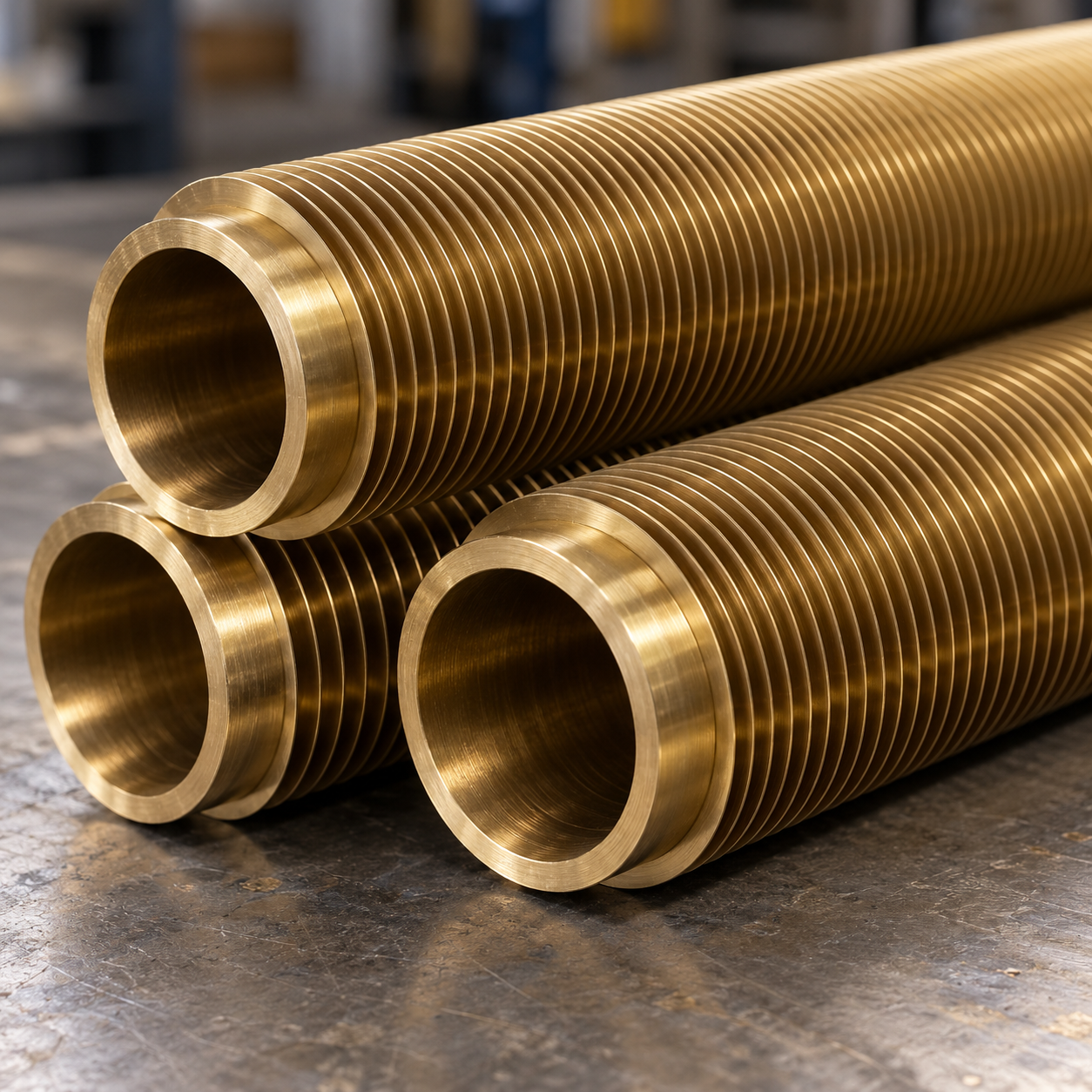
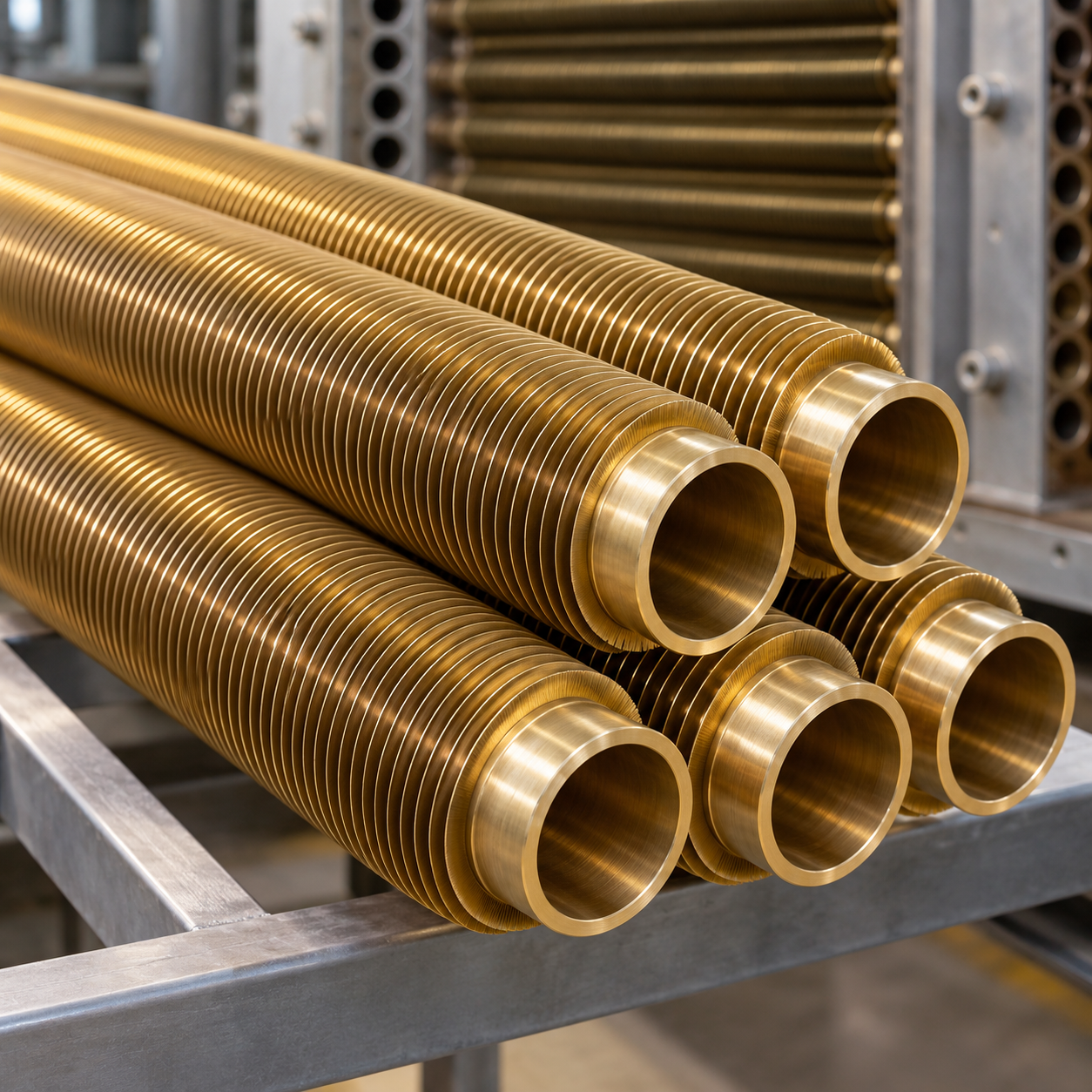
- Integral (rolled) low-fin brass tubes – fins are cold-rolled out of the tube wall, so there is no joint between fin and tube. Plain, annealed ends are left for expanding into tube sheets. This is by far the most common type.
- Brass tubes with wound fins – copper or aluminium fin strip wound onto a brass tube as crimped or L / KL fins, for air coolers and heaters.
The integral fins increase the outside area by about 2.5 to 3.5 times, which is ideal for condensing steam or refrigerant on the shell side while cooling water flows inside the tubes.
Brass Alloys for Finned Tubes
| Alloy | UNS / EN | Nominal Composition | Key Property | Typical Use |
| Admiralty brass (inhibited) | C44300 / CW706R (CuZn28Sn1As) | Cu 70–73%, Sn approx. 1%, As 0.02–0.06%, Zn balance | Good corrosion resistance in fresh and brackish water | Steam condensers, oil coolers, feedwater heaters |
| Aluminium brass (arsenical) | C68700 / CW702R (CuZn20Al2As) | Cu 76–79%, Al 1.8–2.5%, As 0.02–0.1%, Zn balance | Best erosion / impingement resistance among brasses | Seawater and high-velocity cooling water |
| Red brass | C23000 (CuZn15) | Cu approx. 85%, Zn balance | Higher conductivity, good dezincification resistance | Low-fin tubes for moderate duty |
| Muntz metal | C28000 (CuZn40) | Cu approx. 60%, Zn balance | Strong, economical | Low-fin tubes for oil coolers and non-corrosive service |
For any water-cooled service, specify an inhibited grade (C44300 or C68700).
Brass vs Copper vs Copper-Nickel vs Stainless Finned Tubes
| Property | Admiralty Brass C44300 | Aluminium Brass C68700 | Copper C12200 | 90/10 Cu-Ni C70600 | Stainless 316 |
| Thermal conductivity (W/m·K, approx.) | 110 | 100 | 340 | 45–50 | 15 |
| Dezincification risk | Low (inhibited) | Low (inhibited) | None | None | None |
| Seawater resistance | Fair | Good (clean seawater) | Poor | Excellent | Fair (pitting risk) |
| Erosion resistance | Moderate | Good | Low | Good | High |
| Relative cost | Low | Low – medium | Medium | High | High |
See our copper finned tubes and stainless steel finned tubes for those alloys.
Dezincification – Why Inhibited Brass Matters
Dezincification is the most important failure mode of brass in water. Zinc leaches selectively out of the alloy, leaving a brittle, porous copper layer – either evenly or as deep “plugs” – until the tube leaks.
- Uninhibited high-zinc brasses (such as yellow brass C27000 or Muntz metal) are highly susceptible in water service.
- Arsenic-inhibited alloys – Admiralty brass C44300 and aluminium brass C68700 – are highly resistant and are the standard choice for heat-exchanger tubes.
- Red brass C23000, with only about 15% zinc, is also naturally resistant.
A published failure analysis of yellow brass compressor intercooler tubes that leaked after years of chlorinated well-water service traced the cause to dezincification of an uninhibited, high-zinc brass, and recommended arsenical aluminium brass C68700 – or inhibited Admiralty C44300 – as the replacement. Specifying the right inhibited alloy from the start avoids this problem.
Brass Finned Tube Specifications
| Parameter | Details |
| Alloys | C44300 Admiralty brass, C68700 aluminium brass, C23000 red brass, C28000 Muntz metal |
| Standards | ASTM B359 / ASME SB359, EN 12452; plain tubes to ASTM B111 / SB111, EN 12451 |
| Fin Types | Integral low fin; wound copper or aluminium fins on request |
| Tube OD | 9.52 mm to 38.10 mm |
| Fin Density | 11, 16, 19, 23, 26, 30, 40 FPI (19 and 26 FPI most common) |
| Fin Height | approx. 1.0 – 1.5 mm (low fin) |
| Wall Under Fin | From approx. 0.6 mm, to design |
| Plain Ends | Unfinned, annealed ends at full tube OD for expansion |
| Length | Up to approx. 30 m |
| Forms | Straight, U-bent; inner-grooved on request |
| Testing | Eddy current, hydrostatic or pneumatic, expansion, flattening, mercurous nitrate / ammonia vapour stress test where specified |
| Certification | EN 10204 3.1 / 3.2 |
Typical Brass Low-Fin Tube Dimensions
| Finned OD | Fin Density | Typical Use |
| 15.88 mm (5/8″) | 26 – 30 FPI | Refrigerant condensers, small oil coolers |
| 19.05 mm (3/4″) | 19 – 26 FPI | Steam condensers, oil and water coolers |
| 25.4 mm (1″) | 16 – 19 FPI | Large condensers and feedwater heaters |
| 9.52 – 12.7 mm (3/8″ – 1/2″) | 26 – 40 FPI | Compact exchangers and evaporators |
Typical combinations; root diameter, wall under fin and plain-end dimensions are confirmed for each order.
Water Velocity and Operating Guidelines
- Keep tube-side velocity moderate – Admiralty brass has the lowest erosion resistance of the inhibited alloys; use aluminium brass where velocity or turbulence is higher.
- Avoid sulfide-polluted water – sulfides break down the protective film on brass and copper alloys.
- Keep water clean – debris lodged in tubes causes local turbulence and impingement attack.
- Avoid ammonia – ammonia and ammonium compounds can cause stress-corrosion (season) cracking of brass.
- Isolate dissimilar metals – use compatible tube sheets and avoid galvanic couples with less noble metals.
What to Specify When Ordering Brass Finned Tubes
- Alloy (UNS / EN) and standard – e.g. ASTM B359 C68700
- Finned OD, fin density (FPI) and fin height
- Root diameter and minimum wall under the fins
- Plain-end OD, wall and lengths at each end
- Overall length, U-bend radii if any
- Cooling water type and velocity; shell-side fluid
- Testing – eddy current, hydro, stress-corrosion test – and certification
- Quantity and delivery schedule
Brass Finned Tube Quality Control & Testing
- Chemical analysis including arsenic content for inhibited alloys
- Eddy current testing of the plain tube
- Fin density, fin height, root diameter and wall-under-fin checks
- Grain size and temper check of annealed plain ends
- Expansion and flattening tests
- Hydrostatic or pneumatic pressure test
- Residual-stress (mercurous nitrate or ammonia vapour) test where specified
- Visual and dimensional inspection; third-party inspection on request
Applications of Brass Finned Tubes
- Steam surface condensers in power and process plants
- Feedwater heaters
- Lube-oil, hydraulic and transformer-oil coolers
- Compressor intercoolers and aftercoolers
- Marine coolers using clean seawater (aluminium brass) – see also ship boiler tubes
- Refrigeration condensers (non-ammonia refrigerants)
- Generator and motor air coolers
- General shell-and-tube heat exchangers
Why Buy Brass Finned Tubes from ASC LLP?
- Since 1984: decades of supplying copper-alloy and heat-exchanger tubes
- Inhibited alloys: C44300 and C68700 with arsenic content verified on certificates
- Standard and custom fin densities from 11 to 40 FPI
- Standards: ASTM B359, EN 12452, B111 and EN 12451 with 3.1 / 3.2 certificates
- Made to drawing: plain ends, U-bends and long lengths
- Export packing that protects fins and plain ends
Related Products
Frequently Asked Questions – Brass Finned Tubes
What are brass finned tubes?
Brass finned tubes are copper-zinc alloy tubes with fins on the outside – usually integral low fins rolled from the tube wall, or copper or aluminium fins wound onto a brass tube. They are used in condensers, oil coolers, feedwater heaters and marine coolers where brass offers good conductivity, corrosion resistance and lower cost than copper-nickel.
Which brass alloys are used for finned tubes?
The main alloys are inhibited Admiralty brass C44300 (CuZn28Sn1As, CW706R) and arsenical aluminium brass C68700 (CuZn20Al2As, CW702R). Red brass C23000 and Muntz metal C28000 are also used in some low-fin tubes. For water service, always choose an inhibited (arsenical) grade.
What is dezincification and why does it matter?
Dezincification is selective corrosion in which zinc leaches out of brass in water, leaving a weak, porous copper layer that eventually leaks. Uninhibited high-zinc brasses are very susceptible. Inhibited alloys with a small arsenic addition, such as C44300 and C68700, are highly resistant, which is why they are specified for heat-exchanger tubes.
What is the difference between Admiralty brass and aluminium brass tubes?
Admiralty brass (C44300) contains about 1% tin and is used for fresh and brackish cooling water at moderate velocities. Aluminium brass (C68700) contains about 2% aluminium, which forms a tougher protective film, giving better resistance to impingement and erosion – so it is preferred for clean seawater and higher water velocities.
Which standards cover brass finned tubes?
ASTM B359 / ASME SB359 covers copper and copper-alloy seamless condenser and heat-exchanger tubes with integral fins, including C23000, C44300 and C68700. EN 12452 covers rolled, finned, seamless copper-alloy tubes. Plain brass condenser tubes are made to ASTM B111 / ASME SB111 and EN 12451.
What are typical brass low-fin tube sizes?
Brass integral low-fin tubes are commonly made from about 9.5 to 38.1 mm OD, with fin densities from 11 up to 40 fins per inch (19 and 26 FPI are most common), fin heights of about 1–1.5 mm and lengths up to about 30 m. Plain ends are left unfinned for tube-sheet expansion.
Is brass better than copper for finned tubes?
Copper conducts heat about three times better than Admiralty brass, but brass is stronger, harder and – in inhibited grades – more resistant to erosion and some cooling waters. Brass is often chosen for condensers and oil coolers for its balance of cost, strength and corrosion resistance.
Can brass finned tubes be used with ammonia?
No. Ammonia and ammonium compounds can cause stress-corrosion cracking (season cracking) of brass. Use steel or stainless steel tubes for ammonia refrigerant or ammonia-bearing process streams.
Where are brass finned tubes used?
They are used in steam surface condensers, feedwater heaters, lube-oil and transformer-oil coolers, compressor intercoolers and aftercoolers, marine coolers using clean seawater, refrigeration condensers (non-ammonia), and general shell-and-tube heat exchangers.
What details are needed to quote brass finned tubes?
Brass alloy (UNS / EN) and standard, finned OD, root diameter and wall under the fins, fin density and height, plain-end OD, wall and lengths, overall length, U-bends, the cooling water or fluid and velocity, quantity, and testing or certification requirements.
