
Stainless Steel Finned Tubes – SS Fin Tube Manufacturer, Supplier & Exporter
Stainless steel finned tubes (also called SS finned tubes or stainless fin tubes) combine the large heat-transfer surface of a finned tube with the corrosion and oxidation resistance of stainless steel. They are the right choice where carbon steel finned tubes fail – condensing economizers, acidic or chloride-bearing flue gas, hygienic process air, and high-temperature gas.
ASC LLP, Mumbai, supplies stainless steel finned tubes in 304 / 304L, 316 / 316L, 321, 347, 409, 439, duplex 2205 / 2507 and 904L, with HFW solid or serrated, laser-welded, crimped, integral low-fin, extruded, G-type and L / KL fins. They are part of our complete range of finned tubes and stainless steel products.
Quick specification: base tube 12.7–168.3 mm OD · fin height 6–38 mm · 2–11 FPI · stainless or aluminium fins · lengths up to approx. 20 m · EN 10204 3.1 / 3.2.
What Are Stainless Steel Finned Tubes?
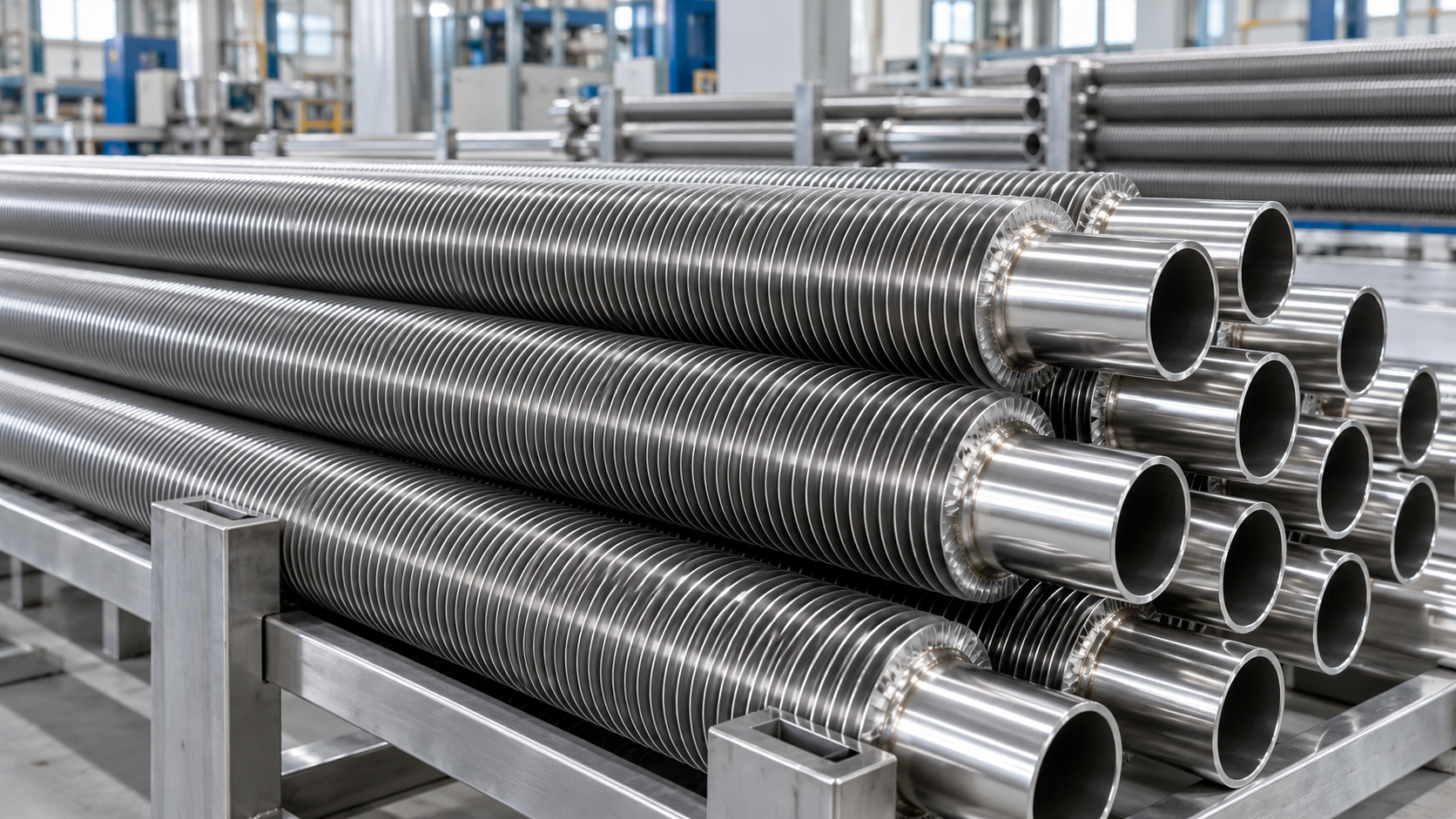
A finned tube is a base tube with fins on its outside surface, multiplying the gas- or air-side heat-transfer area. In a stainless steel finned tube, stainless steel is used where it matters most:
- Stainless base tube with stainless fins – for condensing, corrosive or high-temperature gas, where every wetted or hot surface must resist attack.
- Stainless base tube with aluminium fins – for dry air coolers where the process fluid inside the tube is corrosive or must stay clean, while aluminium fins keep cost down.
- Carbon or alloy steel tube with stainless fins – where only the fins run too hot for carbon steel, as in some alloy steel finned tubes.
Choosing the right combination is the key to long service life – the sections below explain how.
Stainless Steel Grades for Finned Tubes
| Grade | Type | Key Property | Typical Finned Tube Use |
| 304 / 304L | Austenitic | General corrosion resistance, good weldability | Air coolers, food and pharma air heaters, HVAC |
| 316 / 316L | Austenitic + Mo | Better pitting resistance in chlorides and acids | Condensing economizers (gas firing), chemical and marine air |
| 321 / 347 | Stabilized austenitic | Strength and resistance to sensitization at high temperature | Hot gas heat recovery, exhaust gas coolers |
| 309 / 310 | High-Cr-Ni austenitic | Oxidation resistance at very high temperature | Fins and tubes in furnace and incinerator gas |
| 409 / 439 | Ferritic | Low cost, oxidation and exhaust-gas resistance | Fins on HRSG superheaters; exhaust and economizer tubes |
| 410S | Ferritic (13 Cr) | Oxidation resistance for hot fins | Fins on high-temperature alloy tubes |
| Duplex 2205 / 2507 | Austenitic-ferritic | High strength, chloride stress-corrosion resistance | Chloride-bearing condensate, seawater and coastal service |
| 904L | Super austenitic | Resistance to sulfuric acid | Oil, coal and biomass condensing economizers |
Fin Types Available on Stainless Steel Tubes
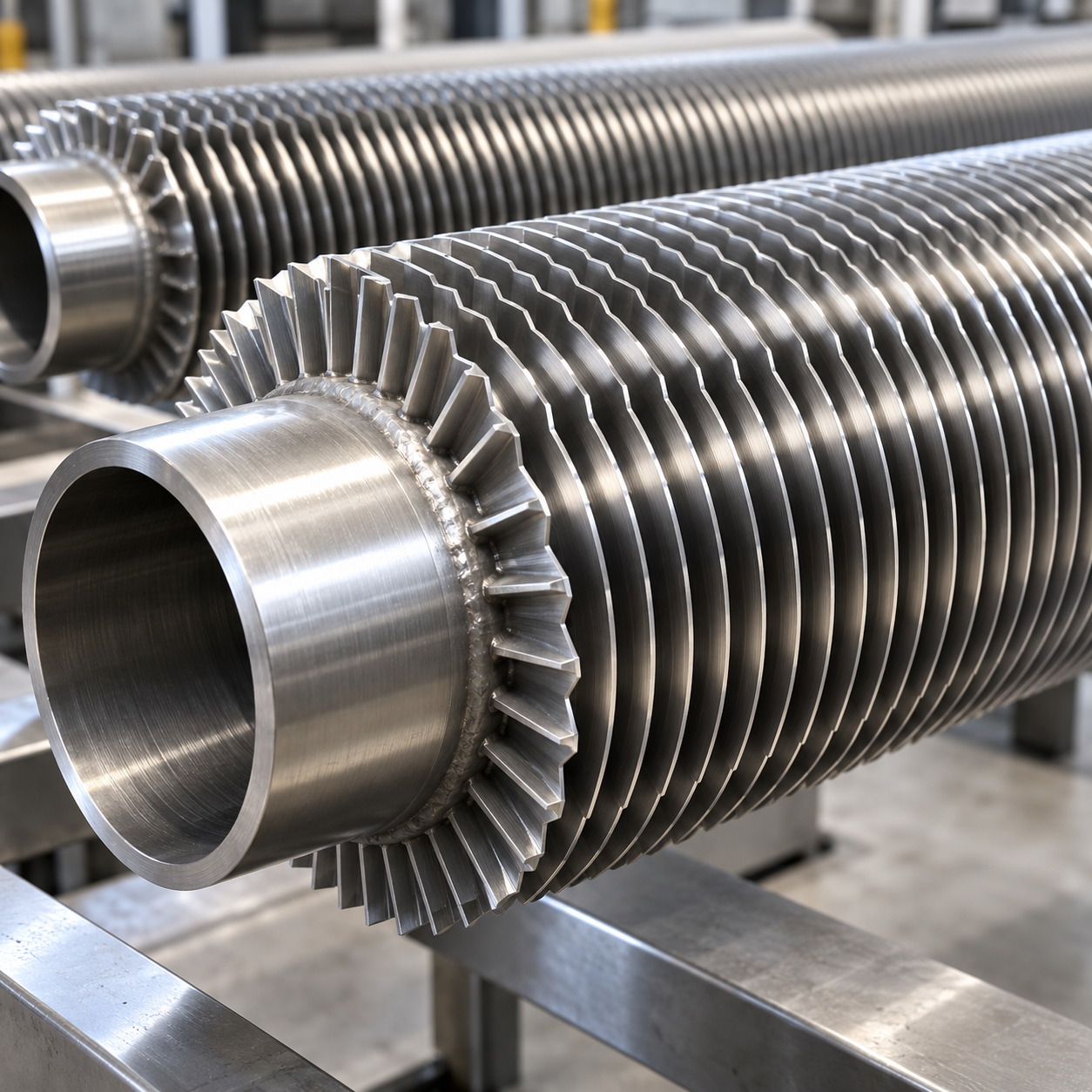
HFW Solid & Serrated Stainless Fins
- 409, 410S, 304 or 316 fin strip high-frequency welded to the tube
- High temperature and corrosive flue gas – HRSGs, waste heat boilers, condensing economizers
Laser-Welded Stainless Fins
- Thin stainless fins welded with a narrow, precise laser weld
- Compact, high-efficiency coils with full metallurgical bond
Crimped Stainless Fins
- Edge-wound stainless strip with a crimped root – economical for air heaters and dryers
Integral Low-Fin Stainless Tubes (ASTM A1012)
- Fins rolled out of the tube wall itself – no separate fin material, no bond to fail
- Condensers, evaporators, chillers and MSR tubes (304, 316, 439, duplex)
Extruded, G-Type and L / KL Aluminium Fins on Stainless Tubes
- Aluminium fins on 304 / 316 tubes for dry air coolers with corrosive process fluid inside
- Not for condensing or wet corrosive air – use stainless fins there
Stainless Steel Finned Tube Specifications
| Parameter | Details |
| Base Tube Grades | 304 / 304L, 316 / 316L, 321, 347, 309, 310, 409, 439, 2205, 2507, 904L |
| Base Tube Standards | ASTM A213, A249, A269, A268, A789, A1012; EN 10216-5, EN 10217-7 |
| Base Tube OD | 12.7 mm to 168.3 mm |
| Base Tube Wall | 1.0 mm to 8 mm |
| Fin Types | HFW solid / serrated, laser welded, crimped, integral low-fin, extruded, G-type, L / KL |
| Fin Materials | 409, 410S, 304, 316, 309, 310 stainless; aluminium on request |
| Fin Height | 6 mm to 38 mm (integral low-fin approx. 1–1.5 mm) |
| Fin Thickness | 0.3 mm to 2 mm |
| Fin Pitch | 2 to 11 FPI; integral low-fin 19–40 FPI |
| Tube Length | Up to approx. 20 m |
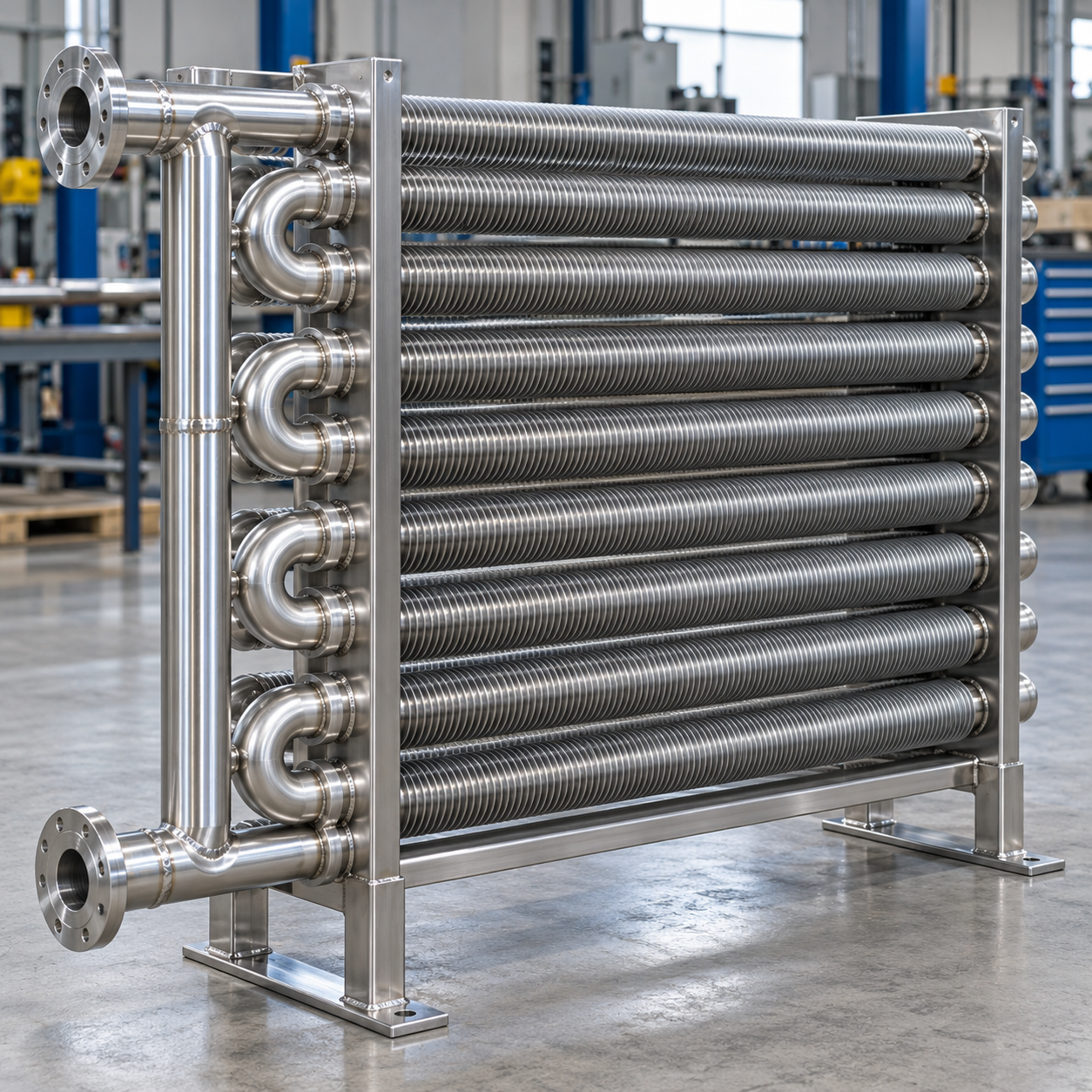
| Forms | Straight with bare ends, U-bent, serpentine coils, headered bundles |
| Certification | EN 10204 3.1 / 3.2 with finning inspection report |
Which Stainless Steel for Which Service?
Use this guide to shortlist the grade and fin combination for your duty:
| Service Condition | Recommended Base Tube | Recommended Fin |
| Dry air cooler, clean or corrosive process fluid inside | 304 / 316 | Aluminium (extruded, G or KL) |
| Natural-gas condensing economizer | 316L | 316L or 304 stainless (HFW or laser welded) |
| Oil, coal or biomass condensing heat recovery | 904L, duplex 2205 or 2507 | Matching stainless fins |
| Coastal, marine or chloride-bearing wet air | Duplex 2205 / 316L | Stainless fins |
| Hot gas 450–650 °C (fins above carbon steel limit) | Alloy or 321 / 347 | 409 or 410S fins |
| Very hot gas (furnaces, incinerators) | 321 / 347 / 309 / 310 | 309 / 310 fins |
| Food, pharma and clean-room air heating | 304 / 316L | Stainless crimped or laser-welded fins |
| Condensers, evaporators, chillers | 304, 316, 439, duplex | Integral low-fin (ASTM A1012) |
For dusty flue gas in boilers, also consider stainless H fin tubes.
Stainless Steel Fin Temperature Limits
| Fin Material | Approx. Max Fin Temperature in Air* |
| Carbon steel (for comparison) | approx. 450 °C |
| 409 stainless | approx. 600 °C |
| 410S stainless | approx. 650 °C |
| 304 / 316 stainless | approx. 700–800 °C |
| 309 / 310 stainless | approx. 900–1,000 °C |
| Aluminium (on stainless tube) | approx. 285–400 °C depending on fin type |
*Typical oxidation-based guide values for fin tips; base-tube temperature is limited by the pressure design code for the tube grade.
Stainless Steel vs Carbon Steel vs Alloy Steel Finned Tubes
| Feature | Stainless Steel | Carbon Steel | Alloy Steel (T11 / T22 / T91) |
| Corrosion resistance | High – resists condensate, acids, chlorides (by grade) | Low – must stay above acid dew point | Low to medium |
| Max fin temperature | 600–1,000 °C (by grade) | approx. 450 °C | Fins usually stainless above 450 °C |
| Hygiene / cleanliness | Excellent | Poor (rust) | Poor |
| Relative cost | High | Lowest | Medium |
| Typical use | Condensing economizers, corrosive and hygienic service | Economizers, air coolers above dew point | HRSG superheaters and reheaters |
See our carbon steel finned tubes and alloy steel finned tubes for those services.
Avoiding Common Problems with Stainless Steel Finned Tubes
- Galvanic corrosion – aluminium fins on stainless tubes corrode quickly if condensate forms; use stainless fins in wet service.
- Chloride stress corrosion cracking – 304 and 316 can crack when wet with chlorides above about 60 °C; choose duplex 2205 / 2507 instead.
- Sensitization – use low-carbon (304L, 316L) or stabilized (321, 347) grades where welds see corrosive condensate.
- Fin oxidation – match fin grade to fin tip temperature, not just gas temperature.
- Fouling – use wider fin pitch for dusty or sticky gas, and plan for soot blowing or washing.
What to Specify When Ordering Stainless Steel Finned Tubes
- Base tube grade and standard (e.g. ASTM A213 TP316L)
- OD, wall thickness and tube length
- Fin type and fin material / grade
- Fin height, thickness and pitch (FPI)
- Bare-end lengths, bends, coils or headers
- Gas composition, temperatures and whether condensing occurs
- Fluid, pressure and temperature inside the tube
- Quantity, testing, PMI and inspection requirements
Stainless Steel Finned Tube Quality Control & Testing
- Base tube mill test certificate (chemistry, mechanical, hydro / eddy current)
- PMI of base tubes and fin strip
- Fin weld / bond strength test (pull or peel)
- Fin height, thickness and pitch measurement
- Visual inspection of welds, fin seating and surface condition
- Pickling and passivation of welds where specified
- Hydrostatic test of finished tubes or coils
- Optional third-party inspection and EN 10204 3.2 certification
Applications of Stainless Steel Finned Tubes
- Condensing economizers and low-temperature flue gas heat recovery
- Waste heat recovery from incinerators, furnaces and engine exhaust
- HRSG superheater and reheater fins (409 / 410S on alloy tubes)
- Air-cooled heat exchangers with corrosive process fluids
- Food, dairy, pharmaceutical and clean-room air heaters
- Chemical, fertilizer and petrochemical process coolers
- Marine and offshore air and gas coolers
- Condensers, evaporators and chillers (integral low-fin)
- Industrial dryers, heat exchangers and HVAC coils
Why Buy Stainless Steel Finned Tubes from ASC LLP?
- Since 1984: decades of supplying stainless, boiler and heat-exchanger tubes
- All key grades: austenitic, ferritic, duplex and super austenitic
- Every fin type: HFW, laser welded, crimped, integral, extruded, G and KL
- Grade selection support for condensing and corrosive service
- PMI-verified material with EN 10204 3.1 / 3.2 certificates
- Made to drawing with export packing that protects fins
Related Products
Frequently Asked Questions – Stainless Steel Finned Tubes
What are stainless steel finned tubes?
Stainless steel finned tubes are heat-exchanger tubes with a stainless steel base tube, stainless steel fins, or both. They combine the large outside surface of a finned tube with the corrosion and oxidation resistance of stainless steel, for condensing, corrosive, hygienic or high-temperature service where carbon steel finned tubes would fail.
Which stainless steel grades are used for finned tubes?
Base tubes are most often 304 / 304L and 316 / 316L, with 321 and 347 for high temperatures, ferritic 409 and 439 for exhaust and economizer service, duplex 2205 and 2507 for chloride environments, and 904L for severe acid condensate. Fins are commonly 409, 410S, 304 or 316 stainless, or aluminium on stainless tubes in dry air.
When should I use stainless steel finned tubes instead of carbon steel?
Use stainless steel when flue gas or air condenses on the tubes (condensing economizers, low-temperature heat recovery), when the gas contains acids or chlorides, when the process needs hygienic or contamination-free surfaces, or when fin temperatures exceed the oxidation limit of carbon steel fins (about 450 °C).
Can aluminium fins be used on stainless steel tubes?
Yes – extruded, embedded (G) and L / KL aluminium fins on 304 or 316 tubes are common in dry air coolers and give high heat transfer at low cost. They are not suitable where condensate or wet corrosive conditions occur, because aluminium can corrode galvanically against stainless steel; use stainless fins there.
What is the best stainless steel for condensing economizers?
316L is the usual minimum for condensing economizers on natural gas. For oil, coal, biomass or waste flue gas with sulfuric and hydrochloric acid condensate, higher alloys such as duplex 2205, 904L or super duplex 2507 are used, with matching stainless fins.
What is the maximum temperature for stainless steel finned tubes?
It depends on the fin grade. As a guide, 409 fins are used to about 600 °C, 410S to about 650 °C, 304 / 316 to about 700–800 °C, and 309 / 310 to about 900–1,000 °C in air. Base-tube temperature is set by the pressure design code for the tube grade.
Do 304 and 316 finned tubes suffer from chloride stress corrosion cracking?
They can. Austenitic grades such as 304 and 316 are susceptible to chloride stress corrosion cracking when stressed, wet with chlorides and above about 60 °C. Duplex stainless steels such as 2205 and 2507 have much better resistance and are preferred in those conditions.
How are stainless steel fins attached to the tube?
Stainless fins are attached by high frequency (HFW) welding as solid or serrated spiral fins, by laser welding for thin fins, by tension winding as crimped fins, or by rolling integral low fins out of the tube wall itself (ASTM A1012). Aluminium fins on stainless tubes are extruded, embedded or wrapped.
Which standards cover stainless steel finned tube base tubes?
Common standards are ASTM A213 (seamless), A249 (welded heat-exchanger tubes) and A269 (general service) for austenitic grades, A268 for ferritic grades such as 409 and 439, A789 for duplex, EN 10216-5 and EN 10217-7, and ASTM A1012 for tubes with integral fins.
What details are needed to quote stainless steel finned tubes?
Base tube grade and standard, OD, wall thickness and length; fin type, fin material and grade, fin height, thickness and pitch (FPI); bare-end lengths; bends or coils; operating temperature, gas composition and whether condensing occurs; quantity and inspection requirements.
