
Copper Finned Tubes – Copper & Copper-Nickel Fin Tube Manufacturer, Supplier & Exporter
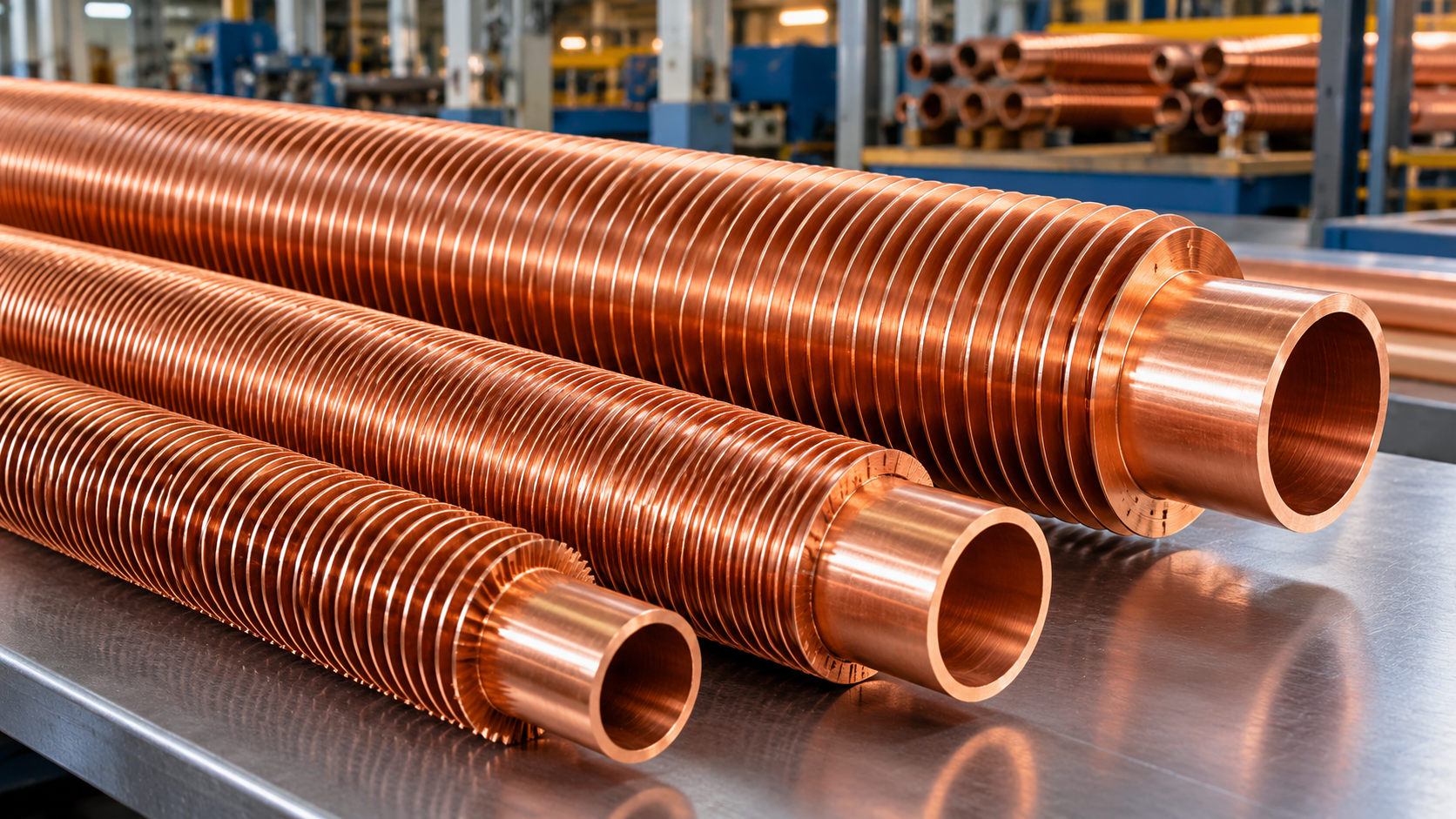
Copper finned tubes (also called copper fin tubes or Cu finned tubes) use copper – the most heat-conductive technical metal – for the fins, the tube or both. That makes them the most efficient choice for compact HVAC and refrigeration coils, oil and gas coolers, condensers, evaporators and seawater-cooled heat exchangers.
ASC LLP, Mumbai, supplies integral low-fin, medium-high-fin and high-fin copper and copper-nickel tubes, as well as copper L / LL / KL, crimped and embedded-fin tubes, in C12200, C10200, 90/10 and 70/30 copper-nickel and brass alloys to ASTM B359 and EN 12452. They are part of our complete range of finned tubes and copper and copper alloys.
Quick specification: tube OD 9.5–50.8 mm · integral fin height 1–10 mm · wrapped fin height up to 16 mm · 7–40 FPI · Cu, Cu-Ni and brass alloys · ASTM B359, EN 12452.
What Are Copper Finned Tubes?
A finned tube adds fins to the outside of a tube to multiply the heat-transfer surface. Copper finned tubes come in three main constructions:
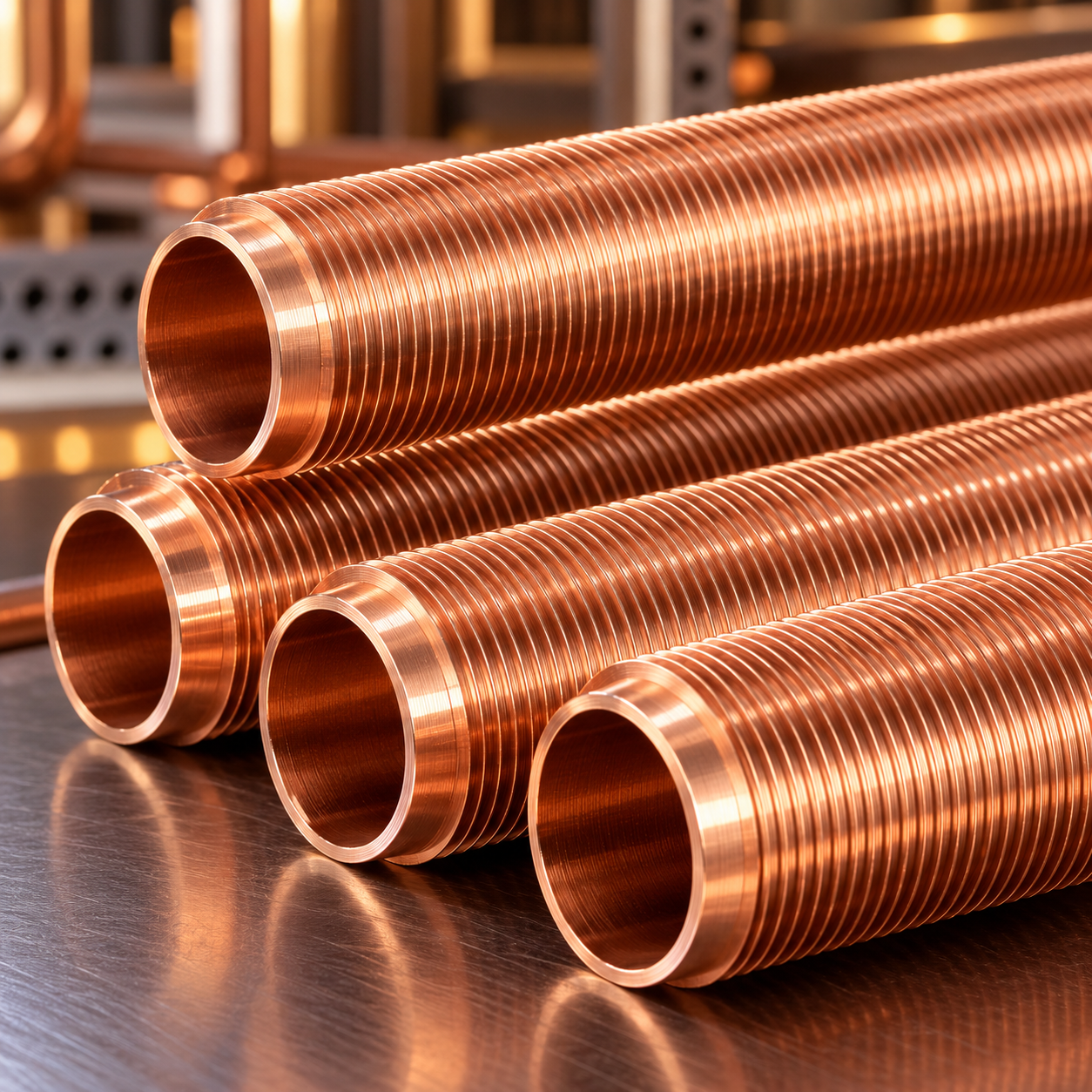
- Integral (rolled) fin tubes – the fins are cold-rolled out of the copper or copper-nickel tube wall itself, so there is no fin-to-tube joint at all. Plain, soft ends are left for tube-sheet expansion.
- Copper fins on a copper tube – copper strip wound as L, LL, KL or crimped fins, often soldered for a permanent, high-conductivity bond.
- Copper fins on a steel tube – copper strip embedded (G-type) or wound on carbon or stainless steel tubes, combining copper’s conductivity with steel’s pressure strength.
The right construction depends on whether the outside medium is a condensing refrigerant, air, gas or water, and on temperature, pressure and corrosion conditions.
Why Choose Copper for Finned Tubes?
Copper’s main advantage is thermal conductivity. Higher conductivity means higher fin efficiency – more of each fin’s area actually transfers heat – so a copper coil can be smaller for the same duty:
| Material | Approx. Thermal Conductivity (W/m·K, 20 °C) | Relative to Carbon Steel |
| Copper (C10200 / C12200) | 340 – 390 | approx. 7 – 8 × |
| Aluminium (1050 / 1100) | 220 – 230 | approx. 4.5 × |
| Admiralty brass (C44300) | approx. 110 | approx. 2 × |
| 90/10 copper-nickel (C70600) | approx. 45 – 50 | approx. 1 × |
| Carbon steel | approx. 50 | 1 × |
| 70/30 copper-nickel (C71500) | approx. 30 | approx. 0.6 × |
| Stainless steel 304 / 316 | approx. 15 | approx. 0.3 × |
- Corrosion resistance in water, many process fluids and – for copper-nickel – seawater.
- Easy to form, bend, braze and solder for compact coils and return bends.
- Natural resistance to biofouling, especially copper-nickel in seawater.
- Fully recyclable with high scrap value.
Types of Copper Finned Tubes We Supply
Integral Low-Fin Copper Tubes
- Short fins (about 1–1.5 mm) at 19–40 FPI, rolled from the tube wall
- Refrigerant condensers and evaporators, shell-and-tube heat exchangers (ASTM B359, EN 12452)
Medium-High-Fin Copper Tubes
- Fins about 3–5 mm high at around 11 FPI
- Oil coolers, gas coolers, hot-water tanks and high-pressure refrigerant (e.g. CO₂) coils
High-Fin Copper & Copper-Nickel Tubes
- Fins up to about 10 mm high, rolled from Cu or 90/10 Cu-Ni tubes
- Flue gas condensers, air coolers, engine charge-air and mine coolers
Copper L, LL & KL Wrapped Fin Tubes
- Copper fin strip tension-wound with a footed root; LL overlapped, KL knurled
- Air heaters and coolers at low to moderate temperatures
Crimped Copper Fin Tubes
- Edge-wound crimped copper fins, often soldered to copper tubes
- Steam and hot-water air heaters, radiators and dryers
Embedded G-Type Copper Fin Tubes
- Copper fin locked into a groove in a steel or copper tube
- Higher-temperature air coolers where copper conductivity is wanted
Copper and Copper-Alloy Grades for Finned Tubes
| Alloy | UNS / EN | Key Property | Typical Finned Tube Use |
| Phosphorus-deoxidized copper (Cu-DHP) | C12200 / CW024A | High conductivity, excellent brazing | HVAC/R coils, condensers, oil coolers |
| Oxygen-free copper | C10200 / CW008A | Highest conductivity | High-efficiency coils, electrical-equipment coolers |
| 90/10 copper-nickel | C70600 / CW352H | Seawater corrosion and biofouling resistance | Marine condensers, seawater coolers |
| 70/30 copper-nickel | C71500 / CW354H | Higher strength, higher-velocity seawater | Naval and offshore coolers |
| Admiralty brass | C44300 / CW706R | Good corrosion resistance in fresh water | Steam condensers, process coolers |
| Aluminium brass | C68700 / CW702R | Erosion resistance in clean seawater | Power-plant condensers |
For marine heat exchangers, see also our ship boiler tubes.
Copper Finned Tube Standards
| Standard | Covers |
| ASTM B359 / ASME SB359 | Copper and copper-alloy seamless condenser and heat-exchanger tubes with integral fins |
| EN 12452 | Copper and copper alloys – rolled, finned, seamless tubes for heat exchangers |
| ASTM B111 / ASME SB111 | Copper and copper-alloy seamless condenser tubes (plain base tubes) |
| ASTM B75 / B280 | Seamless copper tube; copper tube for air-conditioning and refrigeration |
| EN 12451 / EN 12735 | Seamless copper tubes for heat exchangers; copper tubes for air-conditioning and refrigeration |
| ASME Section VIII | Pressure-vessel design of shell-and-tube heat exchangers |
Copper Finned Tube Specifications
| Parameter | Details |
| Tube Materials | C12200, C10200, C70600 (90/10 Cu-Ni), C71500 (70/30 Cu-Ni), C44300, C68700; steel tubes for G-fin |
| Fin Types | Integral low / medium-high / high fin, L, LL, KL, crimped, embedded G |
| Tube OD | 9.5 mm to 50.8 mm |
| Integral Fin Height | approx. 1 mm (low fin) to 10 mm (high fin) |
| Wrapped / Embedded Fin Height | Up to approx. 16 mm |
| Fin Density | Integral low-fin 19–40 FPI; medium-high approx. 11 FPI; wrapped 7–11 FPI |
| Plain Ends | Unfinned ends of full tube OD for tube-sheet expansion |
| Forms | Straight, U-bent, coils |
| Temper | Annealed plain ends; finned section work-hardened (integral fins) |
| Testing | Eddy current, hydrostatic or pneumatic, expansion and flattening |
| Certification | EN 10204 3.1 / 3.2 |
Typical Integral-Fin Copper Tube Dimensions
Integral-fin copper tubes are made to standard fin geometries. Typical ranges are:
| Fin Style | Finned OD (mm) | Fin Height (mm) | Fin Density | Approx. Outside Area (m² per m) |
| Low fin | 15.9 – 25.4 | 1.0 – 1.5 | 19 – 40 FPI | 0.12 – 0.25 |
| Medium-high fin | 19 – 27.5 | 3.2 – 4.5 | approx. 11 FPI | 0.16 – 0.33 |
| High fin (Cu / 90/10 Cu-Ni) | 37.5 – 47 | 8.9 – 10.4 | approx. 7 – 9 FPI | 0.54 – 0.79 |
Typical published values for rolled copper and copper-nickel finned tubes; exact geometry is confirmed with each order.
Copper Finned Tube Temperature Limits
| Construction | Approx. Max Operating Temperature* |
| Copper L-fin (wrapped) | approx. 150 °C |
| Copper LL-fin (overlapped) | approx. 180 °C |
| Copper KL-fin (knurled) | approx. 260 °C |
| Copper G-fin (embedded) | approx. 400 °C |
| Soldered crimped copper fin | Limited by solder – typically approx. 150 °C |
| Integral (rolled) fin tube | Set by tube alloy and pressure design code |
*Typical industry values for the fin bond; confirm with your thermal and mechanical design.
Copper vs Aluminium vs Stainless vs Carbon Steel Finned Tubes
| Feature | Copper / Cu-Ni | Aluminium Fin | Stainless Steel | Carbon Steel |
| Heat transfer per fin | Highest | High | Low | Medium |
| Corrosion resistance | Good; Cu-Ni excellent in seawater | Good in dry air | Excellent (by grade) | Low |
| Max temperature | Moderate | Moderate | High | Medium – high |
| Weight / cost | Heavier, higher cost | Light, low cost | High cost | Lowest cost |
| Best for | HVAC/R, oil coolers, condensers, seawater | Air coolers | Condensing, corrosive, hot gas | Boilers, economizers |
See stainless steel finned tubes and carbon steel finned tubes for those services.
Where Not to Use Copper Finned Tubes
- Ammonia systems – ammonia attacks copper and can cause stress-corrosion cracking of brasses; use steel or stainless tubes.
- Sulfide-polluted water – sulfides cause pitting of copper and copper-nickel.
- Very high water velocity – keep within the limit for each alloy to avoid erosion-corrosion (copper lowest, 70/30 Cu-Ni highest).
- Very high temperatures – choose steel or stainless finned tubes for hot flue gas.
- Mixed-metal joints – isolate copper from aluminium and carbon steel in wet conditions to prevent galvanic corrosion.
What to Specify When Ordering Copper Finned Tubes
- Tube alloy (UNS / EN) and standard – e.g. ASTM B359 C12200
- Fin type – integral, L, LL, KL, crimped or embedded
- Finned OD, fin height and fins per inch
- Root diameter and wall thickness under the fins
- Plain-end OD, wall and lengths
- Overall length, U-bends or coils
- Working fluid, pressure and temperature on both sides
- Quantity, testing (eddy current, hydro) and certification
Copper Finned Tube Quality Control & Testing
- Chemical analysis and temper verification of the tube alloy
- Eddy current test of the plain tube before finning
- Fin height, fin density, root diameter and wall-under-fin checks
- Expansion and flattening tests on plain ends
- Hydrostatic or pneumatic pressure test of finished tubes
- Fin bond check for wrapped and embedded fins
- Visual and dimensional inspection; third-party inspection on request
Applications of Copper Finned Tubes
- HVAC and refrigeration – condensers, evaporators, chillers and heat pumps
- Oil coolers – lube oil, hydraulic and transformer oil coolers
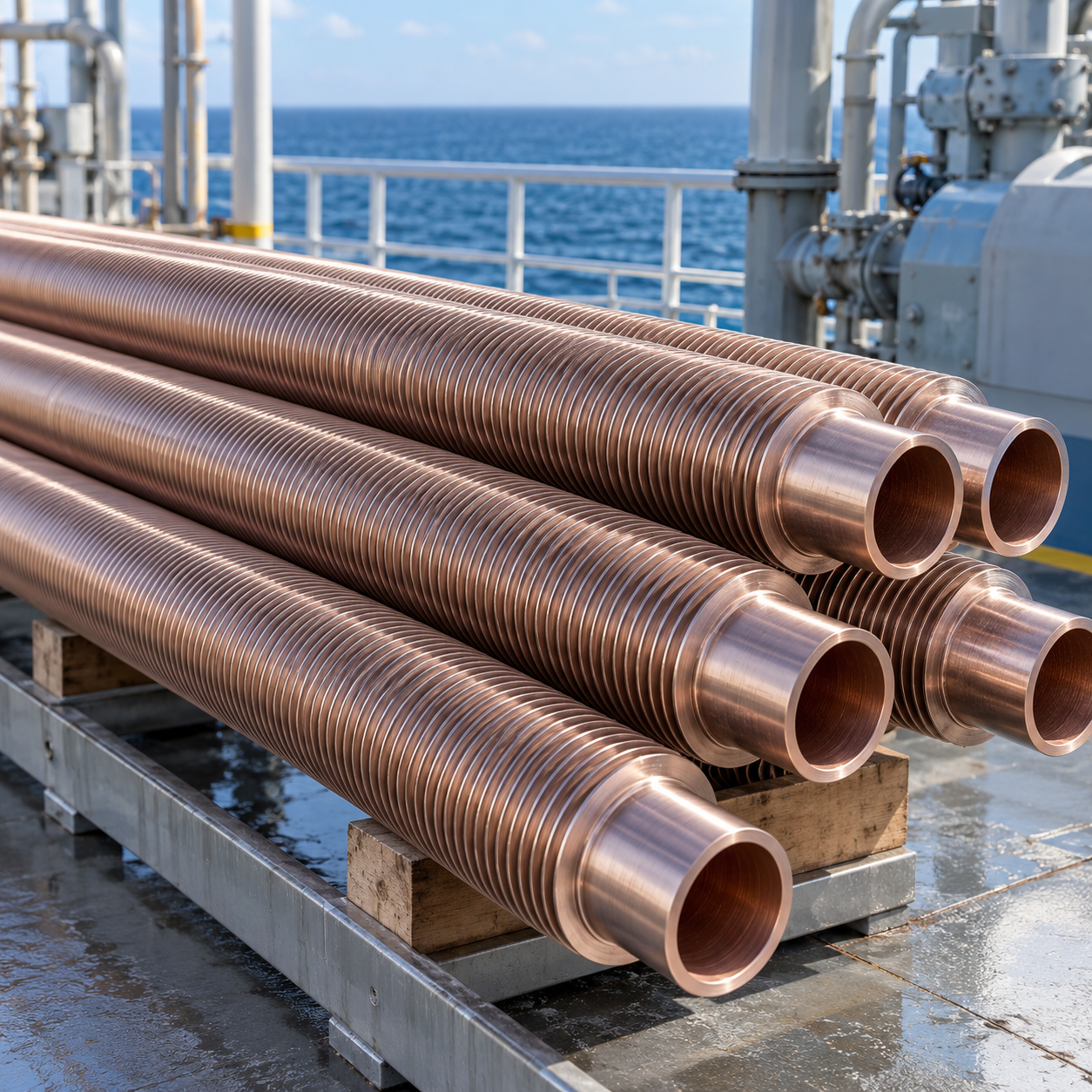
- Marine and offshore – seawater-cooled condensers and coolers (Cu-Ni)
- Power plants – air coolers, condensers and generator coolers
- Engine and compressor charge-air and intercoolers
- Heating – gas-fired boiler and flue-gas condensers, hot-water tanks, air heaters
- Process and chemical heat exchangers with compatible fluids
- Mine coolers, radiators and solar thermal collectors
Why Buy Copper Finned Tubes from ASC LLP?
- Since 1984: decades of supplying copper alloys and heat-exchanger tubes
- All constructions: integral, wrapped, crimped and embedded copper fins
- Full alloy range: C12200, C10200, 90/10 and 70/30 Cu-Ni, Admiralty and aluminium brass
- Standards: ASTM B359, EN 12452, B111 and EN 12451 with 3.1 / 3.2 certificates
- Made to drawing: plain ends, U-bends and coils
- Export packing that protects soft copper fins in transit
Related Products
Frequently Asked Questions – Copper Finned Tubes
What are copper finned tubes?
Copper finned tubes are heat-exchanger tubes with copper or copper-alloy fins, a copper or copper-alloy base tube, or both. Because copper conducts heat about eight times better than carbon steel and about 1.7 times better than aluminium, copper fins transfer heat very efficiently, making copper finned tubes ideal for compact HVAC, refrigeration, oil-cooler and condenser coils.
What types of copper finned tubes are available?
The main types are integral (rolled) low-fin, medium-high-fin and high-fin tubes where the fins are formed from the copper or copper-nickel tube wall; copper fins wrapped as L, LL or KL fins; crimped copper fins, often soldered; and embedded (G-type) copper fins on steel or copper tubes.
Which standards cover copper finned tubes?
ASTM B359 / ASME SB359 covers copper and copper-alloy seamless condenser and heat-exchanger tubes with integral fins, and EN 12452 covers rolled, finned, seamless copper-alloy tubes for heat exchangers. Plain base tubes are made to ASTM B111, B75, B280 or EN 12451 / EN 12735.
What copper alloys are used for finned tubes?
The most common are phosphorus-deoxidized copper C12200 (Cu-DHP), oxygen-free copper C10200, 90/10 copper-nickel C70600, 70/30 copper-nickel C71500, Admiralty brass C44300 and aluminium brass C68700. Copper-nickel is preferred for seawater cooling.
Is copper or aluminium better for fins?
Copper conducts heat better and is stronger, more corrosion resistant in many environments and easy to solder, so it gives the most compact coil. Aluminium is lighter and cheaper. Copper fins are chosen where performance, durability or soldered construction matter; aluminium where cost and weight matter most.
What is the maximum temperature for copper finned tubes?
It depends on the fin bond. Wrapped L-fin copper tubes are typically used up to about 150 °C, KL-fin to about 260 °C and embedded G-fin to about 400 °C. Integral-fin tubes are limited by the tube alloy and the pressure design code rather than by a fin bond.
What is the difference between low-fin and high-fin copper tubes?
Low-fin tubes have short fins (around 1–1.5 mm) at a high density (typically 19–40 fins per inch) and are used inside shells for condensing and evaporating. Medium-high fins (about 3–5 mm) and high fins (up to about 10 mm in copper) give much more outside surface for gas or air cooling.
Are copper finned tubes suitable for seawater?
Copper-nickel 90/10 (C70600) and 70/30 (C71500) finned tubes are widely used for seawater-cooled condensers and coolers because of their resistance to seawater corrosion and biofouling. Avoid sulfide-polluted water and keep water velocity within the alloy’s limits.
When should copper finned tubes not be used?
Avoid copper and brass in ammonia service, where ammonia attacks copper and can cause stress-corrosion cracking of brasses, and in sulfide-contaminated water. Use stainless steel or carbon steel finned tubes instead for those duties and for very high temperatures.
What details are needed to quote copper finned tubes?
Tube alloy and standard, OD, wall thickness and length; fin type, fin material, fin height and fins per inch (or finned OD); plain-end lengths and diameters; bends or U-bends; working fluid, pressure and temperature; quantity and testing or certification requirements.
