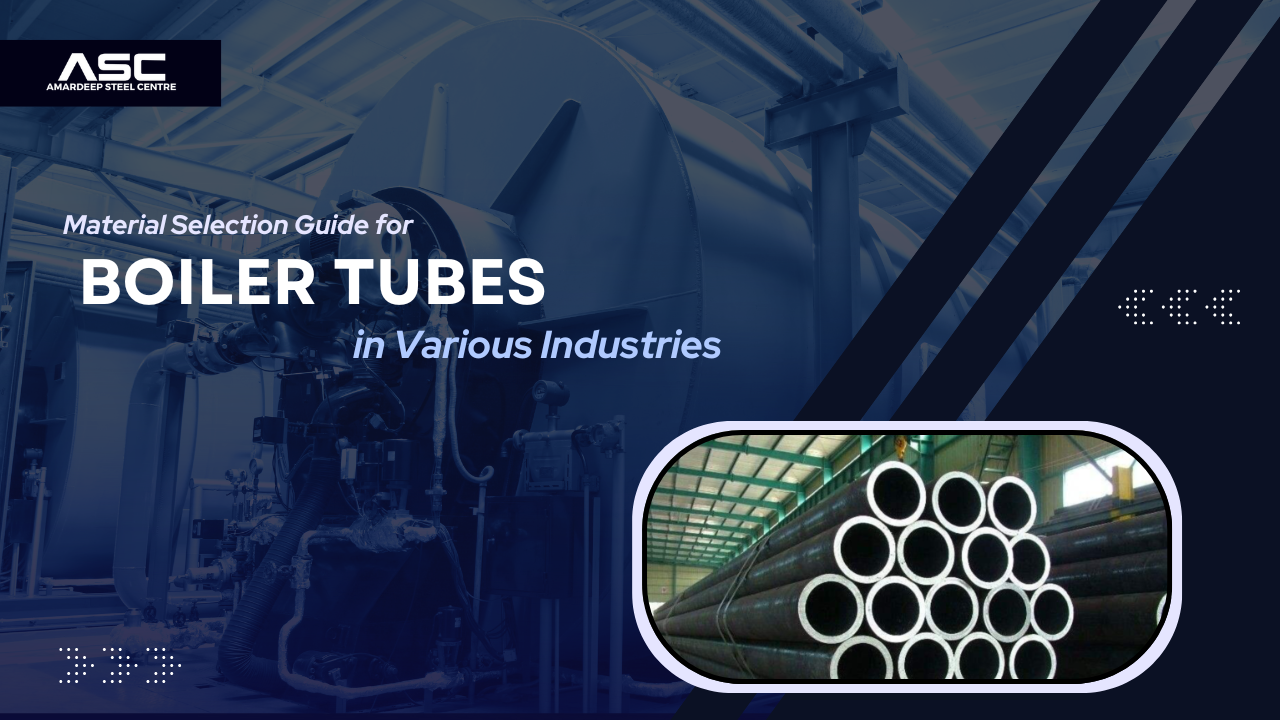
Material Selection Guide for Boiler Tubes in Various Industries
Quick answer – which boiler tube material?
Boiler tubes are chosen by duty and metal temperature:
- Water walls, economisers (up to ≈ 425–450 °C): carbon steel – A192, A210 A-1 / C; ERW A178 for lower pressures
- Superheaters, reheaters (≈ 450–580 °C): Cr-Mo steel – A213 T11, T22
- Final superheaters (≈ 580–620 °C): 9Cr steel – A213 T91, T92
- Hottest sections (above ≈ 620 °C): stainless A213 TP304H / TP347H
- Not boiler duty – heat exchangers, condensers, feedwater heaters: A179 (seamless) and A214 (ERW) carbon steel tubes
Typical guidance only – the boiler designer and the design code (for example, ASME Section I) set the final grade, size and temperature limits. See all grades on our boiler tubes page.
Boiler tubes are the backbone of thermal and pressure-based operations across several industries, including power generation, petrochemical, and manufacturing. Choosing the right Boiler Tube Material Specification is critical for ensuring high performance, longevity, and safety. At ASC LLP, a boiler tubes supplier in Mumbai, India, we help you understand how to select the right materials tailored to your industry’s needs.
What Are Boiler Tube?
Boiler tube are high-pressure, heat-resistant tubes used inside boilers to transfer heat from the combustion process to water or steam. There are two main types:
- Water-Tube Boiler Tubes – Water flows through the tubes and is heated externally by combustion gases.
- Fire-Tube Boiler Tubes – Hot gases pass through the tubes, which are surrounded by water.
Choosing the right material depends on various factors like temperature, pressure, corrosion resistance, and application environment.

Common Boiler Tube Material Specifications
1. Carbon Steel Boiler Tube
- Usage: Low-pressure boilers, general heating systems
- Material Standards: ASTM A192, A210 (seamless); A178 (ERW). Note: A179 and A214 are heat-exchanger and condenser tubes, not boiler tubes.
- Advantages: Cost-effective, good thermal conductivity
2. Alloy Steel Boiler Tube
- Usage: High-pressure and high-temperature applications
- Material Standards: ASTM A213 (T11, T22, T91)
- Advantages: Excellent resistance to heat and corrosion, enhanced mechanical strength
3. Stainless Steel Boiler Tube
- Usage: Chemical processing, food industry, superheaters
- Material Standards: ASTM A213 TP304/TP316
- Advantages: Superior corrosion resistance, long service life
4. Nickel Alloy Boiler Tube
- Usage: Extreme temperature and corrosive environments
- Material Standards: ASTM B163, B167
- Advantages: High thermal stability, excellent resistance to oxidation and acid
Boiler Tube Material Chart
| Material | Common grades | Typical max metal temp. | Used for |
| Carbon steel (seamless) | A192, A210 A-1 / C | ≈ 425–450 °C | Economisers, water walls |
| Carbon steel (ERW) | A178 | Low–medium pressure | Fire-tube boilers, economisers |
| Cr-Mo alloy steel | T11, T12, T22, T23 | ≈ 540–580 °C | Superheaters, reheaters, headers |
| 9Cr alloy steel | T91, T92 | ≈ 600–620 °C | Final superheaters in supercritical plants |
| Stainless steel | A213 TP304H, TP347H | > 620 °C | Hottest superheater / reheater sections |
| British standard | BS 3059 Gr 320, Part 1 / Part 2 | By grade | Boilers built to BS |
| Heat-exchanger tubes (not boiler duty) | A179, A214 | Unfired service | Heat exchangers, condensers, feedwater heaters |
Temperatures are typical guidance; the boiler design code decides the final grade. For heat-exchanger duty, see our heat-exchanger tube material guide.
Seamless Boiler Tube vs Welded Boiler Tube
While welded boiler tube are suitable for certain low-pressure applications, seamless boiler tubes are the industry standard for high-pressure boilers due to their uniform structure and superior strength.
Seamless Boiler Tube are:
- Leak-proof and structurally sound
- Preferred for critical applications like superheaters, reheaters, and economizers
Industry-Wise Boiler Tube Material Selection
1. Power Generation
- Type: Water-Tube Boilers
- Recommended Materials: Alloy Steel (T11, T22, T91)
- Reason: Withstand high temperature and pressure conditions in thermal power plants
2. Oil & Gas Industry
- Type: Fire-Tube Boilers
- Recommended Materials: Stainless Steel, Carbon Steel (A192, A210)
- Reason: Corrosion resistance is crucial due to volatile hydrocarbon processing
3. Chemical and Petrochemical
- Type: Water-Tube Boilers
- Recommended Materials: Nickel Alloy, Stainless Steel
- Reason: Resist chemical attack and extreme heat
4. Food and Beverage
- Type: Fire-Tube Boilers
- Recommended Materials: Stainless Steel (TP304/TP316)
- Reason: Sanitary conditions and corrosion resistance are vital
Why ASC LLP for Boiler Tube?
As a boiler tube supplier in India, ASC LLP offers:
- Tubes certified to ASTM / ASME specifications with EN 10204 3.1 certificates
- Third-party inspection on request
- Wide inventory of seamless boiler tube, Water-Tube Boiler Tube, and Fire-Tube Boiler Tube
- Rapid delivery through a well-established supply chain
Whether you need tubes for a refinery or a thermal power plant, ASC LLP delivers robust and reliable Boiler Tube Material Specifications tailored to your operational requirements.
Conclusion
Selecting the right Boiler-Tubes is more than just choosing a metal. It involves evaluating temperature, pressure, corrosion risk, and specific industry needs. From Water-Tube Boiler Tube to Fire-Tube Boiler Tube, ASC LLP offers end-to-end solutions and expert guidance to ensure optimal performance and safety.
Boiler Tube Material – FAQ
What material is used for boiler tubes?
Most boiler tubes are carbon steel (ASTM A192, A210, or A178 ERW) or chromium-molybdenum alloy steel (ASTM A213 T11, T22, T91). Stainless steel (TP304H, TP347H) is used for the hottest superheater sections.
What is the best material for superheater tubes?
Low-temperature superheaters use A210 C or T11; higher-temperature superheaters use T22, T91 or T92; the hottest sections of modern plants use stainless TP347H.
Why is carbon steel used for boiler tubes?
Carbon steel is economical, easy to weld and has good thermal conductivity. It is strong enough for metal temperatures up to about 425–450 °C, which covers economisers and water walls.
Which is better for boilers – seamless or welded tubes?
Seamless tubes are preferred for high-pressure sections. ERW tubes such as A178 are an economical choice for lower-pressure boilers and economisers, while A214 ERW tubes are used for heat exchangers.
Is ASTM A179 a boiler tube?
No. A179 covers seamless cold-drawn carbon steel tubes for heat exchangers and condensers. Boiler tubes are normally A192 or A210 (seamless) or A178 (ERW).
Why do boiler tubes fail?
Common causes include overheating, corrosion, erosion and fatigue. See our guide to common boiler tube failures.
Explore the full range of Boiler-Tubes products at Amardeep Steel Centre LLP, and let us help you elevate your projects to new heights. Follow us on LinkedIn, Facebook, and Instagram.