
ASTM B247 Aluminum 6061-T6 Flanges – Supplier & Exporter
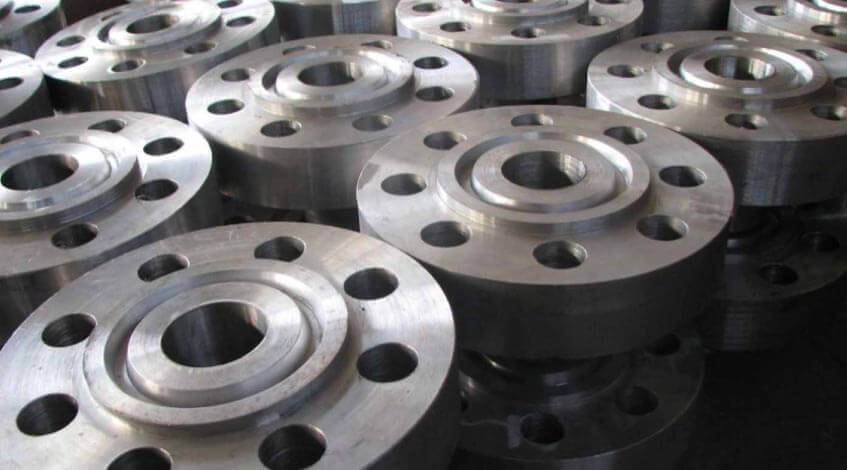
What are ASTM B247 6061-T6 flanges? They are pipe flanges forged to ASTM B247 / ASME SB247 (aluminium die, hand and rolled-ring forgings) from AA 6061-T6 (UNS A96061) – an Al-Mg-Si alloy that is solution heat-treated and artificially aged. B247 requires a minimum tensile strength of 260 MPa (38 ksi) and yield strength of 240 MPa (35 ksi) in the T6 temper, at about one-third the weight of a steel flange.
Aluminium flanges are made to ASME B16.5 dimensions, but B16.5 has no aluminium material group – their pressure ratings come from ASME B31.3 Appendix L (Class 150, 300 and 600).
ASTM B247 6061-T6 Flanges – Quick Facts
- Material: AA 6061-T6 / T652, UNS A96061, EN AW-6061 (AlMg1SiCu)
- Specification: ASTM B247, ASME SB247
- Dimensions: ASME B16.5; ratings per ASME B31.3 Appendix L
- Classes & sizes: Class 150, 300, 600 – ½” to 24″ NB
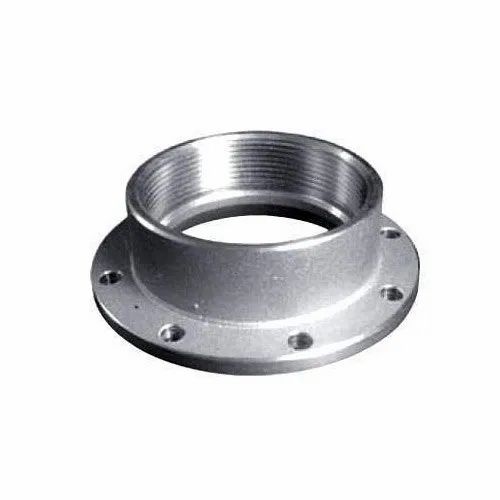
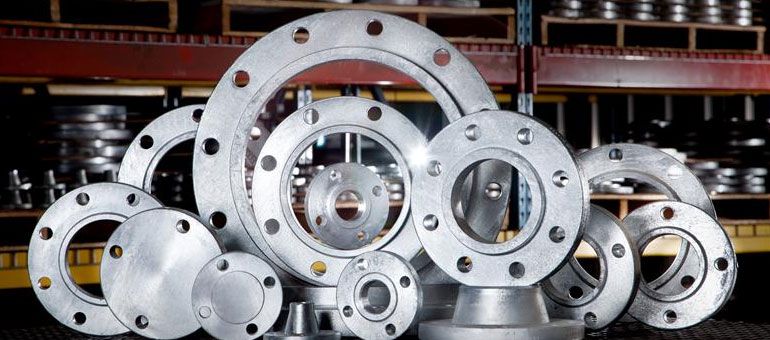
- Types: weld neck, slip-on, blind, socket weld, threaded, lap joint
- Certificate: EN 10204 3.1 mill test certificate with heat traceability
ASC LLP, Mumbai, supplies ASTM B247 6061-T6 flanges from stock and against project drawings. See our full aluminium flanges range.
AA 6061-T6 Chemical Composition (ASTM B247)
| Element | Composition (wt %) |
| Magnesium (Mg) | 0.8 – 1.2 |
| Silicon (Si) | 0.40 – 0.8 |
| Copper (Cu) | 0.15 – 0.40 |
| Chromium (Cr) | 0.04 – 0.35 |
| Iron (Fe) | 0.7 max |
| Zinc (Zn) | 0.25 max |
| Manganese (Mn) | 0.15 max |
| Titanium (Ti) | 0.15 max |
| Others, each / total | 0.05 / 0.15 max |
| Aluminium (Al) | Remainder |
Magnesium and silicon form Mg2Si, which precipitates during ageing and gives 6061 its T6 strength. Copper adds strength; chromium controls grain structure and improves resistance to stress-corrosion cracking.
Mechanical Properties of ASTM B247 6061-T6 Forgings
| Forging type & thickness | Direction | Tensile (min) | Yield 0.2% (min) | Elongation (min) |
| Die forgings, up to 4″ | Parallel to grain flow | 260 MPa (38 ksi) | 240 MPa (35 ksi) | 7% |
| Die forgings, up to 4″ | Not parallel to grain flow | 260 MPa (38 ksi) | 240 MPa (35 ksi) | 5% |
| Rolled rings, up to 2.5″ | Tangential | 260 MPa (38 ksi) | 240 MPa (35 ksi) | 10% |
| Rolled rings, up to 2.5″ | Axial | 260 MPa (38 ksi) | 240 MPa (35 ksi) | 8% |
| Hand forgings, up to 4″ | Longitudinal | 260 MPa (38 ksi) | 240 MPa (35 ksi) | 10% |
| Hand forgings, 4.001″–8″ | Longitudinal | 255 MPa (37 ksi) | 235 MPa (34 ksi) | 8% |
Brinell hardness of 6061-T6 die forgings is 80 HB minimum (for information). Typical values for 6061-T6 are higher than these minimums – about 310 MPa tensile, 276 MPa yield and 95 HB.
Physical Properties of 6061-T6 (typical)
- Density: 2.70 g/cm³ – about 34% of carbon steel
- Melting range: 582 – 652 °C
- Modulus of elasticity: ≈ 68.9 GPa
- Thermal conductivity: ≈ 167 W/m·K
- Coefficient of thermal expansion: ≈ 23.6 µm/m·°C (20–100 °C)
- Electrical conductivity: ≈ 43% IACS
Welding note: welding anneals the heat-affected zone, so a welded 6061-T6 joint is qualified at about 165 MPa (24 ksi) minimum tensile (ASME Section IX) – well below the T6 base metal. Filler 4043 or 5356 is normally used. Designers should base weld-neck and slip-on joint ratings on the welded strength.
ASTM B247 Aluminum 6061-T6 Flanges Specifications
| Item | Details |
| Product | ASTM B247 Aluminum 6061-T6 Flanges |
| Material grade | AA 6061-T6, 6061-T652 (UNS A96061) |
| Material standard | ASTM B247 / ASME SB247 – die, hand and rolled-ring forgings |
| Dimensional standard | ASME B16.5; EN 1092-4 and MSS SP-44 on request |
| Pressure ratings | Class 150, 300, 600 per ASME B31.3 Appendix L |
| Size range | ½” to 24″ NB; larger sizes machined to drawing |
| Facing | Raised face (RF), flat face (FF) |
| Production route | Forged and CNC machined |
| Testing | Chemical analysis, tensile, hardness, PMI, dimensional, visual |
| Certificate | EN 10204 3.1; third-party inspection on request |
6061-T6 Flange Dimensions – Class 150 (ASME B16.5)
| Size (NB) | Flange OD | Bolt circle (BCD) | No. of bolts | Bolt size |
| ½” | 3.50″ (88.9 mm) | 2.38″ (60.3 mm) | 4 | ½” |
| ¾” | 3.88″ (98.4 mm) | 2.75″ (69.9 mm) | 4 | ½” |
| 1″ | 4.25″ (108.0 mm) | 3.12″ (79.4 mm) | 4 | ½” |
| 1½” | 5.00″ (127.0 mm) | 3.88″ (98.4 mm) | 4 | ½” |
| 2″ | 6.00″ (152.4 mm) | 4.75″ (120.7 mm) | 4 | ⅝” |
| 3″ | 7.50″ (190.5 mm) | 6.00″ (152.4 mm) | 4 | ⅝” |
| 4″ | 9.00″ (228.6 mm) | 7.50″ (190.5 mm) | 8 | ⅝” |
| 6″ | 11.00″ (279.4 mm) | 9.50″ (241.3 mm) | 8 | ¾” |
| 8″ | 13.50″ (342.9 mm) | 11.75″ (298.5 mm) | 8 | ¾” |
| 10″ | 16.00″ (406.4 mm) | 14.25″ (362.0 mm) | 12 | ⅞” |
| 12″ | 19.00″ (482.6 mm) | 17.00″ (431.8 mm) | 12 | ⅞” |
Flange thickness, hub and bore follow ASME B16.5 for the class and type. Class 300 and 600 dimensions, and full drawings with weights, are sent with every quotation.
Pressure Classes & Temperature Limits
| Pressure class | Typical use | Rating basis |
| Class 150 | Utility, water, cryogenic and low-pressure process lines | ASME B31.3 Appendix L |
| Class 300 | Medium-pressure process and heat-exchanger nozzles | ASME B31.3 Appendix L |
| Class 600 | Higher-pressure gas and cryogenic service | ASME B31.3 Appendix L |
Aluminium flanges are rated lower than steel flanges of the same class, and their ratings drop quickly with temperature – ASME B31.3 lists allowable stresses for 6061-T6 only up to about 204 °C (400 °F). At low temperatures the opposite is true: aluminium has no ductile-to-brittle transition, so 6061-T6 flanges keep their toughness in cryogenic service such as LNG, liquid nitrogen and liquid oxygen.
When an aluminium flange is bolted to a steel flange, use an insulating gasket kit to prevent galvanic corrosion.
Types & Applications of 6061-T6 Flanges
- Weld neck flanges – heat-exchanger nozzles, cryogenic and higher-pressure lines.
- Slip-on flanges – low-pressure utility, water and air lines; easy to align and weld.
- Blind flanges – closing pipe ends, vessel nozzles and test points.
- Socket weld flanges – small-bore lines up to 2″ (rated lower than weld neck in Appendix L).
- Threaded flanges – low-pressure, non-welded connections.
- Lap joint flanges – used with aluminium stub ends where frequent dismantling is needed.
Where 6061-T6 flanges are used
- Cryogenic & air-separation plants – LNG, nitrogen and oxygen piping and cold boxes.
- Heat exchangers – aluminium nozzles and headers.
- Marine & offshore – topside piping, deck and utility lines (5083 is preferred for continuous seawater immersion).
- Aerospace & defence – ground support equipment and fuel/hydraulic test rigs.
- Semiconductor & vacuum – lightweight, non-magnetic process piping.
- Food, chemical & water – lines where weight and atmospheric corrosion resistance matter.
Matching products: AA 6061 pipes, ASTM B241 6061 fittings, 6061-T6 plates and ASTM F468 6061-T6 fasteners.
Related Aluminum Flanges Grades
Why Buy ASTM B247 6061-T6 Flanges from ASC LLP?
- Certified forgings: ASTM B247 / ASME SB247 material with EN 10204 3.1 certificates and heat traceability.
- Correct ratings: B16.5 dimensions with Class 150–600 ratings per ASME B31.3 Appendix L – no over-stated classes.
- Testing: chemical, tensile and hardness tests, PMI and full dimensional checks; third-party inspection (TPI) on request.
- Custom work: flanges machined to customer drawings, including non-standard bores and drillings.
- Export packing in wooden cases, with regular shipments to the Middle East, Europe, USA and Asia.
Request a Quote for 6061-T6 Flanges
Send the flange type, size, class, facing, bore/schedule and quantity to sales@amardeepsteel.com or call 022-67439130. We reply with price, delivery and drawings.
Frequently Asked Questions – ASTM B247 6061-T6 Flanges
What is ASTM B247?
ASTM B247 is the standard specification for aluminium and aluminium-alloy die forgings, hand forgings and rolled-ring forgings. ASME SB247 is the identical ASME Section II version. Forged aluminium flanges, including 6061-T6, are supplied to this specification.
What are the mechanical properties of ASTM B247 6061-T6?
For 6061-T6 die forgings up to 4 in thick, ASTM B247 requires a minimum tensile strength of 38 ksi (260 MPa), minimum yield strength of 35 ksi (240 MPa) and 7% minimum elongation parallel to grain flow.
Are aluminium flanges covered by ASME B16.5?
Aluminium flanges are made to ASME B16.5 dimensions, but B16.5 has no aluminium material group. Their pressure-temperature ratings are given in ASME B31.3 Appendix L, which covers Class 150, 300 and 600.
What is the maximum temperature for 6061-T6 flanges?
ASME B31.3 gives allowable stresses for 6061-T6 only up to about 400 °F (204 °C), and strength falls quickly above about 150 °C. 6061-T6 performs very well at cryogenic temperatures because aluminium has no ductile-to-brittle transition.
Can 6061-T6 flanges be welded?
Yes, 6061-T6 flanges are welded with 4043 or 5356 filler, but welding anneals the heat-affected zone. Welded joints are qualified at about 24 ksi (165 MPa) minimum tensile, so the design should use the as-welded strength.
What is the difference between 6061-T6 and 5083 aluminium flanges?
6061-T6 is heat-treatable and stronger in the unwelded condition. 5083 is non-heat-treatable, keeps more of its strength after welding and has better resistance to seawater, so it is preferred for marine immersion and welded cryogenic vessels.
Global Reach
ASC LLP supplies aluminium flanges, pipes and fittings to EPC contractors, OEMs and plant operators worldwide, with prompt delivery and full documentation. Buyers in the USA, Europe, the Middle East and Asia rely on our ASTM B247 6061-T6 flanges for certified material and traceability.

Countries We Export To
UNITED STATES, EUROPE, UK, UAE, SAUDI ARABIA, OMAN, KUWAIT, JORDAN, QATAR, INDONESIA, MALAYSIA, BRAZIL, SPAIN, ITALY, FRANCE, GERMANY, BAHRAIN, SRI LANKA, AZERBAIJAN, AUSTRALIA, AUSTRIA, PHILIPPINES, TURKEY, RUSSIA, IRAN, IRAQ, CANADA, KOREA, JAPAN, YEMEN, FINLAND, ZIMBABWE, HUNGARY, PORTUGAL, VIETNAM, MOROCCO, THAILAND, SOUTH AFRICA, MEXICO, SINGAPORE, GREECE, KUWAIT, POLAND, NEW ZEALAND, SWEDEN, SWITZERLAND, BELGIUM, BHUTAN, BANGLADESH, TAIWAN, ROMANIA, CAMBODIA, KAZAKHSTAN, AFGHANISTAN.
