
HB 400 Steel Plates (HB400 Wear Resistant Plate) Supplier
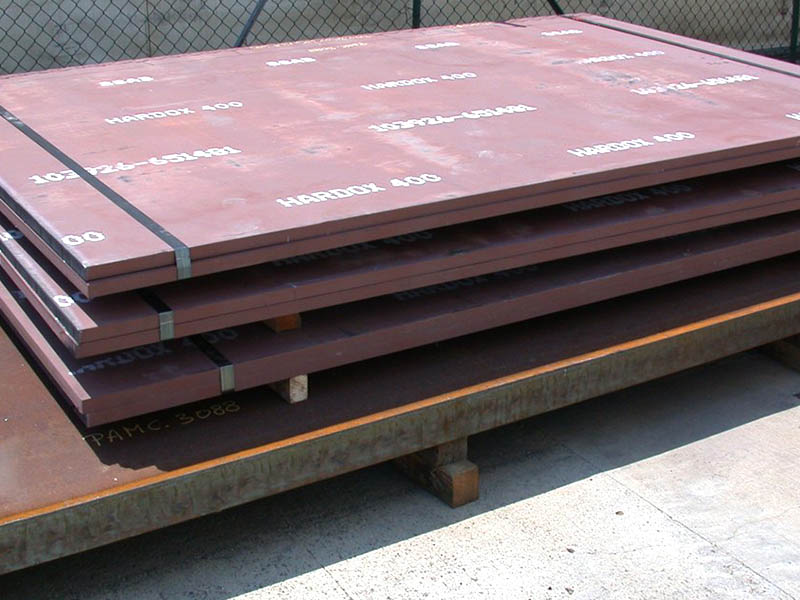
ASC LLP, Mumbai, supplies HB 400 steel plates – quenched, abrasion-resistant plates with a nominal hardness of 400 Brinell – from 6 mm to 100 mm thick. We stock and source HB400 plates from leading mills, including Hardox 400, Rockstar 400 (AM/NS India) and NM400, with mill test certificates, cut-to-size profiles and delivery across India and for export.
What is HB 400 Steel?
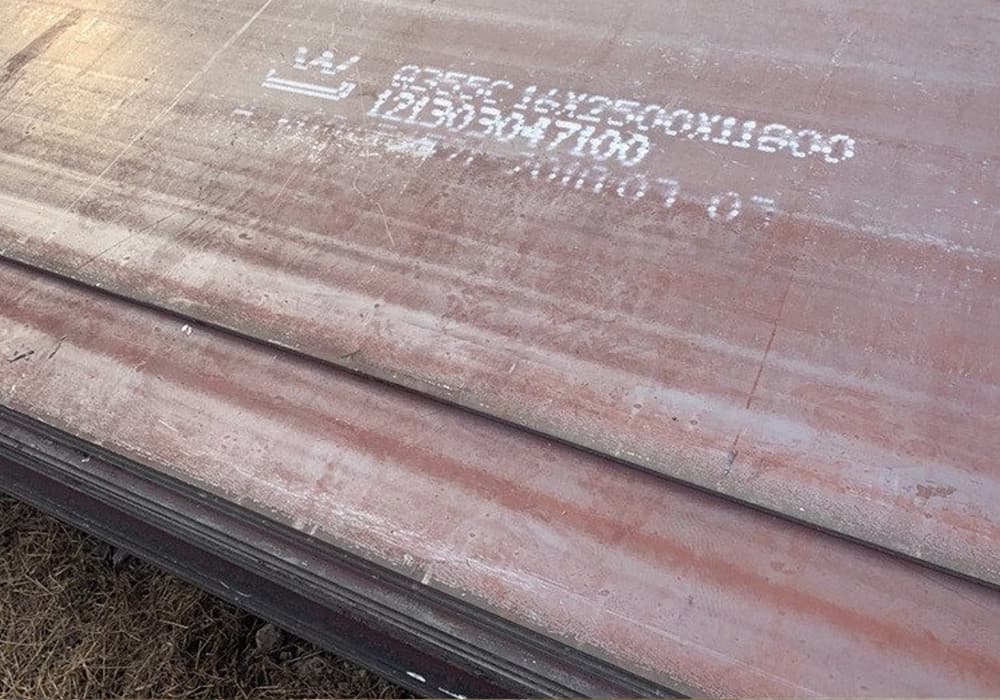
HB 400 steel (also written HB400, “Hardened 400” or “400 BHN”) is a low-alloy, boron-bearing martensitic steel plate that is water-quenched at the mill to a surface hardness of about 370–430 HBW. “HB 400” is a hardness class rather than a single standard grade: each mill sells it under its own brand name (Hardox 400, Rockstar 400, NM400, Raex 400, XAR 400 and others), but all are designed to give roughly three times the wear life of mild steel while remaining tough, weldable and bendable.
Because the hardness comes from quenching rather than high alloy content, HB 400 plate offers the best balance of wear resistance, toughness and workshop-friendliness of the wear-plate classes, which is why it is the most widely used grade for dumper bodies, buckets, chutes and liners.
Key Properties of HB 400 Plates
- High abrasion resistance: 370–430 HBW surface hardness resists sliding wear from sand, coal, ore, gravel and aggregates.
- High strength: yield strength around 1000 MPa, roughly four times that of mild steel, allowing thinner and lighter wear parts.
- Good toughness: withstands impact from rocks and lumps without cracking (Charpy impact typically 27–45 J at –40 °C, depending on the mill).
- Weldable and bendable: can be welded with low-hydrogen consumables and cold-formed with suitable bend radii.
- Not corrosion resistant: HB 400 is a low-alloy steel and will rust like mild steel; paint or coat it where corrosion is a concern.
HB 400 vs HB 450 vs HB 500 Plates
| Property | HB 400 | HB 450 | HB 500 |
| Hardness range (typical) | 370 – 430 HBW | 425 – 475 HBW | 470 – 530 HBW |
| Wear resistance | High | Higher | Highest |
| Toughness / impact resistance | Best | Good | Moderate |
| Ease of bending & welding | Easiest | Moderate | Most demanding |
| Typical brands | Hardox 400, Rockstar 400, NM400 | Hardox 450, Rockstar 450, NM450 | Hardox 500, Rockstar 500, NM500 |
| Typical use | Dumper bodies, buckets, chutes, general liners | Heavy-wear tippers, bucket lips, crusher liners | Severe sliding wear: cutting edges, screens, liners |
Summary: choose HB 400 when parts need to be bent, welded and take impact; move to HB 450 or HB 500 when pure sliding wear dominates and fabrication is simple.
Applications of HB 400 Plates
- Mining & quarrying: dumper and tipper bodies, crusher liners, feeder and hopper liners.
- Construction & earthmoving: excavator and loader buckets, bulldozer blades, side cutters.
- Bulk material handling: chutes, transfer points, conveyor skirts and silo liners.
- Cement, steel & power plants: coal and clinker handling, ash handling and fan liners.
- Recycling: shredder parts, scrap-handling buckets and containers.
- Agriculture: ploughs, tillage tools and harvester wear parts.
HB 400 Plate Specifications & Sizes
| Item | Details |
| Hardness class | HB 400 (370 – 430 HBW nominal) |
| Brands / mill grades | Hardox 400, Rockstar 400, NM400 (GB/T 24186), Raex 400, XAR 400 and equivalents |
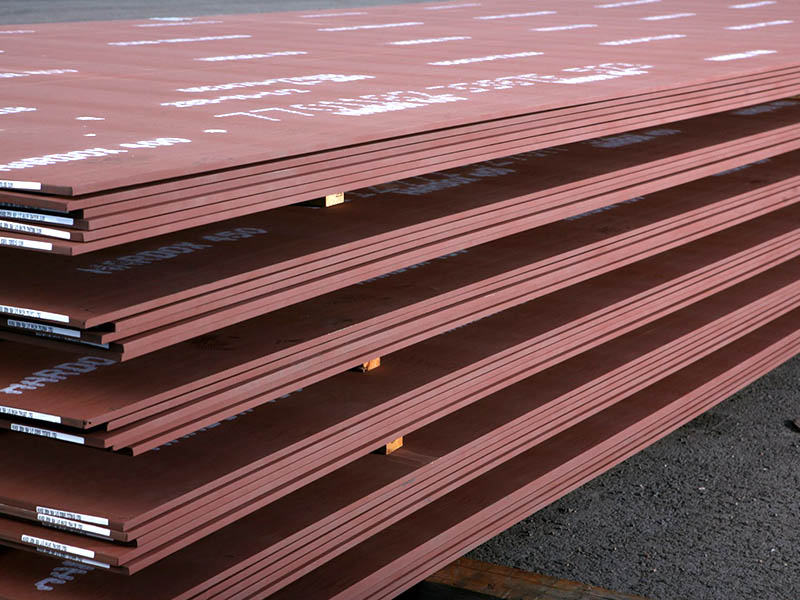
| Thickness | 6 – 100 mm (thinner sheet and thicker plate on request) |
| Width | 1500 – 2500 mm (mill dependent) |
| Length | 6000 – 12000 mm; cut-to-size and profiles on request |
| Delivery condition | Quenched, or quenched & tempered |
| Thickness tolerance | EN 10029 / mill standard |
| Edges | Mill, sheared or thermally cut |
| Test certificate | EN 10204 3.1 mill test certificate |
Plate weight: 7.85 kg per m² per mm of thickness. For example, a 10 mm HB 400 plate weighs about 78.5 kg/m², and a 2500 × 6000 × 10 mm plate weighs about 1,178 kg.
Chemical Composition of HB 400 Plates
| Element | Hardox 400 (max %) | NM400 – GB/T 24186 (max %) |
| Carbon (C) | 0.32 | 0.30 |
| Silicon (Si) | 0.70 | 0.70 |
| Manganese (Mn) | 1.60 | 1.60 |
| Phosphorus (P) | 0.025 | 0.025 |
| Sulphur (S) | 0.010 | 0.010 |
| Chromium (Cr) | 2.50 | 1.20 |
| Nickel (Ni) | 1.50 | 0.70 |
| Molybdenum (Mo) | 0.60 | 0.50 |
| Boron (B) | 0.004 | 0.0005 – 0.006 |
Maximum values vary with plate thickness – thicker plates carry more alloy for through-hardening. Actual analysis is shown on the mill certificate.
Mechanical Properties & Hardness of HB 400 Plates
| Property | Typical value |
| Surface hardness | 370 – 430 HBW (Rockstar 400: 360 – 430 BHN) |
| Yield strength | approx. 1000 MPa |
| Tensile strength | approx. 1200 – 1250 MPa |
| Elongation | approx. 10 – 12% |
| Charpy V impact | 27 – 45 J at –40 °C (mill dependent) |
| Maximum service temperature | approx. 250 °C – hardness drops above this |
Values are typical for plates around 20 mm thick; guaranteed values depend on the mill and thickness.
HB 400 Steel Equivalent Grades
| Mill / standard | Equivalent HB 400 grade |
| SSAB (Sweden) | Hardox 400, Raex 400 |
| AM/NS India | Rockstar 400 |
| China – GB/T 24186 | NM400 |
| thyssenkrupp (Germany) | XAR 400 |
| Dillinger (Germany) | Dillidur 400V |
| JFE (Japan) | JFE-EH400 |
| Nippon Steel (Japan) | Abrex 400 |
| NLMK | Quard 400 |
| USA (generic) | AR400 / AR400F |
These grades share the same hardness class and are interchangeable for most wear applications; compare chemistry, toughness and thickness range if a drawing names a specific brand.
Physical Properties of HB 400 Steel
| Property | Value (approx.) |
| Density | 7.85 g/cm³ |
| Modulus of elasticity | approx. 205 – 210 GPa |
| Magnetic | Yes (ferromagnetic) |
| Plate weight | 7.85 kg/m² per mm thickness |
Cutting, Bending & Welding HB 400 Plates
- Cutting: plasma, laser, oxy-fuel and waterjet are all used. Thicker plates need preheating before thermal cutting to avoid cracking at cut edges; waterjet avoids heat effects entirely.
- Bending: HB 400 can be cold-bent, but needs a larger punch radius and die opening than mild steel – follow the mill’s minimum bend radius for the thickness, and allow for more springback.
- Welding: use low-hydrogen consumables, keep joints clean and dry, and preheat thicker plates as per the mill’s guidelines. Keep interpass temperature low so the plate does not lose hardness near the weld.
- Machining: drilling and countersinking are possible with carbide or cobalt HSS tools at low speeds and rigid set-ups.
How to choose: tell us the material being handled, whether wear is sliding or impact, the plate size and any bending or welding involved – we will recommend HB 400 or a harder grade and a suitable brand.
Why Buy HB 400 Plates from ASC LLP?
- Multiple mill brands: Hardox 400, Rockstar 400 and NM400 sourced to your specification.
- Certified material: EN 10204 3.1 mill test certificates; hardness verification and third-party inspection on request.
- Cut-to-size: plates, strips and profile-cut parts as per drawing.
- India-wide & export supply: prompt dispatch from Mumbai with export-worthy packing.
Related Plates Products
Frequently Asked Questions – HB 400 Steel Plates
What is HB 400 steel?
HB 400 steel is a quenched, low-alloy abrasion-resistant steel plate with a nominal Brinell hardness of 400 (typically 370–430 HBW). It is sold under brand names such as Hardox 400, Rockstar 400 and NM400.
What is the hardness of HB 400 plate?
HB 400 plates have a surface hardness of about 370–430 HBW. Some mills, such as AM/NS India for Rockstar 400, specify 360–430 BHN.
What is the equivalent of HB 400 steel?
Equivalent HB 400 grades include Hardox 400 and Raex 400 (SSAB), Rockstar 400 (AM/NS India), NM400 (GB/T 24186), XAR 400, Dillidur 400V, JFE-EH400, Abrex 400, Quard 400 and AR400.
Is Rockstar 400 the same as Hardox 400?
Both are HB 400-class wear plates from different mills – Rockstar 400 from AM/NS India and Hardox 400 from SSAB. They are interchangeable for most wear applications, though chemistry, toughness and thickness range differ slightly.
Can HB 400 plates be welded and bent?
Yes. HB 400 can be welded with low-hydrogen consumables (with preheat for thicker plates) and cold-bent using a larger bend radius than mild steel, following the mill’s guidelines.
What is the difference between HB 400 and HB 500?
HB 500 is harder (about 470–530 HBW) and lasts longer under pure sliding wear, while HB 400 is tougher and easier to bend and weld. HB 400 is preferred for parts that take impact or need fabrication.
Global Reach
ASC LLP serves customers across India and around the world with prompt delivery and dependable support. Mining, construction and equipment manufacturers in the Middle East, Africa, Asia and beyond rely on our HB 400 wear resistant plates for consistent hardness, documentation and cut-to-size service.

Countries We Export To
UNITED STATES, EUROPE, UK, UAE, SAUDI ARABIA, OMAN, KUWAIT, JORDAN, QATAR, INDONESIA, MALAYSIA, BRAZIL, SPAIN, ITALY, FRANCE, GERMANY, BAHRAIN, SRI LANKA, AZERBAIJAN, AUSTRALIA, AUSTRIA, PHILIPPINES, TURKEY, RUSSIA, IRAN, IRAQ, CANADA, KOREA, JAPAN, YEMEN, FINLAND, ZIMBABWE, HUNGARY, PORTUGAL, VIETNAM, MOROCCO, THAILAND, SOUTH AFRICA, MEXICO, SINGAPORE, GREECE, KUWAIT, POLAND, NEW ZEALAND, SWEDEN, SWITZERLAND, BELGIUM, BHUTAN, BANGLADESH, TAIWAN, ROMANIA, CAMBODIA, KAZAKHSTAN, AFGHANISTAN.
