
ASTM A193 Alloy Steel Fasteners – A193 Material Grades & Bolting Specification
ASC LLP, Mumbai, supplies ASTM A193 fasteners in alloy and stainless steel grades: stud bolts, heavy hex bolts and threaded rod in B7, B7M, B16, B8 and B8M, together with matching A194 nuts. In addition, every lot comes with an EN 10204 3.1 certificate. This page therefore explains the ASTM A193 material grades side by side, including chemistry, mechanical properties by diameter, heat treatment and which nut to use. Ordering B7? For sizes, threads and torque, see A193 B7 stud bolts; for complete studs with 2H nuts and washers, see B7 fastener sets.
What is ASTM A193 Material?
ASTM A193 / A193M (ASME SA193) is the specification for alloy steel and stainless steel bolting for high-temperature or high-pressure service, as well as other special-purpose applications. It covers bars, studs, stud bolts, bolts and screws for pressure vessels, valves, flanges and fittings. However, it does not cover nuts; those are ordered to ASTM A194.
A193 grades fall into two groups. Ferritic grades (B5, B6, B7, B7M, B16) are heat-treated low-alloy or martensitic steels chosen for strength at temperature. By contrast, austenitic grades (B8, B8M and their variants) are stainless steels chosen for corrosion resistance, and they come in Class 1 (solution treated) or Class 2 (strain hardened).
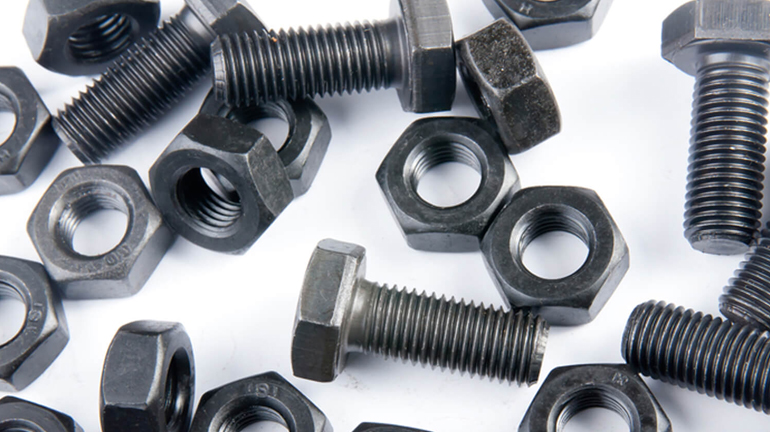
ASTM A193 Grades Overview
| Grade | Material | Main use |
| B7 | Cr-Mo steel (AISI 4140 type), Q&T | The standard high-strength flange stud bolt, so it suits most piping |
| B7M | Cr-Mo steel, tempered to 235 HBW max | Sour (H₂S) service, because hardness is controlled |
| B16 | Cr-Mo-V steel, Q&T | High-temperature service, when B7 is not enough above about 450 °C |
| B5 | 5Cr-½Mo steel | High-temperature, mildly corrosive service |
| B6 | Type 410 martensitic stainless | Moderate corrosion resistance as well as higher strength |
| B8 (304) | Austenitic stainless, Class 1 or 2 | Corrosion-resistant bolting; also cryogenic service |
| B8M (316) | Austenitic stainless with Mo, Class 1 or 2 | Chloride and chemical service, since Mo adds pitting resistance |
In addition, A193 lists stabilised and low-carbon stainless variants such as B8T (321), B8C (347) and B8MLCuN. For most flange bolting, however, the choice is B7, B7M or B16 in alloy steel, or B8 / B8M in stainless.
ASTM A193 Chemical Composition
| Element (%) | B7 / B7M | B16 | B8 (304) | B8M (316) |
| Carbon (C) | 0.37 – 0.49 | 0.36 – 0.47 | 0.08 max | 0.08 max |
| Manganese (Mn) | 0.65 – 1.10 | 0.45 – 0.70 | 2.00 max | 2.00 max |
| Phosphorus (P) | 0.035 max | 0.035 max | 0.045 max | 0.045 max |
| Sulphur (S) | 0.040 max | 0.040 max | 0.030 max | 0.030 max |
| Silicon (Si) | 0.15 – 0.35 | 0.15 – 0.35 | 1.00 max | 1.00 max |
| Chromium (Cr) | 0.75 – 1.20 | 0.80 – 1.15 | 18.0 – 20.0 | 16.0 – 18.0 |
| Nickel (Ni) | – | – | 8.0 – 11.0 | 10.0 – 14.0 |
| Molybdenum (Mo) | 0.15 – 0.25 | 0.50 – 0.65 | – | 2.00 – 3.00 |
| Vanadium (V) | – | 0.25 – 0.35 | – | – |
B7 and B7M share the same chemistry, so only the tempering and hardness differ. B16, on the other hand, adds vanadium and more molybdenum, which gives it better strength and relaxation resistance at high temperature.
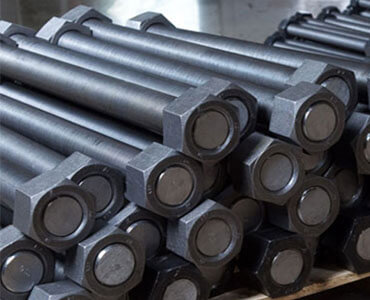
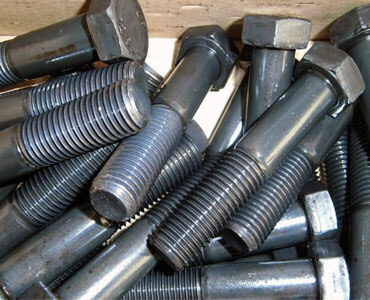
ASTM A193 Mechanical Properties – Alloy Steel Grades
| Grade | Diameter | Tensile / yield, min (ksi) | Elongation / RA, min |
| B7 | ≤ 2½” | 125 / 105 | 16% / 50% |
| B7 | > 2½” to 4″ | 115 / 95 | 16% / 50% |
| B7 | > 4″ to 7″ | 100 / 75 | 18% / 50% |
| B7M | ≤ 4″ | 100 / 80 | 18% / 50% |
| B16 | ≤ 2½” | 125 / 105 | 18% / 50% |
| B16 | > 2½” to 4″ | 110 / 95 | 17% / 45% |
| B16 | > 4″ to 8″ | 100 / 85 | 16% / 45% |
Because larger sections harden less, the minimum strength falls as diameter increases. In addition, A193 sets only a maximum hardness: 321 HBW / 35 HRC for B7 and B16, while B7M is limited to 235 HBW / 99 HRB. In other words, there is no minimum hardness.
ASTM A193 B8 & B8M Mechanical Properties – Class 1 vs Class 2
| Grade / class | Diameter | Tensile / yield, min (ksi) | Elongation / RA, min |
| B8 & B8M Class 1 | All | 75 / 30 | 30% / 50% |
| B8 Class 2 | ≤ ¾” | 125 / 100 | 12% / 35% |
| B8 Class 2 | > ¾” to 1″ | 115 / 80 | 15% / 35% |
| B8 Class 2 | > 1″ to 1¼” | 105 / 65 | 20% / 35% |
| B8 Class 2 | > 1¼” to 1½” | 100 / 50 | 28% / 45% |
| B8M Class 2 | ≤ ¾” | 110 / 95 | 15% / 45% |
| B8M Class 2 | > ¾” to 1″ | 100 / 80 | 20% / 45% |
| B8M Class 2 | > 1″ to 1¼” | 95 / 65 | 25% / 45% |
| B8M Class 2 | > 1¼” to 1½” | 90 / 50 | 30% / 45% |
Maximum hardness is 223 HBW / 96 HRB for Class 1 and 321 HBW / 35 HRC for Class 2. Class 1 stainless bolting is solution treated, so it is soft but fully corrosion resistant. Class 2, however, is strain hardened after solution treatment; as a result, it is much stronger in small diameters, but the gain falls away as the size increases. See also our stainless steel fasteners range.
A193 Bolts and Matching A194 Nuts
| Bolt grade | Matching A194 nut | Notes |
| B7 | 2H | The standard combination for most flanges |
| B7M | 2HM | Sour service, because both parts are hardness-controlled |
| B16 | 4 or 7 | High-temperature service, so the nut matches B16 |
| B8 Class 1 / Class 2 | 8 / 8 (strain hardened) | Stainless, 304 type |
| B8M Class 1 / Class 2 | 8M / 8M (strain hardened) | Stainless, 316 type |
For complete stud and nut sets, see our A193 Grade B7 fasteners page. For low-temperature service, however, bolting is ordered to ASTM A320 (for example L7 or B8 Class 2 with impact testing) instead of A193.
A193 Heat Treatment
- B7: liquid quenched and then tempered at 593 °C (1100 °F) minimum.
- B7M: tempered at 620 °C (1150 °F) minimum; in addition, every piece is hardness tested to 235 HBW max.
- B16: quenched and tempered at 650 °C (1200 °F) minimum, so it keeps its strength at higher temperatures.
- B8 / B8M Class 1: carbide solution treated, which gives the best corrosion resistance.
- B8 / B8M Class 2: solution treated and then strain hardened for higher strength.
ASTM A193 Fasteners Specifications
| Item | Details |
| Specification | ASTM A193 / A193M, ASME SA193 |
| Grades | B7, B7M, B16, B5, B6, B8 / B8M Class 1 and 2, as well as B8T and B8C |
| Products | Stud bolts, tap-end and double-end studs, as well as heavy hex bolts and threaded rod |
| Threads | UNC up to 1″, then 8UN above 1″; also metric (A193M) |
| Dimensions | ASME B18.2.1 for bolts and B18.31.2 for studs, while nuts follow B18.2.2 |
| Finish | Plain or PTFE / fluoropolymer; also zinc and HDG for alloy grades |
| Testing | Tensile, hardness, chemistry; in addition, impact, PMI and third-party inspection on request |
| Certificate | EN 10204 3.1; also 3.2 on request |
Applications of ASTM A193 Fasteners
| Industry | Typical A193 grade and use |
| Oil & gas / refining | B7 flange studs on process piping; also B7M in sour service |
| Power generation | B7 for steam flanges, while B16 is used for high-temperature turbine and valve bolting |
| Petrochemical & chemical | B7 on Cr-Mo and carbon steel lines; B8M for corrosive service |
| Pressure vessels & heat exchangers | B7 or B16 studs for girth flanges, channels and nozzles |
| Food, pharma & cryogenic | B8 / B8M stainless bolting |
A193 is pressure bolting. Therefore, structural steel connections use A325 or F3125 bolts instead. In addition, A193 B7 is typically used on Cr-Mo lines such as A182 F22 within its temperature limit.
Why Buy ASTM A193 Fasteners from ASC LLP?
- All grades from one source: B7, B7M, B16, B8 and B8M, together with matching A194 nuts.
- Traceable material: EN 10204 3.1 certificates, so each lot shows chemistry, heat treatment and test results.
- Correct grade advice: help choosing between B7, B7M, B16, B8M or A320, because temperature and sour service decide the grade.
- Checks before dispatch: hardness, thread gauging and PMI; also third-party inspection on request.
For the full range, see our alloy steel fasteners.
Frequently Asked Questions – ASTM A193 Fasteners
What is ASTM A193 material?
ASTM A193 is the specification for alloy steel and stainless steel bolting (studs, bolts and threaded rod) for high-temperature or high-pressure service. Its main grades are B7, B7M, B16, B8 and B8M.
What is the most common ASTM A193 grade?
Grade B7, a quenched and tempered Cr-Mo steel (AISI 4140 type), is by far the most common. It has 125 ksi tensile and 105 ksi yield strength up to 2½” diameter.
What is the difference between A193 B7 and B16?
B16 adds vanadium and more molybdenum to the Cr-Mo base, and it is tempered at a higher temperature. As a result, B16 is used for high-temperature bolting above about 450 °C, whereas B7 is the general-purpose grade.
What is the difference between B8 Class 1 and Class 2?
Class 1 is solution treated, so it is soft (75 / 30 ksi) but fully corrosion resistant. Class 2 is strain hardened, which gives up to 125 / 100 ksi in small diameters.
Does ASTM A193 cover nuts?
No. A193 covers only bolting such as studs and bolts. Nuts are ordered to ASTM A194, for example Grade 2H for B7 and Grade 8M for B8M.
What is the difference between ASTM A193 and A320?
A193 covers bolting for high-temperature or high-pressure service, while A320 covers bolting for low-temperature service with impact testing, such as Grade L7.
Are A193 B7 bolts corrosion resistant?
No. B7, B7M and B16 are low-alloy steels, so they need coatings such as PTFE or galvanising for corrosion protection. For corrosion resistance, B8 or B8M stainless grades are used instead.
Global Supply
ASC LLP supplies ASTM A193 fasteners from Mumbai to customers in India, the Middle East, Europe, Africa, the Americas and South-East Asia. To get a prompt quotation, simply send your bolt list with grade, size, length, coating and quantity.

Countries We Export To
UNITED STATES, EUROPE, UK, UAE, SAUDI ARABIA, OMAN, KUWAIT, JORDAN, QATAR, INDONESIA, MALAYSIA, BRAZIL, SPAIN, ITALY, FRANCE, GERMANY, BAHRAIN, SRI LANKA, AZERBAIJAN, AUSTRALIA, AUSTRIA, PHILIPPINES, TURKEY, RUSSIA, IRAN, IRAQ, CANADA, KOREA, JAPAN, YEMEN, FINLAND, ZIMBABWE, HUNGARY, PORTUGAL, VIETNAM, MOROCCO, THAILAND, SOUTH AFRICA, MEXICO, SINGAPORE, GREECE, KUWAIT, POLAND, NEW ZEALAND, SWEDEN, SWITZERLAND, BELGIUM, BHUTAN, BANGLADESH, TAIWAN, ROMANIA, CAMBODIA, KAZAKHSTAN, AFGHANISTAN.
