
ASTM A193 Gr B7 Bolts & Stud Bolts – A193 Grade B7 Alloy Steel Bolting
ASC LLP, Mumbai, supplies ASTM A193 Gr B7 bolts: full-thread stud bolts, double-end and tap-end studs, heavy hex bolts and B7 threaded rod in UNC, 8UN and metric sizes. In addition, every lot is supplied with an EN 10204 3.1 certificate and matching ASTM A194 Gr 2H heavy hex nuts. This page therefore covers the A193 B7 material in full, including chemistry, mechanical properties by diameter, heat treatment, sizes, bolt load and torque, and how B7 compares with B7M, L7 and B16.
What is ASTM A193 Gr B7 Material?
ASTM A193 (ASME SA193) is the specification for alloy steel and stainless steel bolting for high-temperature or high-pressure service, for example on pressure vessels, valves, flanges and fittings. Within it, Grade B7 is a chromium-molybdenum steel (AISI 4140 / 4142 / 4145 type) that is quenched and then tempered. As a result, it combines high strength with good toughness, so B7 is by far the most widely used flange stud bolt grade in oil, gas, refinery and power piping.
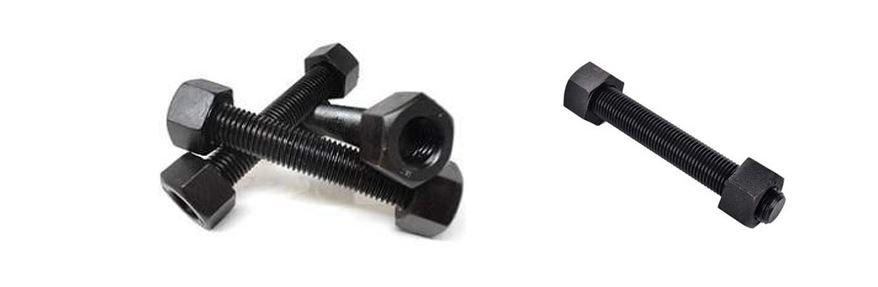
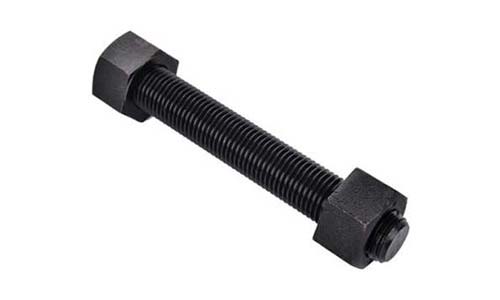
In practice, “A193 B7 bolts” usually means stud bolts, threaded full length with a heavy hex nut on each end, because ASME B16.5 flanges are normally bolted with studs rather than headed bolts. For the other A193 grades (B7M, B16, B8, B8M), see our ASTM A193 alloy steel fasteners page.
A193 Gr B7 – Quick Facts
- Specification: ASTM A193 / ASME SA193, Grade B7
- Material: Cr-Mo alloy steel (AISI 4140 type), first quenched and then tempered
- Strength (≤ 2½”): 125 ksi tensile / 105 ksi yield min
- Hardness: 321 HBW / 35 HRC max
- Matching nut: ASTM A194 Gr 2H heavy hex, or 2HM for B7M
- Threads: UNC up to 1″, 8UN above 1″ (unless otherwise specified)
A193 B7 Product Forms We Supply
- Full-thread stud bolts – the standard bolting for B16.5 as well as B16.47 flanges
- Double-end and tap-end studs – for valve bonnets and pump casings, as well as equipment
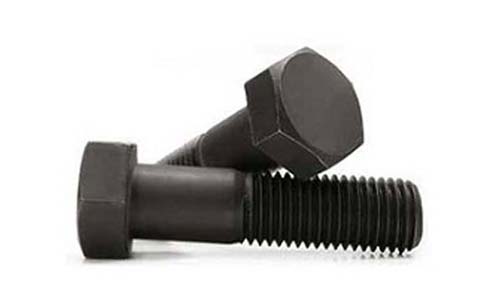
- Heavy hex bolts – when a headed bolt is specified instead of a stud
- B7 threaded rod – in 1 m, 2 m and 3 m lengths, then cut to length on request
ASTM A193 B7 Chemical Composition
| Element | A193 B7 (%) |
| Carbon (C) | 0.37 – 0.49 |
| Manganese (Mn) | 0.65 – 1.10 |
| Phosphorus (P) | 0.035 max |
| Sulphur (S) | 0.040 max |
| Silicon (Si) | 0.15 – 0.35 |
| Chromium (Cr) | 0.75 – 1.20 |
| Molybdenum (Mo) | 0.15 – 0.25 |
These are the ASTM A193 Table 1 limits for B7, so they already include the permitted product-analysis variation. In other words, typical AISI 4140, 4142 and 4145 steels (and their H grades) fall within this range.
ASTM A193 B7 Mechanical Properties
| Diameter | Tensile, min | Yield, min | Elongation, min | Reduction of area, min | Hardness, max |
| Up to 2½” (M64) | 125 ksi (860 MPa) | 105 ksi (720 MPa) | 16% | 50% | 321 HBW / 35 HRC |
| Over 2½” to 4″ (M100) | 115 ksi (795 MPa) | 95 ksi (655 MPa) | 16% | 50% | 321 HBW / 35 HRC |
| Over 4″ to 7″ (M180) | 100 ksi (690 MPa) | 75 ksi (515 MPa) | 18% | 50% | 321 HBW / 35 HRC |
Because larger sections cannot be hardened as deeply, the minimum strength of B7 drops as the diameter increases. For this reason, always check the strength band for the actual stud size. Also note that A193 sets only a maximum hardness for B7, so there is no minimum hardness requirement.
A193 B7 Heat Treatment, Temperature Range & Marking
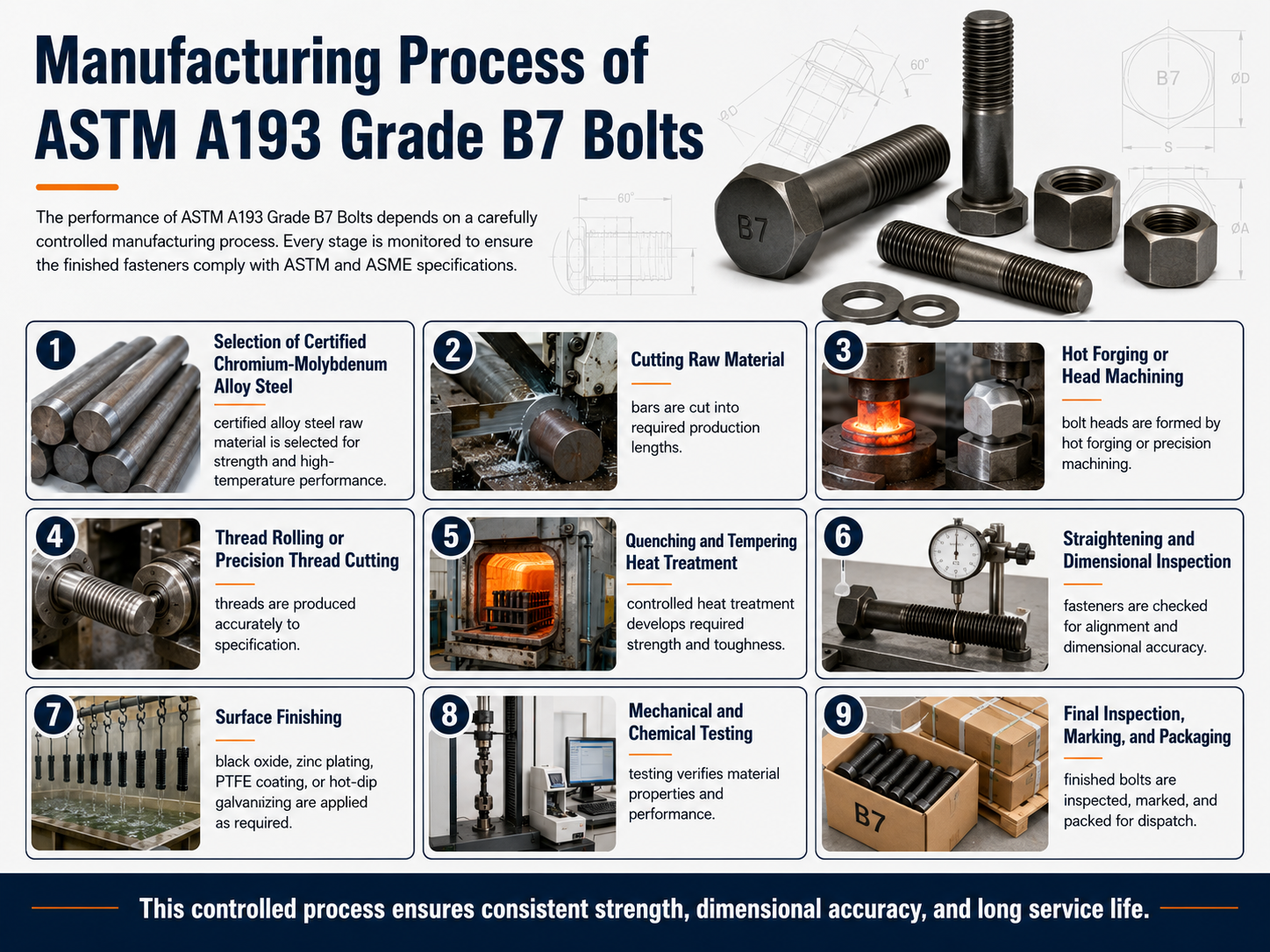
- Heat treatment: B7 is liquid quenched and then tempered at 593 °C (1100 °F) minimum. As a result, the steel gets its high strength while keeping its toughness.
- Upper temperature: B7 is commonly used up to about 450 °C. Above that, strength and relaxation resistance fall, so A193 B16 (Cr-Mo-V) is used instead.
- Lower temperature: B7 has no impact-test requirement; therefore, for cold service below about −29 °C, impact-tested A320 L7 is specified.
- Marking: each stud is stamped “B7” on one end, together with the manufacturer’s identification mark, so it remains traceable to its heat.
- Coatings: plain (black), zinc plated, hot-dip galvanised and PTFE / fluoropolymer coated. However, galvanising needs matching oversized nut threads.
ASTM A193 Grade B7 Bolts Specifications
| Item | Details |
| Specification | ASTM A193 / ASME SA193, Grade B7 |
| Material | Cr-Mo alloy steel (AISI 4140 / 4142 / 4145), quenched and tempered |
| Products | Stud bolts, double-end and tap-end studs, as well as heavy hex bolts and threaded rod |
| Diameter | ¼” to 4″ and M6 to M100; also larger sizes on request |
| Threads | UNC up to 1″, then 8UN above 1″; also UNF and metric on request |
| Length | As required for the flange class, or threaded rod in 1–3 m lengths |
| Nuts | ASTM A194 Gr 2H heavy hex; also 2HM for B7M |
| Finish | Plain or zinc; also HDG and PTFE (Xylan type) coated |
| Testing | Tensile, hardness, chemistry; in addition, PMI and third-party inspection on request |
| Certificate | EN 10204 3.1; also 3.2 on request |
A193 B7 vs B7M vs L7 vs B16
| Grade | Material | Key requirement | Matching nut | Typical use |
| A193 B7 | Cr-Mo (4140) | 125 / 105 ksi (≤ 2½”), 35 HRC max | A194 2H | General high-pressure / high-temperature flanges |
| A193 B7M | Cr-Mo (4140) | 100 / 80 ksi, 235 HBW max, 100% hardness tested | A194 2HM | Sour service (NACE MR0175 / ISO 15156) |
| A320 L7 | Cr-Mo (4140) | 125 / 105 ksi, Charpy at −101 °C | A194 Gr 4 / 7 (with S3) | Low-temperature service |
| A193 B16 | Cr-Mo-V | 125 / 105 ksi (≤ 2½”) | A194 Gr 4 / 7 | Service above about 450 °C |
In short, B7 is the default. However, choose B7M with 2HM nuts for sour service, A320 L7 for cold service, and B16 for high-temperature steam lines. For structural and anchor applications, see ASTM A354 and ASTM F1554 instead.
A193 B7 Stud Bolt Thread & Nut Size Chart
| Stud diameter (in) | Threads per inch | A194 2H heavy hex nut, across flats (in) |
| ½” | 13 UNC | ⅞” |
| ⅝” | 11 UNC | 1-1/16″ |
| ¾” | 10 UNC | 1-1/4″ |
| ⅞” | 9 UNC | 1-7/16″ |
| 1″ | 8 UNC | 1-5/8″ |
| 1⅛” | 8 UN | 1-13/16″ |
| 1¼” | 8 UN | 2″ |
| 1⅜” | 8 UN | 2-3/16″ |
| 1½” | 8 UN | 2-3/8″ |
| 1¾” | 8 UN | 2-3/4″ |
| 2″ | 8 UN | 3-1/8″ |
Unless the order says otherwise, A193 bolting uses the coarse (UNC) series up to 1″ and the 8-thread (8UN) series above 1″. Heavy hex nut sizes then follow ASME B18.2.2.
A193 B7 Stud Bolt Torque Chart
| Stud size (in) | Stress area (in²) | Bolt load at 50% yield (kN) | Torque, K = 0.16 (N·m) | Torque, K = 0.20 (N·m) |
| ½” | 0.142 | 33 | 67 | 84 |
| ⅝” | 0.226 | 53 | 134 | 168 |
| ¾” | 0.334 | 78 | 238 | 298 |
| ⅞” | 0.462 | 108 | 383 | 479 |
| 1″ | 0.606 | 142 | 575 | 719 |
| 1⅛” | 0.790 | 185 | 844 | 1,055 |
| 1¼” | 1.000 | 234 | 1,186 | 1,482 |
| 1⅜” | 1.233 | 288 | 1,610 | 2,012 |
| 1½” | 1.492 | 348 | 2,124 | 2,655 |
| 1¾” | 2.082 | 486 | 3,458 | 4,323 |
| 2″ | 2.771 | 647 | 5,259 | 6,574 |
Values are calculated, not taken from a standard: the bolt load is 50% of the 105 ksi minimum yield on the thread stress area, and torque = K × load × diameter. For example, K = 0.16 suits a lubricated stud with moly or PTFE coating, while K = 0.20 suits a dry, plain stud. However, the actual torque for a flange joint depends on the gasket and the lubricant, so always follow the gasket maker’s or the site’s bolting procedure (e.g. ASME PCC-1).
Applications of ASTM A193 Gr B7 Bolts
| Industry | Typical A193 B7 use |
| Oil & gas / refining | Flange stud bolts on process as well as hydrocarbon piping |
| Petrochemical & chemical | Flanges and valves, as well as pressure vessel nozzles |
| Power generation | Steam and feedwater flanges, while temperatures stay below about 450 °C |
| Heat exchangers & vessels | Channel covers and girth flanges, as well as bonnet studs |
| Pumps, valves & compressors | Casing and bonnet studs, as well as tap-end studs |
| Offshore & LNG | Flange bolting, usually with PTFE or HDG coating; also L7 for cold sections |
B7 bolting is generally paired with carbon steel flanges such as A105 flanges and A216 WCB flanges, and it is also used on heat exchangers.
ASTM A193 B7 Stud Bolt Price
There is no single price list for A193 B7 stud bolts, because the price depends on the order. For example, these factors change the price:
- Diameter, length and quantity – so bulk flange sets cost less per piece
- Thread type (UNC, 8UN, metric) as well as nut type
- Coating – plain, zinc, HDG or PTFE
- Testing and documents, such as third-party inspection or 3.2 certificates
- Finally, packing and delivery destination
Therefore, send us your bolt list or flange schedule, and we will quote a price per piece or per set.
Why Buy A193 B7 Bolts from ASC LLP?
- Traceable material: EN 10204 3.1 certificates, so each lot shows chemistry, heat treatment and test results.
- Complete sets: B7 studs together with 2H nuts and washers, cut and packed per flange.
- Checks before dispatch: hardness, dimensional checks and PMI; in addition, third-party inspection on request.
- Correct grade advice: help choosing B7, B7M, L7 or B16, because service temperature and sour conditions decide the grade.
- Export packing: seaworthy boxes or pallets, with marking as per your specification.
Related Alloy Steel Fasteners
- ASTM A193 alloy steel fasteners – all A193 grades
- ASTM A193 Grade B7 fasteners
- ASTM A194 alloy steel nuts, A194 Gr 2H and A194 Gr 2HM
- ASTM A320 (L7) low-temperature fasteners
- ASTM A354 bolts and studs and ASTM F1554 anchor bolts
- ASTM F468 bolts and studs, ASTM A325 structural bolts, ASTM A490 structural bolts, ASTM F3125 bolts, ASTM F568M fasteners
- Full range: alloy steel fasteners
Request a Quote for ASTM A193 Gr B7 Bolts
To get a quotation, simply send your requirement with diameter, length, thread, coating, nut type and quantity. Alternatively, send the flange list, and we will work out the stud bolt sets for you.
Frequently Asked Questions – ASTM A193 Gr B7 Bolts
What is ASTM A193 Gr B7 material?
ASTM A193 Gr B7 is a chromium-molybdenum alloy steel (AISI 4140 type) that is quenched and tempered. It is the most common grade for stud bolts on high-pressure and high-temperature flanges, valves and vessels.
What is the chemical composition of A193 B7?
A193 B7 contains C 0.37–0.49%, Mn 0.65–1.10%, Si 0.15–0.35%, Cr 0.75–1.20% and Mo 0.15–0.25%. In addition, P is limited to 0.035% max and S to 0.040% max.
What are the mechanical properties of A193 B7?
Up to 2½” diameter, B7 has 125 ksi (860 MPa) tensile and 105 ksi (720 MPa) yield minimum, with 16% elongation and 50% reduction of area. However, the minimums fall to 115/95 ksi for 2⅝–4″ and 100/75 ksi for 4⅛–7″. Hardness is 321 HBW / 35 HRC max.
Which nut is used with A193 B7 bolts?
A193 B7 studs are normally used with ASTM A194 Grade 2H heavy hex nuts. By contrast, B7M studs for sour service use A194 2HM nuts.
What is the difference between B7 and B7M?
B7M has the same chemistry as B7, but it is tempered to a lower hardness (235 HBW max) and every piece is hardness tested. As a result, its strength is lower (100/80 ksi), but it resists sulphide stress cracking in sour service.
What is the temperature range of A193 B7?
B7 is commonly used from about −29 °C up to about 450 °C. Below that, impact-tested A320 L7 is used, while above about 450 °C A193 B16 is used instead.
What thread is used on A193 B7 stud bolts?
Unless otherwise specified, A193 bolting uses UNC threads up to 1″ diameter and the 8UN (8 threads per inch) series above 1″. Metric threads are also supplied on request.
Global Supply
ASC LLP supplies ASTM A193 B7 bolts and stud bolts from Mumbai to customers in India, the Middle East, Europe, Africa, the Americas and South-East Asia, together with the matching nuts, flanges and fittings.

Countries We Export To
UNITED STATES, EUROPE, UK, UAE, SAUDI ARABIA, OMAN, KUWAIT, JORDAN, QATAR, INDONESIA, MALAYSIA, BRAZIL, SPAIN, ITALY, FRANCE, GERMANY, BAHRAIN, SRI LANKA, AZERBAIJAN, AUSTRALIA, AUSTRIA, PHILIPPINES, TURKEY, RUSSIA, IRAN, IRAQ, CANADA, KOREA, JAPAN, YEMEN, FINLAND, ZIMBABWE, HUNGARY, PORTUGAL, VIETNAM, MOROCCO, THAILAND, SOUTH AFRICA, MEXICO, SINGAPORE, GREECE, KUWAIT, POLAND, NEW ZEALAND, SWEDEN, SWITZERLAND, BELGIUM, BHUTAN, BANGLADESH, TAIWAN, ROMANIA, CAMBODIA, KAZAKHSTAN, AFGHANISTAN.
