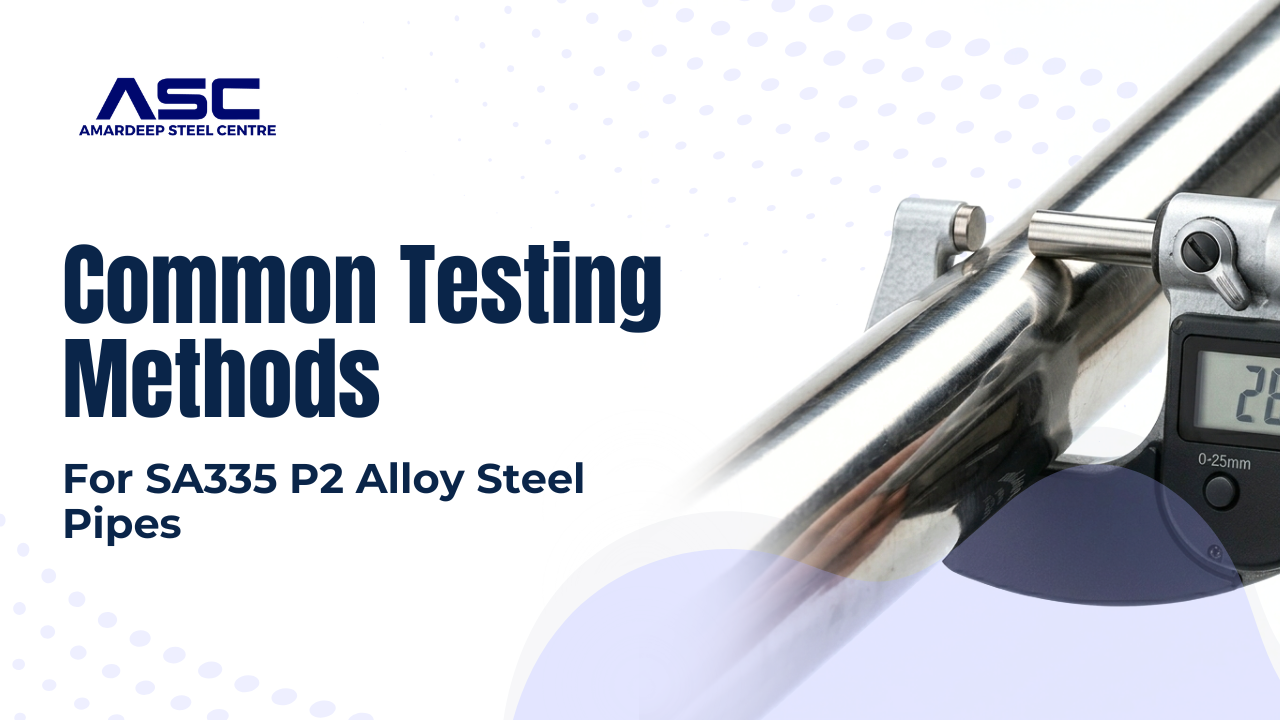
Common Testing Methods for SA335 P2 Alloy Steel Pipes
The pipe quality cannot be compromised in industries where the high temperature, pressure, and corrosion resistance are essential. This is the reason why ASTM A335 P2 Alloy Seamless Pipes go through multiple inspection and testing procedures before being supplied for industrial use.
Testing ensures that the pipes meet international quality standards and perform safely in demanding applications such as in power plants, refineries, petrochemical facilities and boiler systems.
We will discuss the typical testing methods for alloy seamless ASTM A335 P2 Pipes in this article, their significance, and how these tests assist industries in ensuring the safety and efficiency of their operations.
What Is ASTM A335 P2 Alloy Seamless Pipe?
ASTM A335 P2 Alloy Seamless Pipes are chromium molybdenum alloy steel pipes for use in high temperature and high pressure service. These pipes are made without welding joints, making them stronger and more reliable for critical industrial applications.
These pipes are widely used in:
- Thermal power plants
- Oil and gas industries
- Chemical processing plants
- Refineries
- Boiler systems
- Heat exchangers
The excellent heat resistance and durability of alloy seamless pipes ASTM A335 P2 Alloy make them suitable for extreme working environments.
Why Testing Is Important for Alloy Pipes
Industrial piping systems operate under severe conditions where failure can lead to:
- Production shutdown
- Steam leakage
- Equipment damage
- Safety hazards
- Increased maintenance costs
Testing helps manufacturers verify:
- Mechanical strength
- Dimensional accuracy
- Surface quality
- Corrosion resistance
- Pressure handling capability
Proper testing also ensures that the ASTM A335 P2 Alloy Seamless Pipes properties meet ASTM and ASME standards.
Common Testing Methods for SA335 P2 Alloy Steel Pipes
1. Hydrostatic Testing
Hydrostatic testing is one of the most important tests performed on ASTM A335 P2 Alloy Seamless Pipes.
In this process:
- The pipe is filled with water
- High internal pressure is applied
- The pipe is inspected for leakage or deformation
Why It Matters
This test confirms that the pipe can safely withstand high-pressure industrial application
2. Ultrasonic Testing (UT)
Ultrasonic testing uses high-frequency sound waves to detect internal defects in the pipe material.
This method helps identify:
- Cracks
- Voids
- Inclusion defects
- Thickness variations
Advantages of Ultrasonic Testing
- Non-destructive testing method
- High accuracy
- Detects hidden defects
- Improves pipe reliability
This test is commonly used for critical alloy pipes applications.
3. Hardness Testing
Hardness testing measures the hardness level of the pipe material after heat treatment.
Proper hardness levels are essential because they directly affect:
- Wear resistance
- Mechanical strength
- Weldability
- Service life
Incorrect hardness can reduce the performance of ASTM A335 P2 Alloy Seamless Pipes in high-temperature environments.
4. Tensile Testing
Tensile testing evaluates the mechanical strength of the pipe material.
During the test, the material is pulled until failure to determine:
- Tensile strength
- Yield strength
- Elongation capability
This ensures the pipe can withstand operational stress without failure.
5. Flattening Test
In the flattening test, a pipe section is compressed between plates to evaluate flexibility and structural integrity.
Purpose of the Test
- Detects material defects
- Checks welding integrity (if applicable)
- Evaluates ductility
This test confirms the durability of ASTM A335 P2 Alloy Seamless Pipes during installation and operation.
6. Chemical Composition Analysis
Chemical testing verifies whether the alloy composition meets ASTM specifications.
The test checks the percentage of elements such as:
- Chromium
- Molybdenum
- Carbon
- Manganese
- Silicon
Correct chemical composition is essential for maintaining the heat resistance and corrosion resistance of alloy seamless ASTM A335 P2 Pipes.
7. PMI Testing (Positive Material Identification)
PMI testing is used to confirm the material grade of the pipe.
This test ensures:
- Correct alloy selection
- No material mix-up
- Compliance with project specifications
PMI testing is especially important in power plants and refinery projects.
8. Visual Inspection
Visual inspection is a basic but important quality control method.
Inspectors examine the pipe surface for:
- Cracks
- Surface defects
- Rust
- Dents
- Dimensional irregularities
This helps maintain the appearance and structural quality of the final product.
ASTM A335 P2 Alloy Seamless Pipes Properties
Some important ASTM A335 P2 Alloy Seamless Pipes properties include:
- High tensile strength
- Excellent heat resistance
- Corrosion resistance
- Good creep strength
- Long operational life
- Superior pressure handling capability
These properties make the pipes suitable for demanding industrial systems.
ASTM A335 P2 Alloy Seamless Pipes Advantages
- Excellent High-Temperature Performance: These pipes can perform efficiently in elevated temperature applications.
- Better Pressure Resistance: Seamless construction improves pressure handling capability.
- Long Service Life: The alloy composition enhances durability and reliability.
- Reduced Maintenance: Their corrosion resistance lowers maintenance requirements.
- Strong Mechanical Properties: Ideal for critical industrial operations and heavy-duty applications.
The combination of these ASTM A335 P2 Alloy Seamless Pipes advantages makes them highly preferred across industries.
Industries That Use ASTM A335 P2 Alloy Seamless Pipes
These pipes are commonly used in:
- Power generation plants
- Petrochemical industries
- Refineries
- Boiler manufacturing
- Heat exchanger systems
- Oil and gas processing units
Their ability to withstand high heat and pressure makes them essential in industrial infrastructure.
Final Thoughts
Testing plays a critical role in ensuring the safety, reliability, and long-term performance of ASTM A335 P2 Alloy Seamless Pipes. From hydrostatic testing to ultrasonic inspection, every procedure helps verify that the pipes can perform under demanding industrial conditions.
Understanding these testing methods helps buyers choose high-quality alloy seamless ASTM A335 P2 Pipes that comply with international standards and provide dependable service in high-pressure environments.
For industries where safety and efficiency matter most, properly tested alloy seamless pipes ASTM A335 P2 Alloy remain a trusted solution for long-term industrial performance.
Explore the full range of ASTM A335 P2 Alloy Seamless Pipes at ASC LLP, and let us help you elevate your projects to new heights. Follow us on LinkedIn, Facebook, and Instagram.