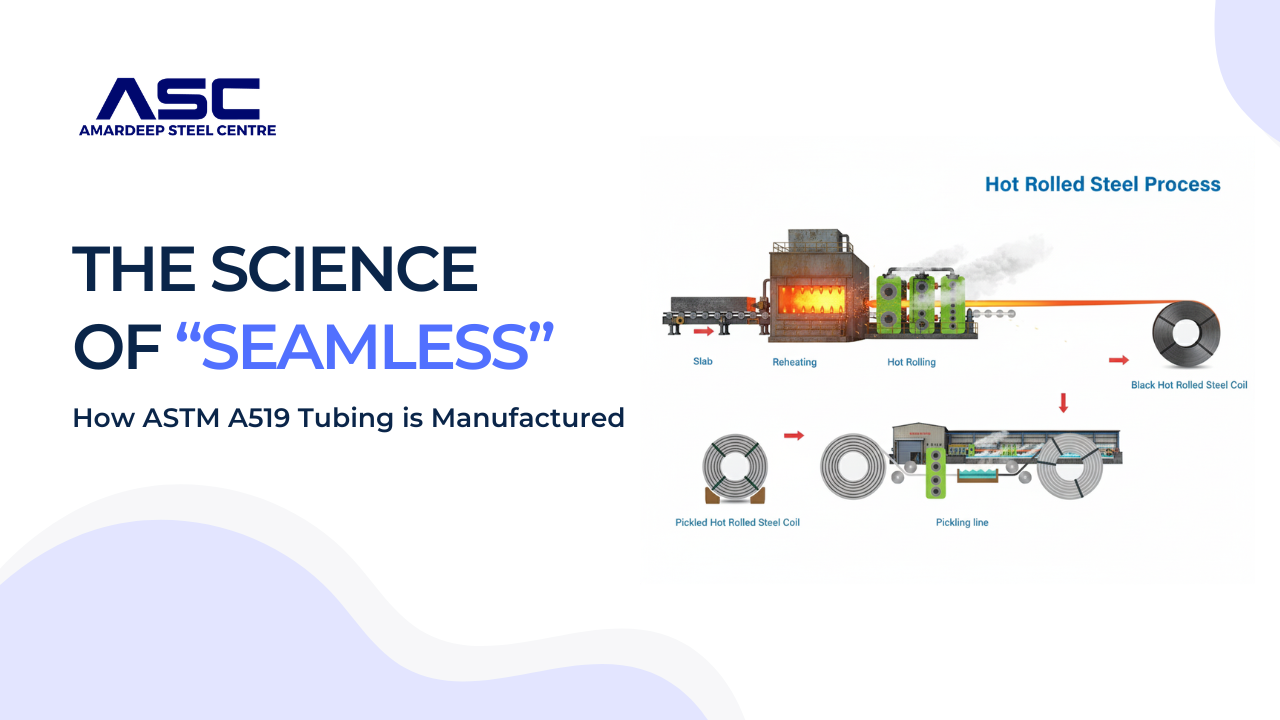
The Science of Seamless: How ASTM A519 Tubing is Manufactured
When a project demands high-precision mechanical tubing, the term “seamless” isn’t just a buzzword—it is a hallmark of structural integrity. For those sourcing from an ASTM A519 1010 seamless steel pipe manufacturer, understanding the journey from a solid billet to a high-performance tube is vital for ensuring application success.
Why Start with ASTM A519 Grade 1010?
ASTM A519 Grade 1010 is a low-carbon steel prized for its ductility. Because it contains roughly 0.08% to 0.13% carbon, it is exceptionally easy to cold-work and weld. However, the manufacturing process is what transforms these chemical properties into a reliable mechanical component.
The Manufacturing Journey: From Billet to Tube
1. Rotary Piercing (The Hot Stage)
The process begins with a solid cylindrical steel billet. This billet is heated to high temperatures (well above its recrystallization point) and forced over a piercing point.
Unlike welded tubes, which are formed from flat strips, this method creates a hollow shell without any seam or joint. This lack of a weld line is exactly why ASTM A519 Grade 1010 carbon steel seamless tubings exhibit uniform strength around the entire circumference.
2. Cold Drawing (Achieving Precision)
To reach the exacting standards of an ASTM A519 Grade 1010 tubings supplier, the hot-finished “hollow” must undergo cold drawing. The tube is pulled through a hardened die and over a mandrel at room temperature.
- Dimensional Accuracy: This reduces the diameter and wall thickness to incredibly tight tolerances.
- Surface Finish: It produces a smooth, scale-free surface.
- Mechanical Strength: The “work hardening” during this phase increases the yield strength of the 1010 grade.
3. Thermal Treatment
Since cold drawing increases hardness, the tubes often undergo annealing or stress relieving. This ensures the ASTM A519 Grade 1010 UNS G10100 carbon steel tubes maintain their signature ductility, making them ready for complex bending or flaring by the end-user.
Why Seamless Over Welded?
Engineers prefer ASTM A519 seamless tubes for three primary reasons:
- Higher Pressure Ratings: No weld seam means no “weak point” under internal pressure.
- Uniformity: Consistent grain structure throughout the tube.
- Reliability in Machining: When you machine a seamless tube, you don’t have to worry about the tool reacting differently to a weld bead.
Conclusion
Understanding the science behind the manufacturing process helps procurement teams choose the right ASTM A519 Grade 1010 materials for their specific needs. Whether it’s for automotive bushings, hydraulic cylinders, or structural spacers, the seamless process ensures your components are built on a foundation of quality.
Explore the full range of ASTM A519 Grade 1010 Tubes at ASC LLP, and let us help you elevate your projects to new heights. Follow us on LinkedIn, Facebook, and Instagram.